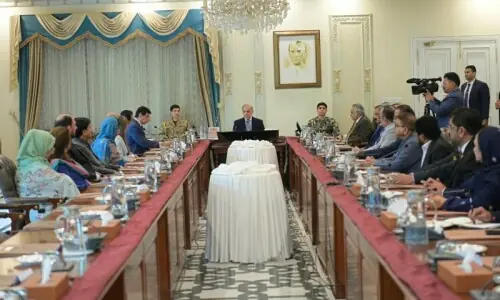
ISLAMABAD, Sept 28: The Senate’s defence committee broke fresh ground in the country’s parliamentary history on Friday by holding a public hearing on issues of national security that were long kept shrouded in excessive secrecy.
Predictably enough, the first hearing caused considerable excitement among the participants. The speakers’ candid remarks didn’t disappoint the audience either.
Hearing experts’ views about changing nuances of the country’s nuclear doctrine, official patronage of sectarianism and how drones had been more effective than counter-militancy operations in Fata was a refreshing experience in the chambers long dominated by official narrative.
The standing committee on defence and defence production is holding a series of public hearings in the lead-up to preparation of a national defence strategy document that the committee’s chairman, Senator Mushahid Hussain Sayed, intends to compile by the start of next year.
Those who testified at the committee included defence analyst Shireen Mazari (nuclear program), retired police officer Tariq Khosa (counter-terrorism) and journalist Saleem Safi (Afghanistan).
The committee’s initiative to hold public hearings comes after parliament got a say in matters related to foreign policy and defence, two areas dominated by the military establishment, earlier this year following the unfortunate Salala incident of November last year.
Public hearings by parliamentary committees, among other purposes, serve to get the opinions of experts in a particular field to supplement government-furnished reports.
The information obtained through the hearings helps parliamentarians to make informed analyses and decisions.
The National Assembly rules allow for public hearings, while Senate regulations are a bit ambiguous.
While there is no explicit provision for public hearing in Senate rules, one of the sections of the rules indirectly allows for it: “A committee may invite or summon any person or member having a special knowledge to give an expert opinion...”
Senator Mushahid, the driving force behind the new tradition, said: “We’ll all go back wiser.”
Marvi Sirmed, project manager for UN-funded project ‘Strengthening Democracy through Parliamentary Development’ (SDPD), whose organisation works for capacity building of parliamentarians and has long advocated openness in working of parliament, said the holding of first public hearing was a dream come true.
NUCLEAR PROGRAM: Ms Mazari, who recently parted ways with the Tehrik-i-Insaaf, said there were perceptible changes in the nuclear doctrine that had been necessitated by the evolving situation in the region, especially India’s cold start doctrine and development of an anti-ballistic missile shield.
Rejecting the criticism surrounding the testing of tactical short range NASR missile, she said the weapon was “strategic for us given our geographic proximity to India”.
Ms Mazari called for sustaining the position on the fissile material cutoff treaty (FMCT) warning that any compromise would undermine Pakistan’s deterrence capacity.
Senator Farhatullah Babar recalled how Pakistan’s doctrine transformed from deterrence to that of minimum deterrence and now credible deterrence.
He called for a debate on effectiveness of the nuclear doctrine.
TERRORISM: Tariq Khosa, a former director-general of FIA, recalled how sectarian groups like the Sipah-i-Sahaba received official patronage at the highest level in the 1980s.
Reminiscing about his early days in police force, he said when he was an ASP in Jhang district, he apprehended Haq Nawaz Jhangvi, the founder of the SSP, for delivering a provocative speech. But the then president Ziaul Haq himself intervened for his release, Mr Khosa added.
Similarly, in another incident he had hauled up a cache of weapons, but was asked to release that on directives from none other than Gen Zia.
After 9/11, Mr Khosa said, dealing with Al Qaeda and Taliban became an exclusive domain of ISI’s counter-terrorism wing.
He disclosed that a survey had revealed that 25,000 young men hailing from Punjab had been trained in Afghanistan.
Based on the findings, Mr Khosa had recommended their de-radicalisation, but during his testimony he regretted that not much had been done in that direction. The mastermind of last month’s Kamra attack was also someone who had fought in Afghanistan, the former FIA chief said.
He called for peaceful resolution of the Balochistan crisis, putting the national counter-terrorism agency under the control of prime minister, giving legal cover to ISI’s counter-terrorism wing and review of anti-terrorism laws.
AFGHANISTAN: Saleem Safi said the much criticised drone attacks were actually effective in breaking the backbone of militants in tribal areas.
He said only an all-inclusive reconciliation process would work to Pakistan’s advantage. Mr Safi said Al Qaeda had lost influence in Afghanistan, but was gaining ground in Pakistan.