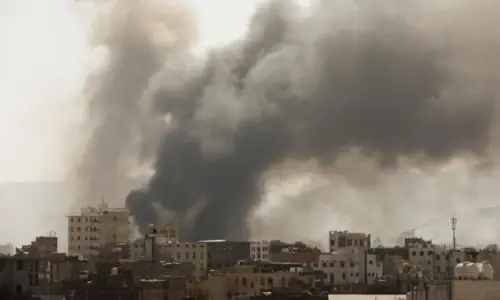
THE Syrian conflict has always had the potential to escalate into a regional conflagration, and recent events have taken a worrying turn in that direction. The Turkish parliament on Thursday authorised military action against Syria for upto a year after five Turks were killed, reportedly by cross-border Syrian shelling. Ankara has responded with shelling of its own. Relations between the neighbours have been frosty ever since the Syrian uprising began last year; in June the Syrians shot down a Turkish surveillance aircraft over the Mediterranean while Syria blames the Turks for hosting rebels. Analysts nevertheless take comfort from the fact that neither Ankara nor Damascus has gone beyond what was expected; the Syrians struck a conciliatory tone while Turkey has said the parliament’s move is not a declaration of war. There have also been anti-war demonstrations in Turkey. Meanwhile, the UN and international players have urged restraint; showing rare unanimity over Syria, the Security Council condemned the Syrian shelling in ‘the strongest terms’.
Syria is in a state of civil war, with around 30,000 casualties reported to date. Rebels control considerable swathes of land along the Turkish, Lebanese and Jordanian borders. Opposition fighters took control of a border town near Turkey a few weeks ago, which may explain Syrian shelling of the region. While Damascus has crushed the revolt with great brutality, the armed opposition is also quite unpredictable, rife as it is with internal divisions and infiltrated by religious extremists. Already a proxy war is being fought within Syria, with the rebels receiving support from Gulf Arabs, among others, while Bashar al-Assad’s regime has Iranian backing. In such a scenario if Turkey were to formally enter the fray, the results would be disastrous. Turkey is part of Nato and other members of the pact can be drawn into a conflict if the territory of a member state is attacked. Fortunately, at this point such a development seems unlikely. The ideal — yet unlikely — solution would be a ceasefire by all belligerents to pave the way for a democratic transition. Meanwhile, regional states must exercise restraint to prevent the conflict from spilling over into other countries.