7
7
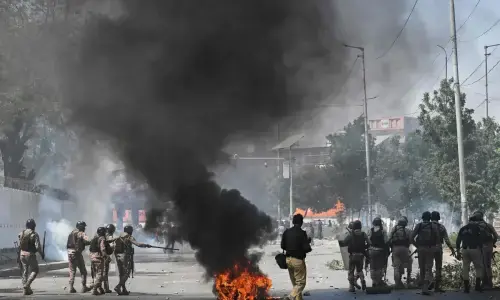
AS a peaceful protest, the Pakistan Tehrik-i-Insaf’s anti-drone march fell well within democratic norms. What was also clear, though, is that its motive was election-era politics rather than confronting the roots of the problem itself. While roundly criticising the Pakistani and US administrations, the party focused far less on the fact that Pakistan’s drone policy, whatever it may be, is being carried out with the approval of the Pakistani army and the cooperation of Pakistani intelligence. So while it may have been effective political propaganda, whether or not the protest will put pressure on those really responsible for the drones mess is questionable.
The frustrating truth is that the real nature of America and Pakistan’s agreement, or lack thereof, on the drones programme is growing more, not less, murky. The conventional wisdom seemed to be that a programme that was once jointly conducted by the two countries, at least in terms of intelligence-sharing and Pakistan providing a physical base, had now become one conducted by the US without Pakistan’s involvement. But a series of reports in Western media outlets are now claiming that Pakistan is still given some knowledge of upcoming drone strikes. Even then, there is no consensus on the extent of the information provided — whether it is just an indication of the broad area within which strikes will take place or an actual list of targets — or on whether or not Pakistan acknowledges receiving the information. The bottom line is that the extent of collaboration remains behind a veil of secrecy that neither the US nor Pakistan governments and intelligence agencies seem eager to lift.
Nor is it clear whether or not the drones are legal — partly because it is unclear how much consent Pakistan provides — how targets are selected, or how militants are distinguished from civilians present in areas where militant activities are being plotted or carried out. All of which has turned drones into a genuine human-rights issue of great sensitivity for many Pakistanis. That in turn means the programme has become a lightning rod for anti-US sentiment and is also being used to support the argument that military action is not the solution in even Fata’s most militant-infested parts. Until the Pakistani military makes a genuine effort to root out militants from the tribal areas, or the government develops a joint mechanism with the US for conducting the programme and shares it with the public, the controversy over drones could derail the objective of cleansing the tribal areas of militants who threaten not only other countries, but Pakistan itself.