0
0

IT is not that mines related accidents do not occur in our country. Many miners, mostly from Swat and Shangla, have died over the years toiling in heart wrenching conditions in mines across Balochistan. There was, however, something particularly eerie about the 39 miners trapped 700 meters under the surface of the earth in a copper mine in Chile that was very disturbing.
Although the Chilean miners were ultimately rescued after an ordeal of 69 days in Oct 2010, their saga had a peculiarly claustrophobic undertone to it that kept the world into following the news hour by hour. Quite strangely, the mayhem witnessed on Sept 21, 2012 in our backyard has revived and indeed reinforced that feeling of claustrophobia as law-enforcers have now learnt to combat rioters through an apparently unbreakable wall built of containers.
The present condition of the people living in Khyber Pakhtunkhwa in general and Peshawar in particular can be likened to the Chilean miners during the latter’s days and nights of despair and forlornness in the bottomless depths of their living. ‘This is a miracle from God,’ a Chilean commented after seeing his kin come out alive in a most spectacular rescue operation known to the civilised world.
Unfortunately, no such operation is afoot to bring redemption to the people of Peshawar from their long days, months and years of sufferings. In the pre-9/11 Afghanistan, containers symbolised death by suffocation; their appearance on the scene in Peshawar thus appears to have dashed all hopes of a possible end to the long painful and dark night for the dwellers of this godforsaken land.
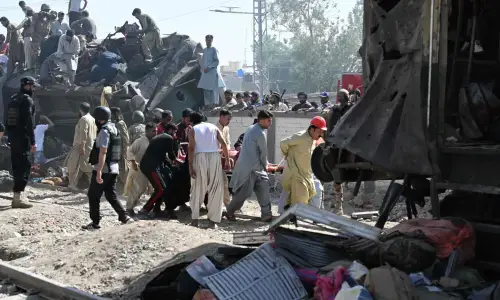
In the event of any protest, the security personnel build a wall of containers on the roads leading to the US Consulate where a ‘Cadaver’ lives, heavens knows for the fulfillment of which diabolic objective for otherwise s(he) is not known to be performing any function of diplomatic nature. The Cadaver’s office, which sits right in the middle of one of the busiest thoroughfares of Peshawar already stands shielded from any perceivable harm, but yet its protection seems to be the sole concern of the authorities that be and at the cost of the exchequer. This was witnessed on Sept 21 when arsonists were torching public and private property with absolute impunity.
The same approach was in evidence again 10 days later on Oct 1 when the garrulous demagogues led by a septuagenarian, not content with the extent of damage caused earlier, observed another day of protest. The protest forced another unproductive day on the Peshawarites as educational institutions and businesses remained closed. No one seemed to have minded that a little bit.
The spate of protests also forced the closure of another portion of a major road in the vicinity of the Cadaver’s office and thus, leaving even little space for the thousands of vehicles headed for the airport, the University Town, Hayatabad and onward to Afghanistan. The road could now be seen clogged at any hour of the day with a lone traffic cop standing aghast and clueless amid vehicles streaming from all directions.
While people in Peshawar thus suffer interminably, Nakoula Basseley Nakoula (real name Mark Basseley Youssef), the accursed mind behind the anti-Islam movie must be laughing his head off for having caused all that destruction to the lives and property of his targeted enemies. Western reviewers have called the movie clunky and unworthy of comments.
The hullabaloo over the movie months after its posting on the internet in the remote war-stricken underdeveloped areas of Khyber Pakhtunkhwa has nevertheless once again exposed the dubious sensitivities of the people. In the aftermath of the events of the second last Friday of Sept, the most vulnerable of the businesses could now be seen perennially draped in black curtains inscribed with religious verses. It is as if people are being forced to wear their faith on their sleeves.
This trend to appease the protesters was first observed in 2006 in the wake of the publication of sacrilegious cartoons by some Danish newspapers. But this proved to be unsuccessful on both occasions as it failed to dissuade the protesters from attacking private property. On both occasions, the traders of Peshawar had also put up banners pledging to sacrifice their lives and properties for the greater glory of the religious cause, and on each occasion their offer was paid back in kind as the protesters duly complied with their wishes.
Biblical symbolism would always be in evidence in Khyber Pakhtunkhwa whether it is natural disasters or furies generated by the ire of Man. In the times of Moses, people had to mark their doorposts with the blood of lambs in order to ward off divine wrath directed at Pharaoh and his people for refusing to let the Israelites enjoy two moments of peace. With all these black draping and offers of appeasement, could it be that we are reliving those primitive times?
Is Khyber Pakhtunkhwa fated to be permanently at war with itself as well as with the outside world? In 2006 also, several people, gullible by all means, lost life when not a word of protest was uttered in the so-called citadel of Islam which is raking in billions of dollars from religious tourism.
Life in Peshawar has lost its charm, if ever there was any. Broken down infrastructure, volatile law and order situation, intolerance and to cap them all headless bodies of the people fighting fanaticism have all made living in the environs of Peshawar, nay Khyber Pakhtunkhwa a grueling exercise, a battle of immense takings.
As the day dawned on Sept 21, 2012, there was something foreboding about it. The air reeked of something sinister brewing up.
Groups of young people wielding sticks had started taking to the roads. There was no one to lead them, not even the septuagenarian provocateurs. As the day wore on and news of violence started pouring in, Peshawar gave more solid reasons to the world why it was considered such a formidable place. One looks to be inescapably trapped in one’s own dwelling quarters with no shafts to escape through in an iron capsule.
It is in this state of mind that one is longingly recalled of Barack Obama’s inspiring remarks made on the occasion of the Chilean miners rescue. ‘This rescue is a tribute not only to the determination of the rescue workers and the Chilean government but also the unity and resolve of the Chilean people who have inspired the world,’ Obama had then said. One finds it is that particular resolve and unity, which are amiss of our polity that has continuously led to our discomfiture in our so-called war against the forces of bigotry.