0
0

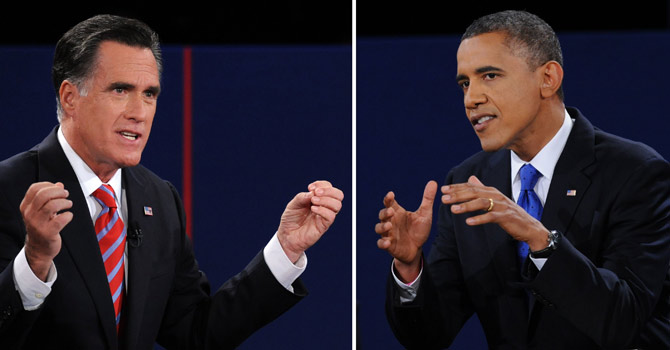
WASHINGTON: Pakistan is one of the five main subjects that the moderator of Monday night’s US presidential debate wants President Barack Obama and his Republican rival Mitt Romney to focus on.
The debate at Lynn University, Florida, is devoted to foreign policy, requiring the two candidates to tell American voters how they intend to deal with the issues that may have a direct bearing on US national security.
“Monday’s final debate could help decide who wins the election two weeks from Tuesday,” noted The Washington Post. Other observers pointed out how foreign policy, which was pushed to the background by an ailing economy, has now become a deciding factor in the Nov 6 election.
Moderator Bob Schieffer of CBS News has picked five topics for the debate, devoting the most time to the Middle East and terrorism. Other subjects are America’s role in the world, Afghanistan and Pakistan, Israel and Iran, and the rise of China.
Until recently, it was believed that President Obama will easily win any debate on foreign policy because of his impressive record: he withdrew US troops from Iraq, set up a timetable for pulling out forces from Afghanistan; killed Osama bin Laden in Pakistan, helped topple another American enemy, Col. Qadhafi in Libya, and backed democratic forces in the Arab world in bringing down despotic rulers.
But an attack on the US Consulate in Libya on Sept 11, 2012, which killed the US ambassador and two other Americans, changed the scenario.
Before this incident, Mr Obama never tired of counting his achievements whenever asked to speak on international affairs. But after Benghazi, Mr Romney is on the offensive.
The Republican presidential candidate claims that the Obama administration lied when it portrayed a terrorist attack as a protest and that diplomats trapped inside the consulate had requested military assistance but were denied.
Mr Romney also accuses President Obama of ignoring Israel to please Arabs and of encouraging the Taliban by setting up a 2014 deadline for leaving Afghanistan.
Prof. Robert Watson, director of American Studies at Lynn University, toocited Libya as possibly the most intriguing issue for Monday night’s (Tuesday morning PST) debate. But he also noted that other foreign policy issues were equally important.
“I cannot think of a time since World War II when there has been this many huge foreign-policy challenges,” Prof. Watson said.
Other experts pointed out that the attack in Benghazi also has changed the tone of the debate on other issues. Instead of underlining President Obama’s achievements, the US media now seems more concerned about uncertainty in a post-Arab Spring world, Iran’s nuclear intentions, US casualties at the hands of Afghan security forces and instability in Pakistan.
Taking advantage of this change of mood, Mr Romney is expected to accuse Mr Obama of failing to provide a strong leadership when the world needed it the most.
Unlike Mr Obama, who emphasises the need to engage Arabs and Muslims, Mr Romney says he will use America’s “might to shape history”.
Since the debate is held in Florida, which has a large Cuban-American population, Mr Romney is also expected to seek greater American involvement in Cuba.
Both candidates will also take a strong pro-Israel stance as Florida has a large Jewish population too and is one of the swing states that will play a crucial role in deciding the election.