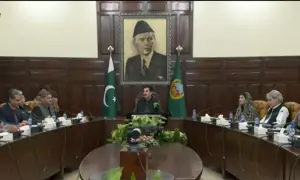
ISLAMABAD: Members of the Parliamentary Committee on National Security (PCNS) will have an ‘in-camera’ discussion with Lord Carlyle, a British lawyer and an expert on anti-terrorism laws, here on Wednesday.
“The meeting is being held to meet Lord Alexander Charles Carlyle, a practising barrister from the UK and a former independent reviewer of British anti-terrorism laws” and to “discuss legislation with respect to terrorism”, says a notice for the meeting received by the members of the committee headed by PPP stalwart Senator Raza Rabbani and a copy of which is available with Dawn.
But it will be an informal meeting, according to the notice.
The meeting is taking place at a time when the government has already introduced “the Investigation for Fair Trial Bill, 2012”, in the National Assembly “to provide for investigation for collection of evidence by means of modern techniques and devices to prevent and effectively deal with scheduled offences and to regulate the powers of the law enforcement and intelligence agencies” to deal with terrorism.
The bill is pending before the house committee for law and justice and if adopted in its present shape, emails, SMSs, phone calls and audio-visual recordings will be admissible evidence, while suspects will be held for six months after a warrant is issued by a district and sessions judge in his chambers.
The proposed legislation has attracted criticism from some quarters for being too intrusive and against the norms of privacy.
The government has introduced the bill after quietly withdrawing its previous Anti-Terrorism Amendment Bill, 2010, which had been tabled by Interior Minister Rehman Malik in the Senate in July 2010, extending the scope and powers of the law-enforcement as well as investigation agencies for probing and detaining an accused under the act while limiting the powers of the judiciary.
The amendment bill became controversial soon after its presentation because, besides the opposition parties, some members of the ruling coalition and rights activists expressed reservations over its certain clauses.