



 1
1

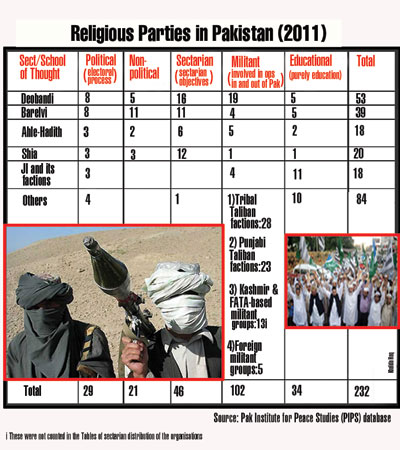
Although general trends are easy to identify, the categorisation of religious parties is not quite as straightforward, mainly because most of the religious organisations are working for multiple agendas, either themselves or through affiliated groups and entities.
A closer look suggests that even today most religious organisations in Pakistan move around, or at least at some point had links, with the main religious parties which were active in the country in the 1950s, including the Jamaat-i-Islami (JI), Jamiat Ulema-i-Islam (JUI), Jamiat Ulema-i-Pakistan (JUP) and Jamiat-i-Ahle Hadith. These included All Pakistan Shia Political Parties, which became Tehrik Nifaz-i-Fiqa-i-Jaffria in the late 1970s.
Almost all other religious outfits, whether working for missionary, sectarian or educational/charitable pursuits or engaged in militancy, are affiliated with or are breakaway factions of these five major parties. Most importantly, even the affiliates or splinters believe in the agendas of their parent organisations.
The major difference is that the parent organisations’ focus is on Islamisation and that of the splinters on religio-socialisation. The parent parties which have a religious agenda and focus, are part of Pakistan’s mainstream politics, believe in the constitution of Pakistan, participate in electoral politics, and are classified as religious political parties.
In the last two decades, another form of religious organisation has emerged: agents of Islamisation and religio-socialisation but with the belief that change is impossible within the constitution of Pakistan and the current political dispensation. They deem democracy and the democratic process inadequate for the change they pursue and advocate.
Some of them — such as Jamaatud Dawa, the Khilafah movement, Hizbut Tahrir and Al-Muhajiroon — deem that democracy is an idea contrary to Islamic principles of governance and want to replace it with their own version of Sharia. Some groups such as Tanzeemul Akhwan and Tanzeem-i-Islami believe that Sharia cannot be introduced in its entirety through the democratic electoral process and consider the use of force or toppling of the government as alternatives.
They have sectarian and militant tendencies but the dominant approach is renewalist, characterised by their quest for a complete change of system: contrary to the religious political parties’ approach that focuses on gradual change within the system.
All parties having a specific sectarian focus promote antagonism against other sects of Islam or engaging in sectarian rhetoric or armed conflict are classified as sectarian outfits, notwithstanding their participation in electoral politics and in militant activities. Examples include Deobandi outfits Ahl-e-Sunnat-Wal Jamaat (ASWJ) and Lashkar-i-Jhangvi (LJ), and Barelvi groups Sunni Tehreek (ST) and Jamaat-i-Ahl-e-Sunnat.



























