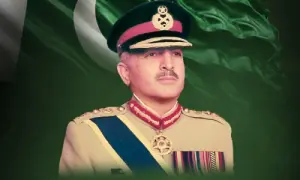
RAWALPINDI: Army Chief General Ashfaq Pervez Kayani on Monday said that any effort to create a divide between the people and Armed Forces undermines Pakistan’s larger national interest.
“The Armed Forces draw their strength from the bedrock of the public support. National security is meaningless without it. Therefore, any effort which wittingly or unwittingly draws a wedge between the people and Armed Forces of Pakistan undermines the larger national interest,” said the military chief according to a press release by the army’s PR wing, the Inter-Services Public Relations (ISPR).
“While constructive criticism is well understood, conspiracy theories based on rumours which create doubts about the very intent, are unacceptable.”
Speaking to officers at the Army’s General Headquarters (GHQ) in the garrison town of Rawalpindi, Kayani said that the country’s national interest could emerge only through a consensus between the people and institutions.
“No individual or institution has the monopoly to decide what is right or wrong in defining the ultimate national interest,” said the military chief according to a press release by the army’s PR wing, the Inter-Services Public Relations (ISPR).
“It [National interest] should emerge only through a consensus, and all Pakistanis have a right to express their opinions. The constitution provides a clear mechanism for it.”
“As a nation, we are passing through a defining phase. We are critically looking at the mistakes made in the past and trying to set the course for a better future,” said the Army chief.
He added: “While individual mistakes might have been made by all of us in the country, these should be best left to the due process of law.
Kayani added that, while individual mistakes may have been made in the past, that no one is guilty until proven otherwise.
“Let us not pre judge anyone, be it a civilian or a military person and extend it, unnecessarily, to undermine respective institutions.
“All systems in Pakistan appear to be in a haste to achieve something, which can have both positive and negative implications,” he said.
“Let us take a pause and examine the two fundamental questions; One, are we promoting the rule of law and the constitution? Two, are we strengthening or weakening the institutions?”