Childhood lost to bullets

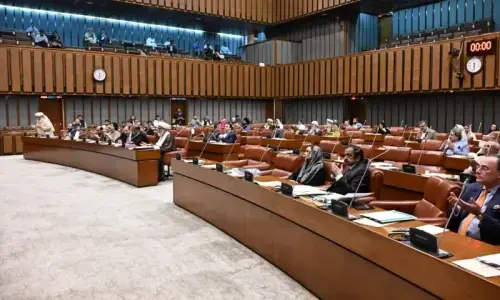
Kashmiris shout slogans after an altercation broke-out between troops and a group of boys in the Brein area of Srinagar. – AFP (File Photo)
SRINAGAR: The musical tunes of a piano greet the ears as one walks towards the room of Muneer Ahmad. Climbing the creaky wooden stairs of a rundown two-storey house, the music gets clearer and louder. The tunes take us to Ahmad’s room where he seems lost playing his electronic piano while his younger sister cleans vegetable besides his bed. The music suddenly stops as we enter the room.
Ahmad is 19 years old, yet he does not live the life of boys of his age. He can neither play cricket, nor stroll around his locality with his friends and nor can he go to school. For the past eight years, his life has been confined to his bed after being partially paralyzed by a stray bullet.
Lying under a blanket on his bed, Ahmad recalls the horror of January 29, 2005.
“I was playing cricket downstairs with my friends when I suddenly fell down numb. I did not know what happened but I was unable to move,” he says in fluent Urdu.
Ahmad was then a class 6 student. He was rushed to the hospital where after investigations a bullet was discovered in his spinal cord.
“I was hit by a cold stray bullet which had come from Habba Kadal where some firing incident had taken place that day.”
Habba Kadal is just few kilometers from Ahmad’s locality, Abi-Guzar.
The bullet had pierced him eight inches deep into the spine, creating a hole in his back.
“I was completely numb and shocked to know that I was hit by a bullet which I did not even realise.”
Within days, Ahmad was operated and the bullet removed. However his condition could not get any better. His lower limbs are completely paralyzed which even refrains him from using the bathroom.
“For eight years my son has been on urine bags. Imagine his condition when he cannot even go to the bathroom on his own,” says his mother.
He grew up sitting on this bed, she adds.
Ahmad has three sisters, and two brothers who work as salesmen. He recently lost his elder brother to a road accident. His father, Mohammad Tariq Bhat supported the family by running a provisional shop in their locality.
“But after the death of my son, his health deteriorated and is unable to work. I have to take debt from people to treat my son,” Ahmad’s mother says.
Ahmad is unable to continue his education because of his paralysis and poverty. When asked about his aim in life he says, “I love music. I love playing the piano and singing.”
The life of 16-year-old Yawar Ibrahim is no better. It has been over three years since Ibrahim has spoken to his family. He can neither talk nor move and can’t walk on his own either.
It was June 30, 2009 when Ibrahim lost his childhood to a tear gas shell that hit him in his head, striking his brain. He was 13 at the time.
In 2009, mass protests were witnessed across the valley against the rape and murder of two women from Shopian district. Scores were killed and injured in the skirmish. Protestors and security forces had restored to firing and tear gas shelling across Kashmir.
On the fateful day, Ibrahim had gone to the market of his locality of Maisuma, Srinagar, to buy butter.
“It was not much trouble at that time in our area and shops were also open. While Yawar went out, my younger daughter was peeping through the window of the upper story,” says Naseema, Ibrahim’s mother.
Within no time the situation grew tense and the peal battle between the protestors and security forces began. While security forces started tear gas shelling and firing bullets at the protestors, Ibrahim, who was on his way home, got hit by a tear gas in his head.
“That tear gas shell hit him straight in his head. He was immediately rushed to hospital for treatment,” Naseema recalls as Ibrahim watches silently.
Ibrahim was in coma for 17 days. Though he gained back his senses, he lost his freedom forever. The tear gas shell had hit his nerves and brains. For eleven months he was spoon fed. Even as he comprehends everything, Ibrahim fails to talk or express himself.
“We have been treating him for so along. There has not been much improvement except that he can now sit on a wheel chair. He does not say anything even today,” says Naseema. Ibrahim tries moving his arms to show the mark on his head left by the tear gas shell.
Mohammad Ibrahim, his father, works as a mechanic. He takes debt from his friends and relatives for his son’s medication. The family wanted to take Ibrahim to New Delhi for treatment but did not have sufficient money.
“My eldest daughter had to quit studies to nurse Yawar. He is my lone son,” adds Naseema.
Ibrahim has not only lost his freedom and childhood, but his friends too. Ever since he got paralyzed none of his friends came to meet him.
When asked if he meets his friends, Ibrahim nods in negative, frowning while waving his hand.
The only time he opens his mouth is to say ‘mum’ while calling out to his mother.







These are the side effects of freedom struggles. I feel sad for these children, I wish their sacrifices yield fruit one day. It makes no sense how India can win hearts of these people after doing all this brutality of their army against children and women.
“Sow the wind and reap the Whirl wind”
These are just after effects.
RE Rattan, take it easy dear, Dawn has always published article on the atrocities in Blaochistan and other secaterian killings in Pakistan, unlike stories of atrocities in Kashmir by Indian media. The author is highlighting the sad situation of people caught in cross fire. So don’t start blame game and pray for their health….and yes…your comments were published.
Who said bullets kill , human beings kill other human beings .
@Rattan, wherever war hurts/ kills women, children and elderly, it is wrong. It is not a matter of borders, its a matter of showing empathy to others. It is impossible to eradicate “war” from the world, but I wish we could do something to limit the war to the battle fields, leaving alone the innocent.
@Shazia.i am sorry my comments were written in a moment of passion.I am so sick of reading about all these killings/maiming everywhere,be it Kahmir,Gujrat,Karachi or Balochistan.As you rightly pointed out that wars will continue to go on even in the name of stopping another war.My prayers are with these kids and their parents.
Felt very sad to read this. The region used to be very peaceful until militancy. Hope this stops soon.
Indians have a habit of pulling out best humor in times of pain and grief.. for best references one can check out this comments section.. Each and every Indian follows sunny deol in letter and spirit > Pakistan and Kashmir bashing all the time
and well I couldn’t find even a single note of sympathy for tragedy stricken Kashmiri kids by any of these indians commenting here.. shame shame
All I can say is, “India Quit Kashmir”..
We wont quit kashmir
I would not hesitate to say Pakistan is responsible for this and will be responsible if they get wiped out or broken in to 4 small countries!!!! Why we fighting with India since separation? what we got? why this big budget is not given to all needy area of pakistan? why we are encouraging religious extremes all liberty? Why we don’t leave Kashmir alone and let live peacefully. Let be a good trading country with India as USA and Canada. Like Canada, we can prosper with India and we both reach greater height in this world together. Don’t listen to selfish mulla or leaders. Please stop writing on such issue, instead concentrate to our own issues.
Thanks for posting this article. Regardless of what has happend in the past, the humanitarian angle should never be ignored, I hope the Indian readers will also acknowledge that something has to be done. Its very easy to blame Pakistan, but hard to correct the wrongdoings of Indian security forces for the past 3 decades. According to Indian and International sources, the militancy has for large parts diminished since 2004/5. What has the Indian government done since to improve the human rights situation in Kashmir? So stop using the militancy card as an excuse.
Pakistanis are responsible for this. They sent terrorists over the border. They provided the training. They provided the weapons. They provided the safe havens. The provided the cover fire to get these terrorists across the border.
Shame on Pakistan.
It is truly tragic and painful to hear this story.
However, one point different about article is that it does not blame the security forces in Kashmir for making the lives of those kids miserable. The bullet that hit Ahmad might have equally been a terrorist’s bullet or bullet of an army man. In a way it doesnt matter whose bullet it was – a bullet is a bullet no matter what! We must all hate bullets.
There is a common saying that, “When Elephants Fight, It Is the Grass That Suffers”, but hearing these stories makes me sad thinking about those innocent kids.
Of course, I am not denying that in addition to providing the necessary law and order enforcement the India Army has, in certain cases, made mistakes and made the innocent people suffer. Some of the acts of Army to frame innocent and law abiding citizens as terrorists without proper investigation have come out in the open now and I highly condemn them.
But first thing first, we need to ensure that those kids dont live harbouring the feeling of hate against the country they live. We must support those kids and their families, psychologically, socially, and if possible financially.
Ankit- you made too many mistakes in your comment. First, here elephants are not fighting. Here we are talking about gorilla warfare, we are talking about terrorists who attack innocent people in the valley and forces.
Second, have you every visited valley before? If not, I suggest go and visit there. Talk to common people, see what they want. See in what conditions our army is standing tall there. They don’t have defined enemy to target. They have to identify terrorist who looks exactly like any other common citizen and eliminate such risk, How do you suggest them to identify these terrorists out of common people?
Indian army is doing it’s best to maintain the peace in valley. I have been there multiple times and I am so proud of them. Be careful when you comment about them.
very well said Nitin.. i’ve been there myself few times and can understand and feel the trauma common man’s being going through.. even the army facing the brunt…. they are fed up with these constant cross border heroics and want to leave valley once situations are under control and people are free to roam on the streets.
will love to see your article on the atrocities in (should i say pakistani controlled)Baluchistan by Pakistani security forces.Thousands missing and brutally killed – muslims killing mislims.First tidy up your house and then comment on others.You will publish my comment – ofcourse not.
there is only one word for you people – Vahyat.
typical indian response. Call spade a spade.
it is again India involved in it, there are proofs of it.
We see your hatred through the comments of your country men everyday
@Rattan, wherever war hurts/ kills women, children and elderly, it is wrong. It is not a matter of borders, its a matter of showing empathy to others. It is impossible to eradicate “war” from the world, but I wish we could do something to limit the war to the battle fields, leaving alone the innocent.
Mr. Rattan
Don’t justify what happens in Pakistan with atrocities in India (occupied Kashmir or else where). What happens in India is India’s problem. By hiding or covering facts don’t change.
Having said that, Pakistan has its own set of problems. Lets not mix 2 togather.
By the way, its ones perspective, Pakistanis call Indian occumpied Kashmir, and Indians call Pakistan occupied Kashmir.
We need to be just when it comes to human rights.
So lets deal it like mature people not like politicians.
Stop blamming and address the issue, both India or Pakistan.
Thankyou dawn for bringing out the issues to public notice whether they are happening in India or in Pakistan.
3 generations back we were one country, one roots. Divide among is benefitting no one except politicians.
Are you justifying this brutality in your held Kashmir?
Why shouldn’t anyone have the right to condemn injustice?
Hindus kill Hindus in India, why does India speak of hindus in Pakistan?
Condemn injustice wherever it happens whether its your own country.
Things were so rosy before 1989 when Pakistan decided to send the Mujahideen it used for Afghanistan to Kashmir. After then a whole generation had to suffer.
Before 1989 movies were shot in Kashmir, tourism was booming. Now things are returning to normal. So much so that one of my friends just spent his honeymoon in Kashmir, unthinkable just few years ago.
When faced with an insurgency, nations have to give it all else lose the war.
You are right buddy. I think its the protesters who are responsible for such incidents. When they protest by pelting stones and destryoing the public property how can the security forces stop them without firing bullets or shells. These protests are funded by outside forces so that kashmir keeps burning. Feel sad at the mentality of some people who think killing innocent is the way to protest. Instead of freedom they need to focus on their education and career.
Isurgency did not ask your military to burn villages and rape thousands of women
Very sad.While the security forces always get blamed – may be rightly , for any such problem,due share should be given to the parties which call for protests on any issue.If I remember correctly,the rape proved to be nothing to do with the security agencies but still protests went on and on.So many misguided youth lose out .
“Collateral damage” is heart-rending.
Sad destiny of kashmiris !!! Struck between misleading leaders and militancy. Due to militancy no jobs there,no investment there , thanks to a little bit tourism . To control militancy , soldiers unitentionally or intentionally do mistakes . Misleading leaders enjoy their life , fight among each other , gives bloody tear to poors. Unemployed youths involved in violence not only cause harm to themselves , but to others .Forget about women empowerment , thanks to Islamic culture .