1
1


ISLAMABAD, Nov 7: Reporting irregular, illegal and objectionable expenditures of Rs1.858 trillion by federal and provincial governments during the last financial year (2011-12), the Auditor General of Pakistan (AGP) astonished a parliamentary committee on Wednesday by disclosing that 16 government entities using public money were still resisting mandatory constitutional audits.
Besides such violations of rules, regulations and constitutional requirements, the Senate Standing Committee on Finance and Revenue was informed that Balochistan had not even set up a public accounts committee (PAC) since the current government assumed power in 2008 and hence there was no system of constitutional scrutiny of public accounts of the provincial government.
As a result, the AGP did not have the powers to take action over violation of accounting principles while the parliamentary oversight of the public accounts was diluted because of delayed examination of its audit objections by the PAC. The committee was informed that audit reports could not be taken up by the PAC during the period of previous government, resulting in a backlog of five to six years.
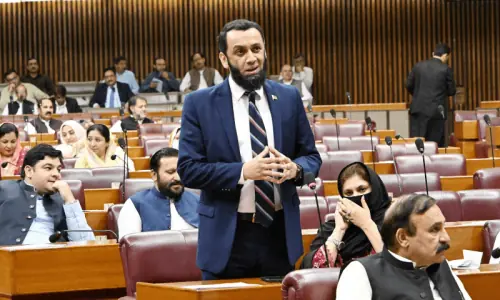
Briefing the Senate committee headed by Nasreen Jalil of the MQM, Additional Auditor General Tanveer Ahmed said the audit of the Supreme Court’s accounts could not be conducted last year, but it had now been included among the entities whose accounts for 2012-13 would be audited this year.
Mr Ahmed said since 100 per cent audit was not possible, sample entities were taken up for audit based on high-risk financial impact because of various reasons, including corruption, irregularities or misappropriation. He said none of the ministries and divisions had an internal audit system that had resulted in a lot of public losses.
Responding to a senator’s question, the AGP said all federal and provincial assemblies had a system of constitutional scrutiny in the form of PAC, except Balochistan, where the provincial assembly’s public accounts committee did not exist, perhaps because all members of the assembly, except three, were ministers.
The standing committee noted violation of Article 171 of the Constitution by the Balochistan government for not having a provincial PAC and not submitting a report to the governor. The committee decided to write a letter to the provincial government and assembly to activate the PAC to ensure transparency of public funds and accountability.
Talking about challenges, Mr Ahmed said that despite being a constitutional forum under Article 168 of the Constitution, the AGP continued to be a department attached to the ministry of finance which was a clear conflict of interest and hence it did not enjoy legal cover to act independently like other constitutional offices such as the Election Commission of Pakistan, the president, the Supreme Court and the two houses of parliament. The government, despite repeated moves, has not given independent constitutional status to the AGP.
Responding to a question, he said the accounts of the two houses of parliament, the Supreme Court and the army were subjected to annual audit by the AGP as a routine, but added that it was not necessary to have 100 per cent audit of all government entities.
The public entities that have refused audits by the AGP included the Securities and Exchange Commission of Pakistan (SECP), the Pakistan Telecommunication Company Limited (PTCL), Pakistan Medical and Dental Council (PMDC), Pakistan Poverty Alleviation Fund (PPAF), National Bank of Pakistan, Defence Housing Authority (DHA), People’s Primary Health Initiative in Khyber Pakhtunkhawa, Virtual University, Lahore, the National Press Trust, the National Database and Registration Authority (Nadra), Wah Nobel Private Limited and Agribusiness Support Fund, Pakistan Ordinance Factories Welfare Trust Fund, Pak-China Investment Company, Record of the assesees by the Federal Board of Revenue and the Frontier Works Organisation (FWO). He said the FWO had now agreed to have audit by the AGP.
He said the AGP had issued audit certificates to 194 accounts with a total size of the accounts at Rs10.369 trillion during financial year 2011-12. This included Rs8.3 trillion worth of accounts of the federal government and Rs1.59 trillion of provincial, district and self accounting entities. The Pakistan Post Office was the only entity whose accounts were given “adverse certificate” because of massive violations of rules and irregularities were found in its accounts.
He said that accounts of various government departments were never subjected to a detailed audit. Out of 44,100 public sector entities, the audit of about 9,000 entities were carried out in 2011-12 involving total public funds of Rs4.474 trillion.
Objections were raised the spending of Rs1.858 trillion and an amount of Rs25.7 billion was recovered as a result of the audit objections.
Giving a break-up, he said violations of rules and regulations were found in the case of Rs1.009 trillion while cases of fraud, embezzlement and theft of Rs24.3 billion were highlighted for and accounting errors were noted against an amount of Rs5 billion. Objections were also raised over weakness of internal accounts of Rs193 billion and Rs332 billion were found to have other discrepancies. At the end of the exercise, an amount of Rs294 billion has been found to be recoverable and referred to the PAC.Tanveer Ahmed said the financial impact of the audit could not be entirely quantified because its objections led to improvement in reporting system, reduction in expenditure and adaptation of procurement rules.
Ilyas Bilour of the ANP said the AGP office should also put its own house in order because its officials were involved in corruption in the matters of audit of other departments. The committee was informed that even though the annual audits had a limited coverage, only 38 per cent directives of the PAC for recovery and correction of public accounts were complied with, diluting the accountability process.