0
0

KARACHI, Nov 7: One of the fundamental problems of Pakistani society is the lack of recognition of ethnic and class differences in the country; the long-term solution to resolving this issue is to let the political process continue undisturbed.
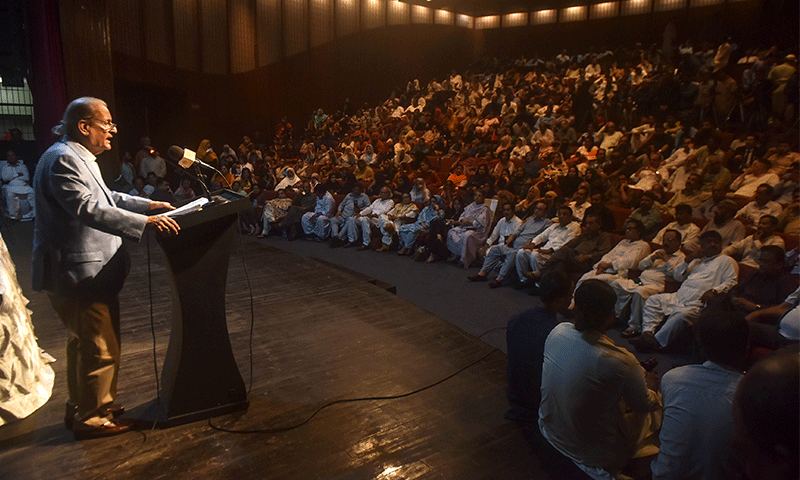
This was stated by Dr Aasim Sajjad Akhtar of Quaid-i-Azam University, Islamabad, while speaking on the second day of a two-day international conference held at the University of Karachi on Wednesday.
The conference on ‘Federalism in pluralistic developing societies: learning from the European experiences’, was organised by KU’s Area Study Centre for Europe in collaboration with the Hanns Seidel Foundation, Islamabad.
Dr Akhtar said that experiments with local government systems in Pakistan, especially during periods of military rule, ended up bypassing the provincial government. He said the recently passed Sindh People’s Local Government Act 2012 was being opposed by a large cross-section of Sindhi nationalists.
The scholar said that during the Ziaul Haq regime the spirit of democracy was taken out of the local government system, which ended up making it a system of patronage. “The result was a bifurcated, conflict-ridden system, especially in Sindh. It was not sustainable. Daily explosions are waiting to happen. Narrow ethnic conflict has resulted.”
Dr Akhtar said that due to the SPLGA 2012 Pakhtuns felt left out in Karachi while residents of rural Sindh also felt excluded.
“Too many claimants have been left out. There is a lack of recognition of differences,” he said while adding that the country’s internal differences needed to be recognised to make the democratic process successful.
Dr Jehan Perera, director of the National Peace Council, Colombo, Sri Lanka, spoke of the problems confronting devolution in the island nation. He said the Sri Lankan government defeated a “rebel terrorist movement” [the LTTE] on the battlefield three years ago while five governments had made efforts, and failed, to negotiate a peaceful settlement with the Tamil Tigers. Dr Perera, who was part of the negotiations, said the parleys failed because both sides felt the other was not negotiating in good faith.
‘A negative peace’
The Sri Lankan scholar said that despite the end of the civil war peace had not really been achieved. “There is a negative peace, which is the absence of war”. Referring to the current tussle between the executive and the judiciary in Sri Lanka, Dr Perera termed it a power struggle. The government wanted to impeach the sitting chief justice as she had declared a move to indirectly undermine the country’s provincial councils as unconstitutional. He felt the chief justice will “inevitably” be impeached as the government had the numbers in parliament.
He said the people of Sri Lanka fear division, so they may support the government’s efforts to take away powers from the provincial councils (PCs). There were also fears that India may intervene in an adverse manner. The scholar said Sri Lanka had a unitary system of government, with the power elite nearly all belonging to the Sinhalese community.
“Federalism is a bad word in Sri Lanka, so we talk of devolution. In the eyes of the people the PCs are white elephants. However the minorities [the Tamils and Muslims] want a federal system”.
Elisabeth Alber of the Institute for Studies on Federalism and Regionalism, Italy, while speaking on autonomy of the Italian region of South Tyrol, said an ethnic quota system existed in the region to accommodate the three major linguistic groups — German, Italian and Ladin speakers.
She said that in order to qualify for public service in South Tyrol, one had to pass a bi- or in some parts of the region, tri-lingual exam. She said the region successfully managed its ethnic issues due to special legal tools.
Dr Asha Sarangi of Jawaharlal Nehru University, New Delhi, discussed demands for smaller states in India. She said there were several reasons for the creation of new states in the huge country including regional disparities, inter-state and intra-state inequalities, the growth of regional parties and the rise of coalition politics as well as a number of ethnic ‘sons of the soil’ movements.
The scholar pointed out that currently there were nearly 15 movements in India seeking to carve out new states, mostly along linguistic lines. She said that according to some projections, by 2040 it was estimated that India may be further carved up into over 50 states, compared to the present 28.
Post-devolution nationalism
Speaking on ethnic nationalism in Pakistan, KU’s Dr Farhan Siddiqi said that until about two years ago, Hazara and Seraiki nationalism had been dormant yet had been reinvigorated by the passage of the 18th Amendment.
He said the Hazara movement became quite active after the erstwhile North West Frontier Province had been renamed Khyber Pakhtunkhwa. This, along with the killing of several protesters in Abbottabad due to police firing in April 2010, gave momentum to the Tehrik Sooba Hazara, led by Baba Haider Zaman. He added that Baba Zaman and the Hazara movement was supported by the MQM due to the latter’s differences in Karachi with the ANP, the party that led the drive to rename the NWFP. However, Dr Siddiqi observed there were internal divisions in the Hazara province movement.
Coming to Seraiki nationalism, he said former prime minister Yousuf Raza Gilani and the PPP had championed the cause of a Seraiki province carved out of southern Punjab. However, Seraiki nationalists including Taj Muhammad Langah criticised the idea of a South Punjab province based on administrative lines. He said there were also divisions within the Seraiki movement, especially when it came to selecting between Multan or Bahawalpur as the capital of a potential Seraiki province.
“The establishment is still loath to the idea of creating new provinces on ethno-linguistic lines due to fears of Balkanisation. However, new provinces — either on administrative or linguistic lines — are needed. This would lead to a stronger Pakistan”, the scholar observed.
Balkrishna Mabuhang of Tribhuvan University, Kathmandu, Nepal, discussed the transformation of Nepal from a Hindu nation state to a multi-nation state while Prof Dr Moonis Ahmar, ASCE director, concluded the conference with the suggestion that a centre for the study and research on federalism in South Asia be set up in Pakistan.