0
0

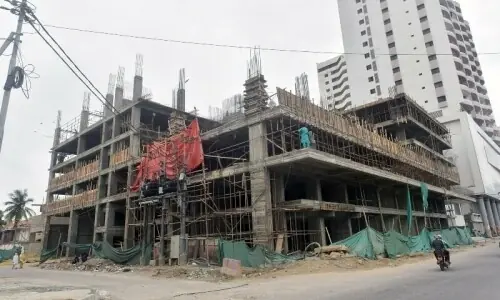
KARACHI, Nov 8: The Sindh High Court on Thursday directed the Sindh Building Control Authority not to regularise any illegal constructions across the province until the judicial pronouncement was made on an amnesty scheme that has already been suspended by the court in an identical matter and ordered ‘strict compliance’ of the directive.
A division bench headed by Justice Maqbool Baqar gave this direction while hearing a petition of a non-government organisation, Check and Watch Environmental Foundation, against illegal construction of floors of a building in Khudadad Colony.
The petitioner NGO, represented by Advocate Syeda Sara Kanwal, impleaded the SBCA Jamshed Town building controller, Muzaffar, the owner of plots E-446 and E-447 who raised two floors without approval of the plan and in violation of rules and regulations.
On Thursday, the SBCA Jamshed Town director appeared in court and stated that the construction on the plots was in excess of 20 per cent of the approved plan. He said that the construction was in violation of building rules and regulations and was not permissible under the law. However, he stated, it might be permissible to regularisation in terms of amnesty scheme announced by the authorities in November last year.
The court observed that the amnesty scheme had been suspended by the SHC in another petition.
The bench observed: “We have in several petitions observed that amnesty scheme prima facie seems to be illegal and violation of law, therefore, SBCA shall not proceed to regularize any illegal constructions till the judicial pronouncement is made regarding the scheme.”
The bench also noted that all cases and requests for regularisation shall be processed and disposed of only after the judicial pronouncement was made on the purported scheme.
The court directed the office to give copies of the court order to the SBCA counsel, Rao Sarfraz Khan, for placing it before the SBCA director general “for strict compliance”.
The bench directed the office to fix the hearing of the petition along with another identical petition “so that legality and propriety of the so-called amnesty scheme may be examined”.
Earth lifting case
A division bench, headed by Chief Justice Mushir Alam, directed the office of the advocate-general to designate a representative to accompany the court nazir for the inspection of land where a government contractor was not being allowed to lift earth and sand.
Contractor Mohammed Idrees filed a constitutional petition against the officials of police and mineral department for stopping him from lifting earth from an area allotted to him.
The petitioner submitted that he had secured a three-month contract for lifting earth for a certain period for roads construction by the government. He said he had undertaken the work and was removing earth when policemen obstructed him and interfered.
He impleaded the director-general of mines and minerals department, station house officer of the mines and minerals police station, Malir SSP and Shah Latif SHO as respondents.
He submitted that he was unable to work for the period of his contract due to the respondent officials.
Later, the petition was disposed of and the mines and mineral department was directed to decide on Idrees’ application for an extension in the period of his contract.The contractor was subsequently given two extensions, but as soon as he began work they interfered and arrested workers and labourers.
On Thursday, the court perused the nazir report that showed that despite specific directions, Additional Advocate General Adnan Karim was not able to depute a representative who could accompany the nazir to identify the land.
The court ordered the AG office to designate a representative within seven days for the inspection of the land and put off the hearing for two weeks.