0
0

HAD he lived, he would have been 100 this year and France would have celebrated the event in a big way. But then, on second thoughts, maybe not. Despite the conferment in his lifetime of awards like Chevalier of Legion of Honour, the War Cross and the Resistance Medal, Pierre Boulle had remained relatively anonymous in his home country.
A reserved, shy character, the young Boulle earned a degree in electrical engineering in 1933 and immediately left France to take a modest job as a technician on British rubber plantations in Malaya.
With the commencement of the Second World War, instead of returning to Europe he enlisted with the Resistance forces in Vietnam, or the French Indo-China as it was called in those days. This was also the beginning of Pierre Boulle’s life as a secret agent that was in fact very different from the hard-drinking, bow-tie and dinner-jacket image of a playboy that is given to us in today’s James Bond movies.
Pierre Boulle was not given a number beginning with a double-zero, but the name of John Rule and his dangerous missions included helping the Resistance army in China, Burma and Vietnam in its struggle against Marshall Petain’s Vichy-based regime in France that was siding with Hitler.
While on a secret errand in 1943 along the Mekong River, secret agent John Rule was arrested by Petain’s men, then hastily tried and sentenced to be shot by a firing squad. His execution was put off a number of times for technical reasons and Pierre Boulle was forced to work on a railway line and bridge construction site.
Once Marshall Petain’s forces were defeated and Gen Charles de Gaulle triumphantly marched into Paris following the Normandy landings by the Allied troops in 1944, Pierre Boulle found himself a free man. He tried to resume his job at the rubber plants, but his mind was stuck with the feverish images of the train track and the unfinished bridge.
Obsessed with the idea, Boulle returned to Paris, rented a single-room flat with help from his sister and started writing a fictional story about a group of British and American prisoners of war captured by the Japanese troops and made to work as forced labour. His work was finally published in 1952 under the title Le Pont de la rivière Kwaï. It had a modest success in France, but became an instant bestseller once translated into English as ‘The Bridge over the River Kwai.’
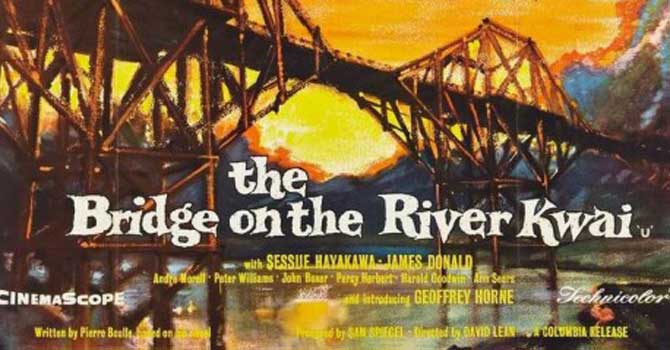
David Lean, the British movie director at the time famous for his screen adaptations of Charles Dickens’ novels ‘Great Expectations’ and ‘Oliver Twist’, later told a reporter that when he picked up Pierre Boulle’s book he was unable to put it down before finishing it at three in the morning. He read it again and again and kept visualising scenes of a film he could make. Lean finally realised his dream with the movie, The Bridge on the River Kwai, which was released in 1957. It won awards all over the world, including seven Oscars (the highest number at the time for best picture, best actor (Alec Guinness) and best screenplay (Pierre Boulle himself).
Planet of the Apes
Following such phenomenal recognition writers normally stick to the same genre. But Boulle worked for six years before coming up in 1963 with a book that appeared as science fiction to the general reader, but was in fact a scathing satire on the shape the modern society was taking.
In the ‘Planet of the Apes’ a group of astronauts voyages in the year 2500 through the time-warp to a strange planet where apes are the master race and humans are no better than animals. They are caged in zoos, used in laboratory experiments and hunted for sport. The unbelievable climax of the story might as well be the America of today!
The author, who had only meant the book to be a modest fictional satire, was taken completely by surprise by its success and impact throughout the world. But he declared the Planet of the Apes could never be turned into a film. He was wrong.
In 1968 the film was released with Charlton Heston in the lead. It was such an astounding triumph that through the years it inspired four sequels, one television series, an animated series and a remake of the original story in 2001.
Despite all the fame and the wealth his work had brought him, Pierre Boulle lived modestly in Paris, shunned all publicity, politely declined invitations to TV shows and magazine interviews, never got married and died quietly in 1994 at age 82.
This year while television networks, newspapers and magazines in France are falling over each other to pay lavish tributes to the half-century celebration of the Rolling Stones, Boulle is noticeably absent from the media.
The writer is a journalist based in Paris. (ZafMasud@gmail.com)