0
0

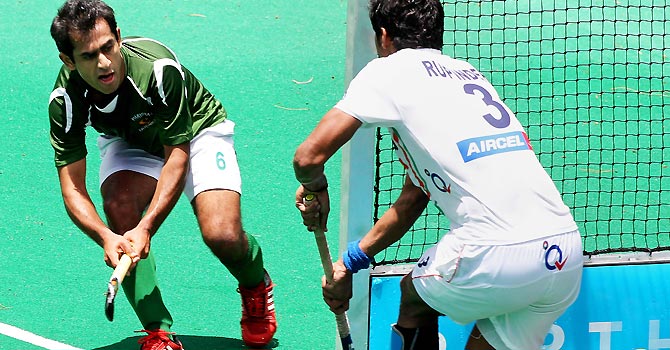
A Bronze medal at an international event is a bronze medal at an international event. The Pakistan Hockey Federation (PHF) will love to shout that from the rooftops after what happened at Perth.
Surely, nothing succeeds like success and a bronze medal finish is a wonderful — and also rightful and lawful — façade for the PHF to mask the simple fact that the team won only a single game in the entire tournament.
There were only four teams in the tournament, mind you. Pakistan lost its games 2-3 against Australia and 2-4 against England to fall out of the race for the top slot. Then came the last league match against India which had also lost its two earlier games. Pakistan lost it 2-5 and finished fourth at the end of the round-robin stage. As the scorelines also suggest, the level of humiliation kept rising with every match.
Luckily, however, the format also had a knockout stage, with the top two teams competing for gold and silver, while the bottom two hitting it out for the bronze. It was here that Pakistan made it count, paying back the Indian compliment 5-2, and picking up the bronze medal with its lone victory in the tournament. The Indians also had a victory, but Pakistan had the victory that mattered. Perhaps, the team management would portray it as some sort of strategy as well.
Before leaving for Perth, Akhtar Rasool, the all-powerful head coach, had said in unambiguous terms that he was not afraid of losing. He kept losing it till he could not afford to lose anymore and then wiped it off with a bronze. That was a perfect strategy, it seems, but does make one wonder if he also has some strategy for being in the mainstream rather than the downstream.
It is good for him that he had pre-empted such a line of reasoning with his single remark before leaving for Australia. “We are answerable to God and the nation for the performance of the team, but currently I am not concerned about any dismal performance of the side.”
He generated that safety valve beautifully. In fact, it was so professional that he should be given the additional charge of communication at the PHF. God, as we all know, is not as impatient as human beings are and would take His time holding the head coach and everyone accountable for what is being done here.
As for the nation, the majority has lost interest in the game of hockey because there has been more politics than professionalism in the corridors and board rooms of the PHF over the last several years. And those who are still following the game in the name of the clichéd good old days have no way of holding anybody answerable or accountable for their deeds. And with the might of PHF standing behind him, the head coach has reasons not to worry about failures and dismal performances.
By the time these lines get into print, the national team would be playing its second game in the Hockey Champions Trophy in Melbourne against the best of the best. It will be the 34th edition of the event that was initiated by Pakistan back in the late 1970s when we were ruling the world — or were at least part of the hockey elite. Over the years, we slipped won the rankings and failed to qualify except when we hosted the trophy.
When the ground position changed and foreign teams stopped coming over to Pakistan, we lost even that chance as well and had to sit out the major event on a routine basis. Even this year, we have benefited from the new format that has been introduced by the International Hockey Federation (FIH).
The top five finishers from the 2011 edition earned automatic places along with Belgium, the winner of the previous Champions Challenge 1. Spain could not make it due to financial constraints that have gripped the European nation, and England was invited as a replacement as the next highest-ranked team not automatically qualified.
The final two places were left for the FIH Executive Board to assign and they went Pakistan and India.
The teams have been split into two preliminary round groups of four teams each. Group A features Germany, England, New Zealand and India, while Group B includes Australia, the Netherlands, Belgium and Pakistan. This is the new format for the event which has traditionally been played on a league basis. This time round, the group standings will lead to cross-over quarterfinals, with the top team of one group playing against the bottom-placed side of the other and so on.
Even with Spain out of contention, it will be a tough ask for Pakistan to make an impression. One would love to see the team doing well, but, with a coach who is not “concerned about any dismal performance of the side”, the chances are that we will have more of the same.