0
0

A growing middle class nurtured by public institutions acts as a catalyst for development of the economy and the society.
However, in Pakistan, this class has not been provided with an enabling environment to realise its full potential.
Constituting about 60 million people or one-third of the country’s population of 180 million, the middle class is sizeable, but it has potential to grow at a faster rate. Pakistan takes a lead over its South Asian neighbours in having a bigger middle class — 33 per cent of the population — when compared to those of India, Bangladesh and Sri Lanka with 25 per cent , 22 per cent and 18.5 per cent. However, the middle class is better represented in the legislative assemblies of the region and Pakistan lags behind in this regard.
Because of the unique characteristics it possess compared to other income groups, the middle class makes a more positive contribution to economic growth. Generally, it enjoys reasonable job security and higher income which is spent on education, health, consumption of good and services, and vacations/leisure. It has the capacity to consume a wide variety of goods and services in an economy. As consumption creates demand for goods and services, it makes available ready markets for producers. The middle class also provides in bulk professional/technical inputs for varied fields of economic activity. It is this segment of the society, rather than the rich, that holds interests in economic prosperity, rule of law, democracy, and political stability.
The 10 per cent of country’s rich with 30 per cent of the national wealth are least bothered about the economic woes and poverty. Empirical results show that the elite-dominated societies create less human capital and physical infrastructure. They formulate macroeconomic policies for the few, and are less democratic than the middle class. They use imported goods and services, enjoy their vacations abroad, save and invest in foreign land while the lower middle class and the poor keep struggling for a decent livelihood.
While the civil society is on a bumpy trajectory, the middle class lacks public institutions and political leadership.
The number of public institutions particularly schools, hospitals, universities, libraries, parks and public infrastructure is shrinking and are being replaced by mushroom growth of private/commercial educational institutions and healthcare businesses. The trend is restricting access to low cost, quality education and healthcare to the majority of middle class which, in turn, is decreasing their purchasing power and eroding savings. This is creating ripple effects, spinning off the vicious cycle (low consumption, low production, low employment, low income and again low consumption). If the cycle goes on, this segment of the population will slip to the lower income strata.
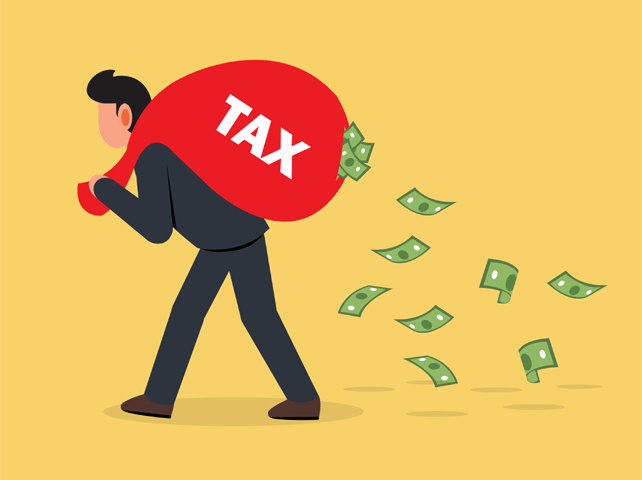
Political leadership comes from feudal and capitalist elites with an exception of Sindh’s urban constituencies. The middle and lower middle classes are represented by a mere 10 per cent legislators. As a result, the middle class virtually remains voiceless, resource-less and powerless. It has limited access to the business loans, minimum opportunities to get leading positions in the civil/military bureaucracy and is highly taxed in comparison to the rich, especially when compared to the big farmland owners. Interestingly, the landlords and farmers are provided support by the tax paid by the middle class whenever they suffer loss because of natural causes or market failures.
We need to widen the network of quality public institutions and create space for developing leadership from the middle class.