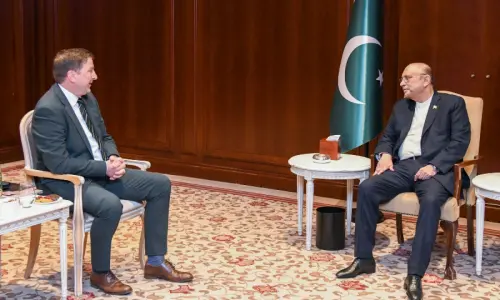
ISLAMABAD: US Ambassador Richard Olson was briefed on Thursday on how counter-productive the drone war was during his first meeting with Prime Minister Raja Pervez Ashraf.
The ‘courtesy call’ turned out to be Mr Olson’s tryst with protests over drone attacks because of the early morning US strike on a militant hideout in North Waziristan that left four people dead.
American officials quite often get to receive protests over drones that are highly unpopular in the country.
Mr Ashraf told the American envoy that “alternative means to eliminate terrorists” needed to be found out.
Pakistan and the US have long been negotiating, what is often referred to as ‘mutually acceptable solution’ to drone attacks, but have made little headway primarily because of non-alignment of their strategic priorities.
The Pakistan government has always insisted that drone attacks are a violation of its sovereignty, whereas US considers drones as a crucial weapon in its war against terrorists.
Drone is more of a political issue in Pakistan.
The politicians, through anti-drone statements, capitalise on anti-American sentiments in the country.
With 43 strikes so far, 2012 is likely to be the year with the lowest number of drone attacks since 2009. The highest number of attacks—117—was carried out in 2010.
Mr Olson promised to convey PM Ashraf’s concern to the US government.
The prime minister hoped that ties between the two countries would improve during Mr Olson’s tenure.
Mr Ashraf said that recent interactions between two countries at different levels had been very encouraging.
The envoy said the United States wanted to have a long-term relationship with Pakistan base on “mutual respect and common interest”.
He said that Pakistan’s sacrifices in the war on terror were not as much acknowledged as they should had been.