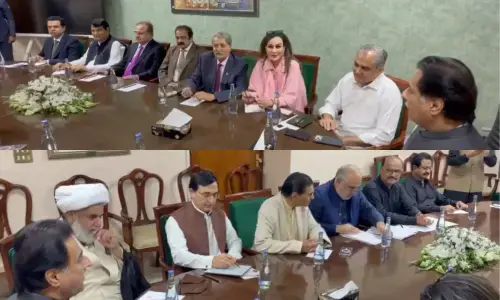
There was unfortunate irony about the words uttered at the beginning of the session to honour those literary stalwarts who have passed away. “To keep remembering its greats is the sign of great nations,” said Iqbal Lateef, who was hosting the session, to a largely empty auditorium.
Papers were read on eight literary personalities: Nazeer Akbarabadi (by Sabir Jaffery), Shamsheer Haidery (by Ayub Shaikh), Krishan Chandr (by Asif Farrukhi), Lutfullah Khan (by Fatima Hassan), Hameed Akhtar (by Asghar Nadeem Syed), Mehdi Hassan (by Arshad Mahmud), Hajrah Masroor (by Zaheda Hina) and Salimuzzaman Siddiqui (by Pirzada Qasim). By the time the last paper was being read, more than two-third of the auditorium had filled up.
Hina and Mahmud had mere narratives to offer, while Hassan read from her published work. Ayub Shaikh brought to life Shamsheer Haidery, a name not much known in the circle of Urdu readers, and Sabir Jaffery spoke more about the lack of allotted time than about Nazeer Akbarabadi. The applause he earned for was mostly in response to the couplets he quoted of the great poet.
Krishan Chandar was not part of the programme and was probably included to replace Shahzad Ahmed on whom a paper was supposed to have been read by Tehsin Firaqi. Asif Farrukhi would probably have done a better job had he known he was to talk about Chandar, but even than he spoke well, discussing Chandar through the prism of Manto: “Chandar and Ismat [Chughtai] outlived their respective peaks; Manto beat them both by dying early,” he said.
Two papers stood out — Pirzada Qasim’s on Salimuzzaman Siddiqui and Asghar Nadeem Syed’s on Hameed Akhtar, with the latter clearly stealing the show. Qasim spoke passionately about the enriched soul of the wonderful scientist: his paintings, his poetry, his command over languages and linguistics, his creativity, his wit — not to forget his commitment to scientific excellence.
Famous playwright Syed showed what a personality sketch ought to be. He had come fully prepared, was witty and never less than literary in his assertions and mannerisms. It was a paper written neither in awe nor in hostility. It was about what he saw and how he saw it. Even when he touched upon what looked like a raw nerve in Akhtar’s life, he dealt only with the outline, not with the details. Others might have preferred to skip the issue altogether, but, dramatist that he is, Syed talked about it, but still left the audience with an element of suspense and conjecture.
- Humair Ishtiaq