0
0


NEW DELHI: Cricket legend Kapil Dev remembers what it was like playing for his country against India’s bitter rivals, Pakistan, when he made his international debut in 1978: a bowler was expected to aim at the batsman’s body.
“When I played my first series against Pakistan, it did look like a war,” India’s 1983 World Cup-winning captain said during a recent TV panel discussion. “In our time, we were expected more to harm the Pakistani players than win a match.”
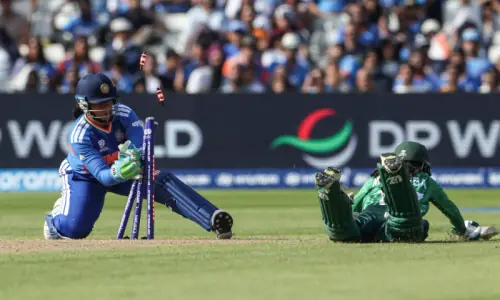
Fast-forward to 2012, and India and Pakistan are once again preparing to face off on the cricket field, playing their first series since 2008, when already brittle relations were shattered by the Mumbai attacks.
The fact that the matches are happening at all is widely seen as a sign of the warming atmospherics between the South Asian neighbours, which have fought three wars in their brief independent history and remain deeply mistrustful of each other.
Some 3,000 Pakistani cricket fans will travel to India, benefiting from a more relaxed visa regime that was agreed on earlier this month as part of a series of confidence-building measures. The teams will play five matches across different Indian cities, starting on Dec 25.
It is the latest round of what is known as ‘cricket diplomacy’ — a tradition of using the subcontinent’s favourite sport to mend relations that stretch back a quarter of a century and saw their respective prime ministers hold pitch-side talks last year.
“Politically, cricket has always been there to break the ice,” said Aamir Naseer, a Pakistani TV sports show host.
Both India and Pakistan are crazy about cricket and emotions run high whenever the two sides meet, usually in stadiums packed to the rafters and resounding with jingoistic slogan-shouting.
“The atmosphere is unparalleled,” Omer Ghaznavi, a sports analyst for City FM, a popular Pakistani radio station. “I haven’t been to another sporting event where people are so charged up.”
Such is the pressure that the Pakistan Cricket Board is sending a psychologist to help the players cope with the tour.
Former Pakistan captain Waqar Younis, alongside Kapil at the panel discussion, explained the strain players come under.
“My boys even stopped speaking to each other, such was the pressure,” Waqar said. “People dub it a war. Well, it’s certainly not a war. At the same time, it’s not just sports either. It is somewhere in between.”
New Delhi and Islamabad have used cricketing occasions to try to make progress on issues that have dogged relations since the two nations won independence from Britain in 1947, especially over the fate of the Kashmir region they both claim.
In 1987, then-Pakistan President Mohammad Zia-ul-Haq visited India to watch a cricket match. But the event was also used to defuse a crisis over troop build-ups on one of the world’s most militarised borders, meeting Indian prime minister of the day, Rajiv Gandhi.
In 2005, Pakistan’s then-military ruler, Pervez Musharraf, travelled to India to watch a cricket match, but the trip also became a summit with Prime Minister Dr Manmohan Singh and the two leaders agreed to open up the Kashmir border.
Relations are slowing improving since the attack on India’s financial capital in 2008, when Pakistani militants went on a killing spree that left 166 people dead and raised fears of an Indian reprisal against its nuclear-armed neighbour.
Festering diplomatic sores are unlikely to overshadow the cricket tour, according to sports historian Boria Majumdar.
Both countries “welcome resumption of cricket ties. They know it’s important to play and engage in trade. They know you don’t achieve anything by not playing with each other,” he said.
“Cricket badly needs an India-Pakistan series. So do the fans,” he said. “Have no illusion, a cricket series can’t herald peace between two feuding nations. At the end of the day, it’s the responsibility of the political classes.”—Reuters