0
0

The Federal Board of Revenue’s much-vaunted, but highly controversial, tax amnesty scheme has now been tabled in the National Assembly after a delay of three months.
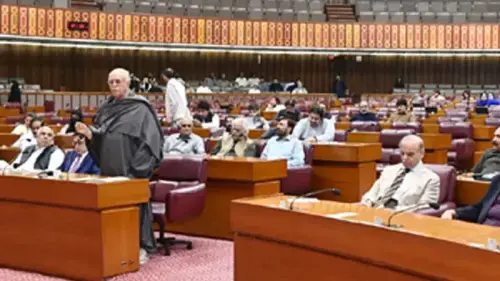
The bill which was greeted with shouts of ‘shame, shame’ by the opposition benches is generally seen as an invitation to launder money. It has now been referred to the Senate Standing Committee where its approval may face tough time and lack of consensus. Past experience of tax amnesties in Pakistan and other countries has shown that they have limited impact in terms of encouraging tax compliance and repatriation of wealth kept abroad and, as the Italians have recently demonstrated, achieves little in the war against tax evaders.
An amnesty scheme was launched during the Musharraf regime in 2000-01 and the FBR collected a sum of Rs10 billion from it.
And this was claimed to be the most successful scheme by the FBR in its history. Another scheme was launched in 2008 by introducing Section 120-A in the Income Tax Ordinance, which fetched Rs 2.5 billion only. Similar schemes were also launched during the Zia regime in 1985 and the government of Zulfikar Ali Bhutto in 1976, but did not achieve the desired results.
India dropped the idea of an amnesty scheme last year after the finance ministry ruled out such a scheme. The worry of the government was that black money is also generated through criminal activities and, if a general pardon is granted, it might send wrong signals. In the past too, at least on two occasions, there was talk of a tax amnesty scheme being introduced but Indian finance ministers stayed away from any such proposal. The government had last introduced a tax amnesty scheme — the Voluntary Disclosure of Income Scheme — in 1997-98, which had helped unearth close to Rs10,000 crore. The scheme had got judicial endorsement with the Supreme Court upholding its validity, though the government had told the court that it was a one-time measure.
The bill called the Tax Laws (Amendment) bill 2012 seeks to amend the Income Tax Ordinance, 2001 to provide a mechanism for bringing potential taxpayers into the tax net and to enforce compliance to the tax law, by giving one-time opportunity to the registered persons and non-filers to regularise their tax affairs by adopting a simplified procedure. It also covers those who did not figure on the tax roll. All of them can whiten their black money or assets up to Rs5 million and above in a period of three months.
The tax amnesty consists of two schemes, namely Tax Registration and Enforcement Initiative, and investment tax scheme. But there is nothing new in it. The current scheme, which is claimed to be different and more comprehensive and fool-proof, aims at bringing about four million tax-evaders into tax net by whitening their black money. Less than one per cent of Pakistan’s 180 million citizens, one may recall, pay income tax and nobody is known to have been prosecuted for not paying taxes in 25 years.
The amnesty was originally scheduled to be launched from October 1, 2012 but was delayed because of lack of consensus among the related ministries. Now it will be launched from January 1, 2013. According to the proposed bill, the schemes allow a tax evader to pay Rs40,000 to legitimise assets worth up to Rs5 million in the first month.
Those availing the offer in the second month will have to pay Rs50,000 and Rs70,000 in the third month. But the third month ending March 31 comes in clash with the elections date which must be not later than March 16, 2013. The FBR expects to collect Rs120-150 billion through these schemes which is seen highly unlikely.
A senior economist recently described the amnesty schemes ‘a slap in the face of the honest tax payer’. What matters is how honest tax-payers would feel when they find swindlers and smugglers being treated at par with them after paying small sums of money. Even the IMF had strongly rejected Pakistan’s tax amnesty scheme saying the tax evaders must be punished for not paying the taxes due to them. Some critics have even described the scheme as ‘financial NRO’.
It is interesting to note that by early November, the finance ministry had not received any summary of the tax amnesty scheme from the FBR. According to media reports, the finance ministry had felt offended for being bypassed by the FBR in devising such schemes on its own and then attempting to implement them through presidential ordinances. However, it did not materialise for certain reasons.
Then the FBR took another route and gave a presentation to Prime Minister Raja Pervez Ashraf on October 4 to win his approval for the schemes which it received, and then the cabinet passed them. However, the scheme did not move beyond that for some time raising speculation that it may have been dropped. The new FBR chief, Ali Arshad Hakeem, boasts of having declared war on some of the country’s worst offenders and is determined to force the rich non-paying elite to pay their taxes.
However, despite his good intentions not much change can be expected in the near future because the country’s legal structure allows too many exemptions and loopholes to certain groups, many of whom sit in parliament and are often part of the decision-making process. For instance, the income from agriculture, the largest sector, is exempt from tax.
It is similar to the exemption from taxes which was a privilege granted to the scions of those elements who helped the British in occupying and ruling the subcontinent. Pakistan’s tax-to-GDP ratio is just nine per cent which is one of the lowest global rates.