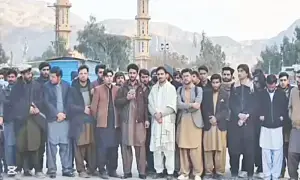
As the young Chairman of the Pakistan Peoples Party (PPP), Bilawal Bhutto, was announcing his entry into mainstream politics with a confident speech at Ghari Khuda Bakhsh on the fifth death anniversary of his mother, Benazir Bhutto, my eyes kept angling towards the more senior members of the PPP who sat cross-legged behind him on the huge stage.
The sight reminded me of a spontaneous rally that late Benazir had held in the early 1980s in Karachi during the Ziaul Haq dictatorship. I had just joined college and also the PSF, the student-wing of the PPP.
As the then 20-something Benazir defied a blanket ban on political activities imposed by the reactionary Zia regime with that rally, she was surrounded by a number of men who had served in her father, Z A. Bhutto's cabinet before he was toppled by Zia and then condemned to death in 1979 through a sham trial.
Benazir was immediately arrested and spent the next three years in jail and two in forced exile before returning in 1986 to directly challenge the dictatorship.
I was again present (as a member of the PSF) during her huge rally in Lahore that year. But this time most of the men whom she had grown up calling 'uncle' were not with her.
So when I saw Bilawal speaking at Ghari Khuda Bakhsh, I thought he was lucky to have uncles with multiple years of experience in politics that were now there to guide his entry into the tricky and slippery corridors of Pakistani politics.
Benazir was not that lucky. Yes, much of her early political training came from none other than her enigmatic father, Z A. Bhutto, but very few of her father's experienced aides were around during the thorniest and most challenging years of her career as a young leader of a party under siege from a dictator determined to wipe out the Bhuttos and their party.
It was interesting to note the side reference that Bilawal's father, President Zardari, made during his own speech at Ghari Khuda Bakhsh, in which he smilingly pointed towards the party's senior leadership and said Bilawal's uncles are not like those who had abandoned Benazir.
It can also be suggested that it was due to the gradual vanishing of Benazir's uncles that the party's youth wings and its most radical factions – that had been kept quiet by Z A. Bhutto during the second phase of his regime – came to the forefront and helped Benazir keep the party afloat in the early 1980s.
Hundreds of such men and women were arrested, tortured and flogged by the Zia dictatorship and it was the leaders who had appeared from these factions of the PPP who were able to influence party policy between 1979 and 1985.
Many of them were also in the forefront in demanding that Benazir purge those PPP big-wigs whom they accused of cowardice and betrayal in the face of the intense onslaught on the party by Zia. These big-wigs were called 'the uncles.'
Most of them had also refused to recognise Benazir as the co-Chairperson of the PPP after Z A. Bhutto’s death.

Consequently by 1986 Benazir had begun to get rid of the once unshakable uncles of the party, even though some of them had themselves quit the PPP the moment Zia began to crack his whip at the mere mention of the party's name.
This is exactly why Zardari made that comment. He was proud of the fact that most of those that Bilawal has grown up calling ‘uncle’ were still around him and watching his back, whereas Benazir was either abandoned by her ‘uncles’ or ended up chucking them out herself. Pressed on by the party's radicals, she had begun to doubt the uncles' commitment and loyalty to the party.
A majority of these men were extremely close to her father but, as the radicals within the PPP claimed, this closeness began to erode the moment they realised Zia was here to stay and that Bhutto would be executed.
Let's briefly take a look at these uncles and what happened to them ...
Maulana Kausar Niazi

A former member of the fundamentalist, Jamat-i-Islami (JI), Kausar Niazi’s thinking moved towards the left and he began supporting the PPP's populist 'Islamic socialist' agenda and joined the party before it came into power in 1972.
Niazi soon became a close aide of Z A. Bhutto and a leading member of what became the party's conservative wing.
Though abhorred by the PPP's radical left lobby, Naizi's profile within the party grew when the Bhutto regime turned rightwards in 1974 and began to purge the party's radical wing.
In 1978, one year after the toppling of the Bhutto regime in a military coup by General Zia, Niazi vehemently opposed the entry of Benazir Bhutto into politics.
He feared that the party’s radical wing would use her to regenerate itself and put the party under more stress and danger than it already was at the time of Zia's coup.
Bhutto's wife Nusrat Bhutto, leading the party while her husband was in jail, vetoed Niazi's suggestion and allowed her then 25-year-old daughter to enter active politics as a PPP leader.
Niazi along with another member of the PPP's conservative wing, Kamal Azfar, threatened to thwart Benazir's entry, but both were immediately dismissed from the party by Nusrat Bhutto.
Niazi went on to form his own PPP faction in 1978. The faction did not last long and Niazi's political career came to a standstill.
During his time in the political wilderness, Niazi authored a book about the 1977 coup, 'Aur Line Kat Gai.'
In 1990 when the first Benazir government was dismissed by President Ghulam Ishaq, Mustafa Jatoi, a former PPP senior who was eased out by Benazir in 1986, was made the Caretaker Prime Minister.
Jatoi tired to revive his old friend Niazi's political career but Niazi fell back into the wilderness when Jatoi failed to become PM after the 1990 election.
In 1993 when Benazir was re-elected as PM, Niazi reconciled his differences with her and was made Chairman of Islamic Ideology Council. But by now suffering from ill health, Niazi died in 1994. His death went almost unnoticed.
_________________________________
Dr. Mubashir Hassan
With a doctorate in Civil Engineering and an ideology steeped in radical democratic socialism, Dr. Mubashir was one of the founding members of the PPP.
He was the most prominent face of the party's left-wing and a close aide of Z A. Bhutto during the first PPP regime (1972-77). As Finance Minster he was the main architect of the Bhutto regime's nationalisation policies.
He was arrested and thrown in jail after the Ziaul Haq coup and spent almost 7 years in solitary confinement. After his release in 1984, the Zia dictatorship continued to harass him and kept him away from politics.

In 1988 when Benazir Bhutto was elected as PM, she invited Dr. Mubashir to join her first cabinet.
Mubashir declined the offer. He said he disagreed with her government's plan of denationalising certain major industries and of initiating privatisation.
By the mid-1990s Mubashir had completely fallen out with his old party and sided with Benazir's renegade brother, Murtaza Bhutto, who in 1993 had formed his own faction of the PPP.
But Murtaza's party remained to be an ineffective fringe group in Sindh, and Mubashir's political career continued to wither away – though off and on he does try to rekindle it by denouncing the current PPP government.
_________________________________
Ghulam Mustafa Jatoi
Coming from a large landowning family in Sindh, Jatoi’s politics was ‘progressive’ and he became one of the founding members of the PPP.
He was made the Chief Minister of Sindh by Bhutto in 1973 and he remained in that position till the downfall of the Bhutto regime in July 1977.
Jatoi helped Nusrat and Benazir Bhutto in forming a multiparty anti-Zia alliance, the Movement for the Restoration of Democracy (MRD), in 1981.
Though Jatoi was jailed twice by Zia, his leadership continued to come under scrutiny by party supporters and members. The PPP’s youth wings accused him of being too soft on the Zia regime and not aggressive enough in leading the MRD.
On Benazir’s return from exile in 1986, she interrogated the accusations leveled against Jatoi by PPP radicals and confronted him. Offended, Jatoi resigned from the party.
In 1987 he formed his own party, the National Peoples Party, but the party failed miserably in the 1988 election.
He then accepted the invitation to become the Caretaker Prime Minster when Benazir’s first government was dismissed by President Ghulam Ishaq.
Jatoi’s party was an ally of the Islami Jamhoori Ittihad (IJI), a 9-party outfit formed by the reactionary head of the ISI, General Hamid Gul, who wanted to keep the PPP out of power after Zia’s violent demise in August 1988.

Jatoi quit the IJI when after the controversial 1990 election, IJI chose Nawaz Sharif to become prime minister.
Though Jatoi remained in politics till his death in 2009, his party continued to shrink and its influence hardly ever ventured outside Jatoi’s hometown in Nawabshah.
_________________________________
Hafeez Pirzada
A lawyer and legal expert, Hafeez Pirzada was one of the 30 members who formed the PPP in 1967. He served as Education and then Law Minister in the Z A. Bhutto government and helped the regime to word the 1973 Constitution.
Considered to be a favorite of Bhutto’s who called him ‘Sona Munda’ (Punjabi for ‘good looking lad’), Pirzada was arrested when Ziaul Haq toppled the Bhutto regime in 1977.

He was soon released and he was then chosen to be the party’s lawyer to fight Bhutto’s case in the courts.
When Zia forced the courts to deliver the death penalty upon Bhutto (in a murky case of the murder of a politician in 1974), Pirzada registered multiple petitions against the judgment but to no avail.
Through a highly controversial trial Bhutto was delivered the death sentence and then hanged in April 1979.
Pirzada was again arrested in 1982 while protesting against Zia’s ‘Islamisation policies.’ Pirzada described them to be draconian laws that had nothing to do with Islam.
He was released on bail and decided to leave the country. He escaped to the UK where he stayed until the demise of Zia and his dictatorship in 1988.
During his exile he disagreed with Benazir on a number of issues until he was finally eased out from the party in 1986.
On his return to Pakistan Pirzada retired from politics and concentrated on being a high profile lawyer.
_________________________________
Mustafa Khar
Mustafa Khar was a young, maverick feudal lord from Muzzafargarh with a huge appetite for whiskey and women when he became a founding member of the PPP in 1967.
Though he was not part of the party’s conservative wing, he wasn’t liked by the PPP’s left wing either.
But Khar did become a close confidant of Bhutto’s who made him the Chief Minister of Punjab in 1973.
Though hailed by the party’s supporters in the Punjab as ‘Sher-e-Punjab’ (Lion of Punjab) for his unorthodox way of running the province, his ministry became a bit too controversial when he began using strong-armed tactics against his opponents.
He was admonished by Bhutto for this but this made him even more eccentric and he began to openly criticise Bhutto in public. Bhutto removed him from his post and chucked him out of the party.
Khar flirted a bit with the opposition but in 1975 he returned to the PPP, apologised and was consequently made the Governor of Punjab.
After the 1977 military coup against the Bhutto regime, he was arrested along with a number of other PPP workers and members. On his release he tried to convince Bhutto to leave the country but Bhutto refused.
Khar did not play any role in the many movements that emerged against the Zia dictatorship in Pakistan. Instead he escaped to the UK and stayed there until Zia’s demise in 1988, even though he did run a number of campaigns against the Zia regime there.
Many believe that he escaped from the country because he had planned a coup with the help of some anti-Zia officers and would have been executed by the dictatorship. He was given a 14-year jail term in absentia.
Khar had fancied himself to be the ‘natural heir’ of the PPP’s leadership after Bhutto, but was frustrated when Benazir Bhutto returned to Pakistan in 1986 and proved herself to be the top person in the party.
Khar refused to accept her as Chairperson and as a consequence was slowly pushed in the background by Benazir.
He returned to Pakistan in 1988 and joined Mustafa Jatoi’s National Peoples Party. He was then made a minister in Jatoi’s caretaker government that was installed to oversee the 1990 election after the first Benazir government was dismissed by President Ishaq Khan.
However, he approached Benazir before the 1993 election (that the PPP won) and rejoined the party.

But Khar’s position in the party was never the same as it was in the 1970s. In fact, just before the 2002 election he could not contest the election because the term of his party membership had run out. When he applied to renew his membership the party’s senior leadership advised Benazir to turn him down because they feared he was still too mercurial and would disturb party discipline. Benazir agreed and Khar was once again chucked out from the party.
Khar tried to maintain his political relevance but it was obvious his popularity had waned.
_________________________________
Jam Sadiq Ali
Whereas the PPP’s ideological engines were fueled and kept running by a host of left-wing and progressive economists, intellectuals and ideologues, party chairman, Z A. Bhutto, kept a handpicked group of men to help him maneuver his more Machiavellian politics.
One of these men was Jam Sadiq Ali, a shrewd politician and a heavy drinker. Bhutto made him a provincial minister in Sindh and Jam obliged by using the police and the bureaucracy to intimidate Bhutto’s opponents in Sindh.
Jam remained with the PPP after Bhutto’s death and tried to move further up in the party. He went into exile in the UK and became an advisor to new party leader, Benazir Bhutto.
In 1985 he met Benazir in France where she had been exiled by the Zia regime and asked her to make him the president of the party in Sindh. Benazir told him that he hadn’t played an active role against Zia in Pakistan and that he would have to wait.
Jam was shocked. How could a girl who was just in her teens when he was a minister in her father’s government talk to him like this. It was obvious that Benazir did not trust Jam and was easing him out of the party.

Jam returned to Pakistan after Zia’s death but was not given a party ticket by the PPP. Though he was made an advisor, he was soon asked to resign by Benazir.
Being a man known to keep grudges, he willingly joined the first Nawaz Sharif government and was made the Chief Minister of Sindh.
Right away he got down to take his revenge against Benazir and his old party by concocting a series of criminal cases against Benazir, Asif Ali Zardari and a number of other PPP members.
He also got the MQM onboard and exploited the party’s street muscle to further intimidate and damage the PPP.
However, a point came when his behavior became too controversial and the MQM went on a rampage, attacking journalists and political opponents in Sindh.
The military asked Nawaz to reign in Jam and to start an operation against the MQM. Jam’s 15 minutes of fame (and sudden fortune) were over when in an about-turn, Nawaz gave the green signal to the army to begin an operation against the MQM and Jam was asked to moderate his tactics.
When the military operation in Sindh started, Jam’s drinking got a lot heavier and he finally died of liver failure in March 1992.
In 1993 President Ishaq sent Nawaz’s government packing and Benazir was reelected as prime minister.
_________________________________
Mumtaz Bhutto
A first cousin of Z A. Bhutto, Mumtaz was one of the founding members of the PPP. He was made the Chief Minister of Sindh in 1972 by the Z A. Bhutto regime but was asked to step down after he failed to control the Urdu-Sindhi ‘language riots’ in Karachi. He was then made the Governor of Sindh.
Mumtaz Bhutto was arrested along with hundreds of PPP supporters and members after the 1977 military coup against Bhutto. He was then sent into exile.
In 1986, he began issuing statements against the ‘Punjabi-Mohajir ruling elite’ which the PPP disowned.
Finding himself out of the party, Mumtaz formed an alliance of Sindhi, Baloch and Pushtun nationalists and demanded that the federation of Pakistan be turned into a confederate.

He returned to Pakistan just before Zia’s death and was arrested. He was released in late 1988 and after not getting any significant response from major Baloch and Pushtun nationalists; he formed the Sindh National Front, a Sindhi nationalist outfit.
He was called back from the political wilderness to be made the Chief Minister of Sindh when President Farooq Laghari dismissed the second Benazir government in 1996.
However, Mumtaz Bhutto could not find a position for himself in the second Nawaz Sharif government that followed.
He continued to criticise Benazir’s leadership and then began attacking her husband Asif Ali Zardari when he became co-chairman of the PPP after Benazir’s tragic assassination by the Taliban in 2007.
Today he continues to run his small Sindhi nationalist party and recently struck an alliance with Nawaz Sharif’s PML-N, in spite of the fact that PML-N is a party dominated by Punjabis.
_________________________________