ISLAMABAD: Although the army generals will discuss the banned Tehrik-i-Taliban Pakistan’s (TTP) ‘peace offers’ at a corps commanders’ meeting to be held on Friday, they want the political leadership to formulate a response to the militants’ suggestion for a ceasefire.
“It is for the government to decide whether or not to hold dialogue with the militants. We are continuing with our operations geared towards eliminating terrorism,” a senior military officer told Dawn on Wednesday.
He said that although the offer was yet to be fully dissected it could be a tactical move by the militant outfit given its timing and the conditions that had been set.
“Political leaders should capitalise on the situation,” he said and referred to pressure on the terrorist group generated by the army’s counter-terrorism operations.
Militant leaders in back-to-back statements sent to the media last week offered a ceasefire if the government ‘adopted Shariat after changing the Constitution, revised foreign policy and ended its engagement with the war on terror in Afghanistan’.
TTP chief Hakimullah Mehsud, while confirming the truce proposal, has refused to disarm.
The army doubts the seriousness of the offers and sees the move as an attempt to ward off pressure, but at the same time it is shying away from rejecting them outright because of apprehensions that it may be criticised for not latching on to the ‘offers’ by those believing that the truce offer could provide a break in the violence unleashed by the TTP.
The reluctance to take a final decision on the offer partly stems from the past record of peace deals with Taliban, most of which — Shakai (March 2004), Sararogha (February 2005), Miramshah (September 2006), Khyber (September 2008) and Swat (April and May 2008) — ended in failure.
Except for the two Swat deals, which had some involvement of the ANP, the rest had been directly negotiated by the army.
Other than the poor track record of the peace deals, the dilemma for any (government) negotiator is deciding on the final goal, agenda of the talks and, importantly, whom to negotiate with. The TTP is not a unified entity; it’s rather an umbrella organisation comprising various militant groups, the officer said.
The first offer came from Asmatullah Muavia, a militant coming with Lashkar-i-Jhangvi background and currently operational head of Al Qaeda in Pakistan, while the second one was made by Hakimullah Mehsud.
“Whom should we talk to?,” the military officer asked.
It is not new for the army to pass the buck to political leadership. A national consensus appeared to be emerging in October for a decisive push against militants after the attack on Malala Yousufzai, but at that time too the military said it was for the political leaders to decide about an operation in North Waziristan and all of a sudden the consensus dissipated. A new ‘army doctrine’ framed in 2011 had identified the warfare being conducted by the TTP and other militant groups as the biggest threat to national security.
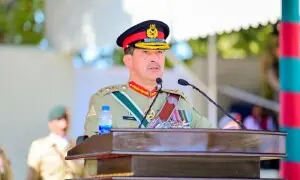
Chief of Army Staff Gen Ashfaq Parvez Kayani had articulated the new doctrine in his well-known independence night speech at Kakul. “No state can afford a parallel system or a militant force,” he said at the premier military training academy.
He also called for clarity on dealing with the threat of terrorism, warning that “otherwise, we’ll be divided and taken towards a civil war. Our minds should be clear on this”.
The ANP, which lost Bashir Bilour in a suicide attack on Dec 22 and has borne the brunt of TTP strikes against secular parties, has cautiously welcomed the talks offer.
Interior Minister Rehman Malik has shown government’s inclination to consider the offer made by Hakimullah.