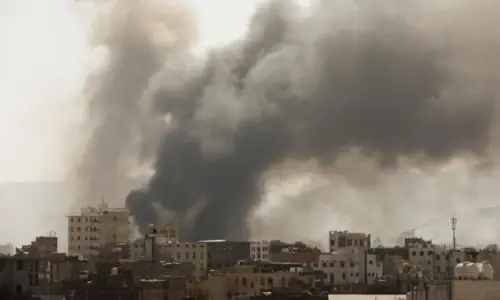
The flight had been delayed for almost 12 hours now. The passengers had already talked enough about democracy versus dictatorship, the influence of Turkish soaps on Pakistani culture and the “handlers” of Tahir ul Qadri. The waiting lounge was suffocated with vanity and everyone took turns on going out towards the runway for a gasp of fresh air. The blinking lights at the control tower were sending some encrypted messages to an unknown location. The message was beyond comprehension but the transmitted chaos could be observed. Suddenly a halo of light was seen on Quetta’s skyline. The sound of the blast took 10 seconds to reach us. Soon after, television channels were airing the tid bits of the news, much like the blinking runway lights.
This time, the crater could not be found; neither could they ascertain the location of the blast. The toppled burnt vehicles were also missing. Strangely, I could not see the charred bones and bodies which had been penetrated by ball bearings. No membrane or vital organ stuck to the soles and no splinters of pressure cooker landed in distant neighborhood. The ‘site of the blast’ also did not smell of sulphur and the place quickly became smoke-free. Even the walls were not marked by blackened lashes.
There were no half-burnt signboards, wailing women and traumatised children; neither was the air clogged with the heaviness of death. Somebody in the distant backyard talked about apparent dangers to Pakistan and critical juncture, which has now become the permanent location of the country. Ambulances moved freely and DSNG vans of news channels were yet to arrive.
Volunteers administered first aid and segregated the dead from the injured. A policeman held a cigarette in one hand and with the other he wrapped the crime scene with yellow “Stay-away” strips.
It was a snooker club. Hazaras had thought that this side of Alamdar road was the delineation of security. They could exist here (without “threatening” any religious belief) with their own beliefs and appearance. But this boundary existed in the Hazara minds only.
Inside the snooker club, when first bomb went off, everybody rushed outside. The ambulances sped up to the place and people rushed towards the life saviours. As they neared one of the vehicles, it went up in the air. This was the second blast of the day but not the first blow away Hazaras’ sense of security.
The whole scene seemed like it was out of a silent movie. Their chests were infested with needles and eyes were swollen with tears but the pain was invisible. Blood dripped and flowed but did not fall on the ground.
When I saw Idrees, I was relieved. He had taken us through the wonderland called Hazara Town during the shooting of “I am Hazara”. He led us through the narrow but clean alleys to shoot once-in-a-lifetime images and meet life-size people. In the late hours, he had told us his story. His father was an established lawyer in Quetta when it all started. They now lived in Sayedabad but his father ended up finding a space in the Hazara graveyard.
Idrees was badly injured but he too did not say a word, no threats, and no fits of rage. He did not even raise his both hands in the Karbalai tradition to say Khudaya Khair…a prayer for extremely difficult times. Holding his bleeding shoulder with one hand, he limped toward the first aid station, established by volunteers.
In the lined up corpses, I identified Irfan Ali Khudi by his curly hair. I stepped ahead but this body was nowhere closer to the energetic Hazara activist, I had met on Constitution Avenue. It was too difficult to relate to this silent Irfan so I covered his face again.
Most of those who lost their lives in the blast dead wore the same bluish look, I was told by a nine year old during visit to Hazara Graveyard. He sat by the fresh grave of his father. I asked him, “How did you find your father, then?” “With his watch, shoe and the two toe-thumbs.”
The Snooker club was a recreational spot for Hazara youth. The visitors ranged between 23 to 30 years of age. With every stroke a new pattern of dreams was designed and discarded. The hurried arrivals and the rushing departures, a cup of qahwa, awaiting mothers and tantrum-throwing fiancés in far off lands of Australia were irrelevant now. The lifeless bodies were free from all and any such bindings.
Somewhere from the memory lane, I realised I had seen it earlier; probably it was Auschwitz and sometime around 1940s, but I could not recall clearly. The shock had affected my memory.
With so many corpses and profuse bleeding, the calmness among the Hazaras was killing me. From dressing the wounds to bathing the dead, I could not find a single tear, a single sob and a single word.
Turning away from Alamdar Road, I was perplexed. Why could I not hear them cry, smell them burn and see them wail? A banner blocked the horizon. It called for Jihad against the infidels and asked for the sacrificial hides. A verse from Iqbal opened the narrative
“Keh Khoon-e-Sadd Hazar Anjum Say Hoti Hay Sehar Peda” “From the blood of a hundred thousand stars, rises the sun”
I picked up my phone to call Punjab and felt that I had lost my ear. In an abstract instinct, my index finger checked for the nasal plank, only to feel the plain skin. I then confirmed from the rear-view mirror and found gaping holes instead of the eyes. It was a moment of madness. Before I entered the house, all the three sensory organs had re-grown.
The following morning, after waking up but before opening my eyes, I felt my eyes and ears again. It was probably a disillusion.
Before seeing my psychiatrist for this delusion, I drove to Alamdar road. As soon as the car turned towards the site, I saw my eyes, nose and ears disappearing again. Tuning in the radio, the news hour had begun. Lashkar-i-Jhangvi had claimed responsibility.
The death toll had now crossed one hundred... Yak Sadd Hazara...
“Keh Khoon e Sadd Hazar Anjum Say Hoti Hay Sehar Peda” From the blood of a hundred thousand stars, rise the sun

The views expressed by this blogger and in the following reader comments do not necessarily reflect the views and policies of the Dawn Media Group.