PREOCCUPATION with domestic issues over the past few weeks should not have prevented Pakistan’s policymakers and informed sections of society from taking note of the dangerous events along the Line of Control in Kashmir.
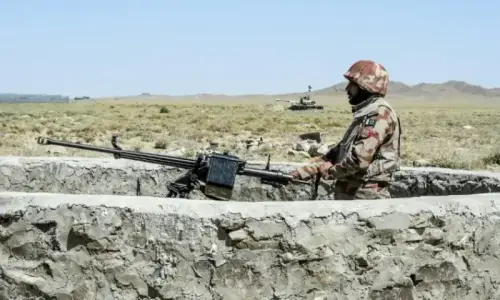
What led to the exchange of fire between Indian and Pakistan troops and the loss of life on both sides is not clear. However, it should not have been difficult to appreciate India’s anger at the reported beheading of one of its soldiers.
One does regret the two sides’ failure to set up a mechanism for the investigation of such incidents. What should have caused immense anxiety in Pakistan was the sharp reaction from the Indian leadership, especially Prime Minister Manmohan Singh’s declaration that bilateral relations had considerably deteriorated.
Fortunately, the foreign ministers of both countries are making an attempt at damage control but a more earnest effort to ease the tension is obviously needed.
Whatever the provocation, the Indian decision to suspend the visa-on-arrival facility for senior citizens was completely unexpected. It also made no sense. People on both sides had hailed the new system as the culmination of years of campaigning by human rights activists on both sides. It seemed the doors were being shut on agents of friendship and goodwill. This impression has been altered somewhat by the explanation that certain preparations for managing the new system have to be completed.
One should hope that the suspension of the new visa regime is only for a short time.
More worrisome has been the effectiveness of the hate-driven campaign by India’s communal organisations, led by the new boss of Shiv Sena, who is obviously keen to establish himself as a tougher troublemaker than his recently departed predecessor.
Pakistani hockey players were sent back home before they had time to unsheathe their sticks, the venue of a Pakistani women’s cricket match was shifted from Mumbai, a Pakistani actor was obliged to rush back home, a drama team was disallowed participation in a theatre festival and Ajoka’s performance of a play on Manto at Jaipur was cancelled (though by allowing two performances of the play in New Delhi, Indian society confirmed its valuable stock of sanity).
These incidents should not be dismissed as infantile petulance; they betray the communal extremists’ fears that cooperation between India and Pakistan in the areas of the arts, sports and culture, as indeed free travel between the two countries, will demolish the walls of acrimony they and their patrons in mainstream politics have raised after years of hard labour. This also underlines the urgency of redoubled efforts to promote deeper cooperation between the two neighbours in the cultural field.
Islamabad and New Delhi both should be aware of the challenges they face from anti-democratic and anti-secular forces in the run-up to their general elections and both need to protect whatever of substance has survived in their democratic systems after the free hand allowed to self-seekers and criminals with money bags. Indian democracy’s being more resilient than Pakistan’s seasonal experiments in democratic governance does not mean that New Delhi can afford to be complacent about the canker of communalism in its body politic. In Pakistan’s case, the battle with terrorists and religious militants has become for obvious reasons a matter of life and death and therefore it has much greater need to strengthen its defences against attacks on its constitutional order.
There have recently been signs and suggestions that Indian politicians and the intelligentsia have begun to see in the threats to Pakistan’s political system and its integrity potential risks to peace and security in their own country.
Similarly, the fact that exploiters of common people’s religious sentiments on both sides derive strength from each other’s antics is now widely known. The soundness of these formulations is manifest and no arguments are necessary to realise the need for India and Pakistan to avoid doing or tolerating anything in their respective lands that could start a cycle of action and reaction on the other side and cause harm to both societies.
Since Pakistan’s problems are quite acute, Islamabad must realise that not only neighbourly relations with India but mutually beneficial collaboration in economic and political fields has become essential for its progress, perhaps even survival.
Thus Islamabad must move beyond the point the army chief recently made when he called for a shift in the security paradigm because of the fact that the threats to Pakistan’s security from the north-west had become more serious than those from the eastern and southern sides. The sooner practical steps are taken to make the border with India peaceful without the presence of large contingents of troops, the better.
There is a clear need for the defence strategists of India and Pakistan to realise what a mess they have created by pursuing inappropriate, to use a mild expression, security doctrines, and to find ways of evolving new and rational answers to their security concerns, preferably in a broader South Asian context. Unfortunately this does not seem likely in the near future and Pakistan and India may have to spend more time on confidence building measures.
Meanwhile there is no reason for Pakistan to delay rethinking its defence strategy. The folly of depending on the benevolence of international war contractors and arms suppliers was exposed long ago and so was the misplaced faith in the capacity of the so-called Muslim bloc to keep Pakistan’s modest war machine going. The impossibility of forcing India to yield ground under the pressure of arms should have been accepted by now by commanders and footmen alike. Likewise Pakistan should have no fears of being destroyed by the Indian military. The time for such scenarios has passed.
The only possibility Pakistan should be on guard against is that a punitive strike against Pakistan may be seen by a desperate government in India as a way to ease the pressure for revival of confrontationist policies from hawks in its political and military establishments. This danger can be warded off by skilful diplomacy. The only condition is that diplomats should begin to be recognised for their ability to defuse tensions and not for proficiency in blame games or point-scoring.
It is also time to realise that Pakistan should seek security less in the size of its arsenal and the strength of its defence personnel and more in the country’s economic stability, democratic consolidation and revival of the people’s allegiance to the state. Once this view is accepted by the defence high command it will become possible for it to wholeheartedly support, possibly lead, the government’s efforts to begin a new era of peace and cooperation with India. The time is ripe for this opening to the east, for at the moment there seems to be no difference between Asif Zardari and Nawaz Sharif on the urgency of good, fruitful ties with India.