ISLAMABAD, Jan 29: “Almost 40 per cent glaciers in Afghanistan have been reduced in 40 years, whereas the glaciers supplying water to Ravi, Chenab, Beas and Jhelum Rivers are thinning,” said Dr Chaudary Inayatullah, Climate Change Expert at Save the Children.
Dr Chaudhry was speaking at a seminar, ‘Building Resilience in the Indus Basin’, on Tuesday, organised by Save the Children.
The doctor presented findings of a research study commissioned by Save the Children on climate change in Pakistan, and said that around 50 per cent of the country’s population was food insecure.
He said that temperatures were likely to increase by at least 0.5 degrees centigrade per decade with significant implications for agriculture, food insecurity and malnutrition rates that were already beyond emergency thresholds in many flood prone districts that make up the Indus Basin.
“For poor and vulnerable communities living near the Indus River, their exposure to the impact of a changing climate pushes them further into poverty and hunger,” said Dr Inayat adding that the changing environment has increased the risk of humanitarian disasters manifold for the people who rely on food and livelihoods from the mighty river.
Dr Chaudhry said that due to drought cycles — lack of rain — rivers have become drier, directly effecting food production.
“Apart from food production, the other causes of malnutrition are diseases and it has been noted that diarrhea, malaria and dengue are on the rise,” he said.
Speakers at the event suggested that the country needed to launch an aggressive tree plantation drive and the farmers should be imparted knowledge related to changing crop sowing patterns.
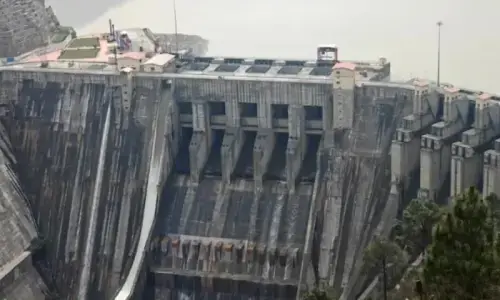
It was also highlighted that Pakistan needed small dams and water reservoirs, so that the water could be stored in case of floods and during a prolonged drought.
Director NDMA Brig Sajid Naeem, highlighting the official efforts in this regard said that the government was working to improve climate change adaptation in the country to ensure that the risks faced by millions of poor and vulnerable communities across Pakistan were reduced.
“We must all be prepared for a world which is changing,” Brig Sajid said, adding, “Pakistan remains vulnerable to climate change due to its geographic location and this vulnerability is likely to increase in the coming decades.”
The 2010 floods in Pakistan are considered to be the worst disaster attributable to climate change, so far, he said.
Over 18 million people were affected and one fifth of the country was underwater. Monsoon floods affected over 5 million in both 2011 and 2012, said Sajid.
Various studies and assessments that were presented in the seminar emphasised the need to scale up DRR (Disaster Risk Reduction) programmes in preparation for cyclical flooding which were expected to worsen in the coming decades. — Kalbe Ali