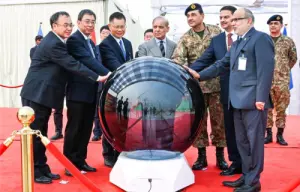
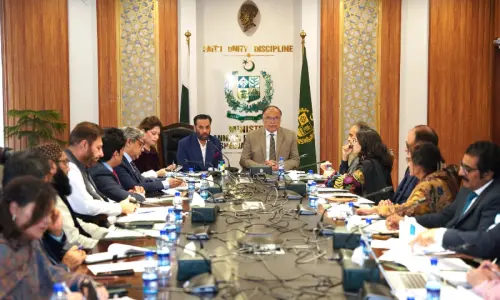
ISLAMABAD: Talks between Pakistan and Afghanistan for opening a third trade corridor through Waziristan got a fresh impetus during the visit of Afghan Defence Minister Gen Bismillah Mohammadi when the two countries narrowed their longstanding strategic differences.
The high-ranking Afghan defence ministry delegation departed on Thursday after completing a five-day visit during which they held meetings with civilian and political leadership and inspected a number of Army’s training facilities.
During his several interactions, Gen Bismillah is said to have stressed the need for finalisation of the agreement on third trade corridor, which will not only reduce the travel time and distance between Karachi and Kabul, but will also contribute to development of border areas of both countries.
“Afghans have recognised the centrality of Pakistan for peace and stability in their country not only in terms of kinetic military operations, but also with regard to socio-economic development of conflict zones,” an official said.
The third route has been under discussion since 2003, but deep-running mistrust between the two neighbours had prevented its materialisation. The Afghanistan-Pakistan Transit Trade Agreement (APTTA 2010) had provided for a third entry-exit point on the Pak-Afghan border in addition to the two existing points — Chaman and Torkham, but had deferred its operationalisation till a “mutually- acceptable date”.
The proposed third trade corridor is a three branched route originating from Karachi and ending in Kabul. Once made functional the distance between Karachi and Kabul would be reduced by some 400 kilometres. The traffic on the new trade corridor would pass through less frequently used roads and join the Indus Highway. After crossing the Indus River the route would divide into three branches entering Afghanistan in three different provinces.
The three routes will be Route-1: D.I. Khan-Tank-Makeen-Miran Shah-Ghulam Khan, and onward to Afghanistan; Route-2: D.I. Khan-Tank-Wana-Angoor Adda, and onward to Afghanistan; and Route-3: Bannu-Miramshah-Ghulam Khan, and onward to Afghanistan.
In Afghanistan, the traffic would come into the newly-constructed Afghanistan Ring Road.
“The third trade corridor is set to become a reality because of the construction of 2200-kilometre-long Afghanistan Ring Road which connects major Afghan cities and development of road network in Fata by FWO as part of the counter-insurgency operations,” an official said.
He further said: “The biggest spin-off will be the livelihood revolution and economic prosperity that this corridor will bring in the region. However, in order to draw its true dividend, security situation has to improve.”
TRAINING OF AFGHAN TROOPS: The six-member Afghan defence delegation visited various military education and training institutions, including the National Defence University, Command and Staff College, Quetta, School of Infantry and Tactics, Quetta, Pakistan Military Academy, Kakul, National University of Modern Language (NUML) and National University of Science and Technology to witness training activities.
During their visits to these centres full spectrum of training from low intensity conflict to conventional warfare, and from tactical to higher defence training was exhibited.
The Afghan delegation showed keen interest in getting their troops trained in Pakistan.
Pakistan had long been offering training facilities to Afghans, but the offers were not considered because of differences between the two countries.
The new-found Afghan interest in training in Pakistan is being seen as a major progress in relations.
The visiting delegation reportedly acknowledged benefits of training in Pakistan, including the similarity of operational environment in two countries and a better option for training of female soldiers who have been reluctant to train in other countries.