By Rajini Vaidyanathan
Amir Hamza for a modern audience

IT is inevitable, perhaps, that when talking about adventure and fantasy writing, the name Harry Potter would come up. The bespectacled wizard may have legions of fans, and a film franchise to his name, but there were only seven books in the series.
That may seem like a hefty number but pales into insignificance when set aside the Adventures of Amir Hamza (Dastan-i-Hamza).
“Harry Potter has become a cult, but this is much more than that,” said writer and translator Zakia Zaheer who was part of a panel discussing Dastan-i-Amir Hamza.
The session called “The Adventures of Amir Hamza: Dastan-i-Hamza” also had on the panel author Sayeeda Hameed and writer and translator Musharraf Ali Farooqi, who has to his credit the translation of the dastan from Urdu to English.
“The adventures have been around for at least seven centuries and first gained prominence in the 16th century,” Farooqi told the packed audience. But the challenge was to bring them to a modern audience.
The stories centre on the adventures of Prophet Muhammad’s uncle, Hamza, and emerged around the sixteenth century. They were designed to be read out, says Farooqi, because Akbar was dyslexic: “professional storytellers would narrate them to him, while illustrations were shown.”
There are more than 20,000 stories contained in a number of volumes. Just how many has been long debated. It took Farooqi seven years to translate his first book, which at 1,000 pages isn’t a complete volume.
“What you have done is a real feat,” Zaheer praised Farooqi as she held a copy of the book on stage.
The difficulty, Farooqi said, was to capture the richness of description and the ornate narration present in the original Urdu text. “To find expressions which were equivalent was challenging. I looked at older texts but none were like the Dastan,” he said, explaining that matching contemporary language to the old scripts is a tough task. “People who translate Arabic have the advantage of a classical body of text to refer to. No such body existed for this.”
So how was the task accomplished, asked his fellow panelists. Farooqi told them that he broke down phrases, sentence by sentence, but the text was unpunctuated, making this even more taxing.
The diverse nature of the books was also discussed. They have humour in many places and a passage centering around the exploits of a sorceress called Gulchi was read out to the audience, raising laughs.
The racier side of the books was also debated. “There’s also a lot of robust sexuality in the book, with love making depicted blow by blow,” explained Hameed. “I don’t know how you dealt with it,” she told Farooqi.
“That’s what brought people to the book, time after time,” suggested Zaheer. But as well as these elements, the enduring theme of the book is classic tales of adventure, ones which the panel and the audience felt bettered modern-day Harry Potter.
So how do you expand the reach of the stories, now they have been translated into English, asked some?
Farooqi told the crowd that he has been contacted by filmmakers, graphic illustrators and animators who all want to turn the book into something for the screen. A cartoon is in its advanced stages, as well as an audio book, he revealed. He is also working on a version for young adults and a simplified version of the book for children, enabling all age groups to read the Dastan. “It’s the most fascinating tale for centuries,” said Zaheer. “We were all raised on these books.”
Judgeing by the interest in the session, it’s fair to assume these tales will continue to be devoured, not just by those who can understand Urdu, but scores of other readers too.
‘Arab literature’: does it exist?
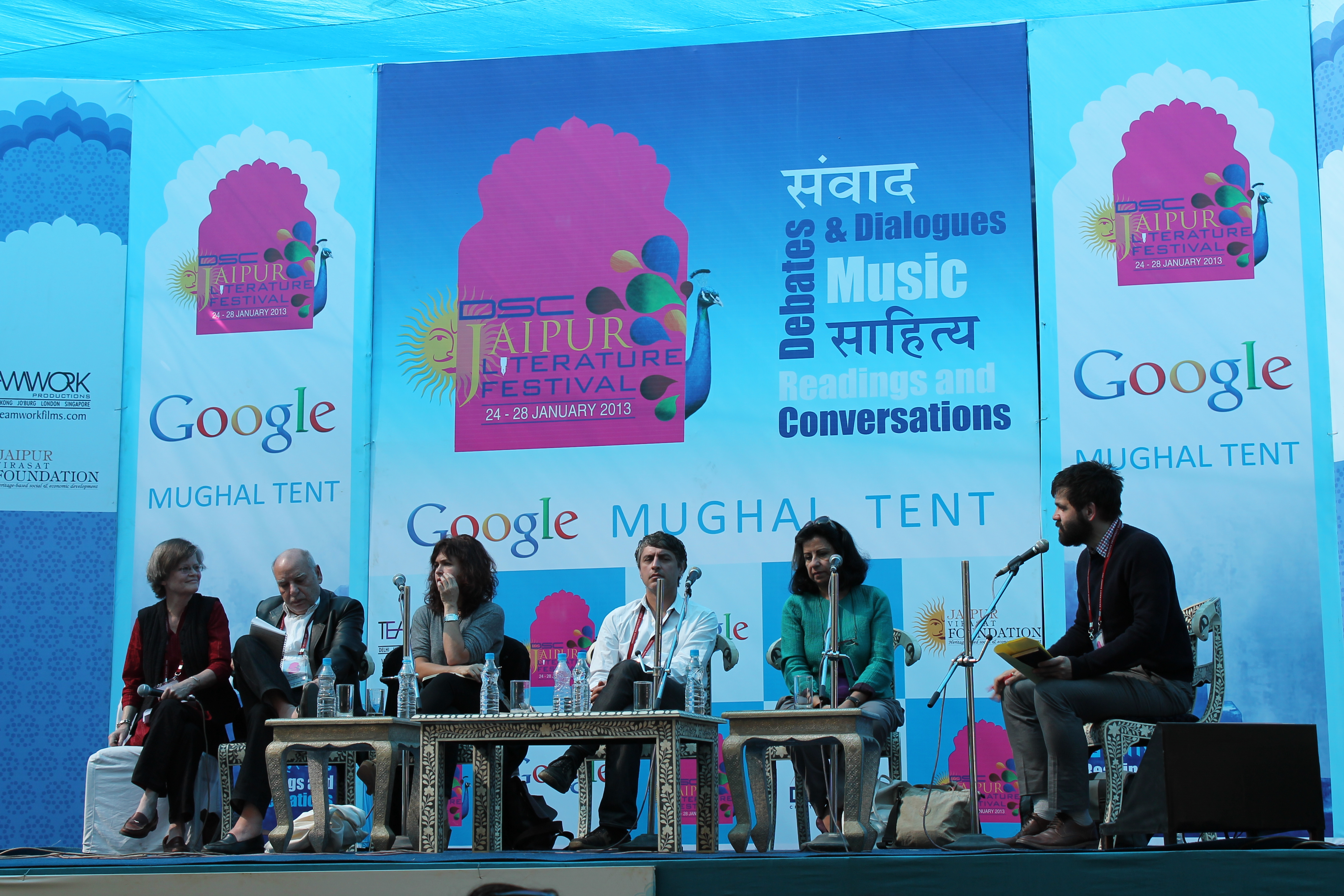
Just what is ‘Arabic’ literature, and is it even sensible or correct to categorise writing from so many different nations under one banner, asked the session “Maps of Love and Hate: Nationalism and Arab Literature”.
The panel of writers from different corners of the world was well qualified to offer their take: Tahar Ben Jelloun, the celebrated Moroccan-French writer, Ahdaf Soueif, an Egyptian writer, Selma Dabbagh, a British Palestinian, and Iranian-American writer Reza Aslan. This geographical spread made for a lively and interesting debate.
Is Arab literature just a conveniently named category in a bookshop, asked panel moderator Jonathan Shainan, who edits India’s Caravan magazine?
No, argued Ahdaf: “There is an Arab literature, which has been written from prehistoric times. It’s a literature that’s aware of itself as ‘Arab literature’,” she explained. Writers in Egypt are well aware of poetry in Morocco, and other Arab nations, she said as an example of this. However, the form of novel has been heavily influenced by the West. “The novel as an art form in Arabic was born from the novel in the West,” she said.
But in today’s globalised world, how do you define what Arab literature is, asked the panel?
Selma Dabbagh is the perfect example of a hybrid writer. She holds a British passport and writes in English, yet her subject matter is Arab issues. “The fault line depends on what you’re writing and what you’re concerned with,” she said.
Dabbagh argued that it would be refreshing if novels were categorised in ways other than by the nation state. For example, books written about families, being seen as ‘family’ books, rather than the critic digging further to discover the ethnicity of the writer.
This was a point further expanded by Jelloun, by far the most entertaining and humourous member of the panel. His words, and wit, stole the show. “You always write from the exterior,” he said, when asked about the sense of belonging a writer has to a nation, or language. “The writer is always in exile, even when he’s at home.”
“My homeland is my language and you’re allowed to have several homelands,” Jelloun continued, jokingly adding, “I’d love to be Indian also,” as the audience clapped in approval.
Jelloun argued that all too often Arab writers are expected to write about Arab problems and that the notion of one Arab world, writing one type of fiction, is unwieldy. “The Arab world doesn’t exist. There are so many countries, they’re not unified and they’re fighting each other. They have classical Arabic in common but most normal people don’t understand classical Arabic,” he said.
But for Ahdaf Soueif, there are some motifs which are common across Arab literature, and which can be found in the category. “One common theme is the fight against colonialism, which is a theme in the Arab novel.”
Yet Soueif cautioned against using too many measures to strictly define the genre, because any type of fiction could fit into any category. “The Mill on the Floss could be an Arab novel, or Middlemarch, if you say that they’re all about finding a voice or a place.” Ultimately, argued Soueif, Arab literature is about writing a good novel or poem, not about where it fits on a bookshop shelf, in a debate, or otherwise: “If you’re writing in Arabic or in an Arabic country, your primary concern isn’t about how your country is represented in the West.”
It was a sentiment echoed by Aslan, who said the focus of a writer is to tell stories, and that any agenda, or theme can get in the way. “Stories are about people, not events. The only thing that has the ability to break through what separates us, is story,” he said.
“If it breaks through, it doesn’t matter what God we pray to, or where we live.”