0
0
TOKYO: Japanese Prime Minister Shinzo Abe urged China on Wednesday not to stoke tension over disputed East China Sea isles, a day after Japan said a Chinese vessel directed radar normally used to aim weapons at a target at a Japanese navy ship.
A Chinese government spokeswoman said she was not aware of the details of the incident, and focused instead on China's stance that Japan should stop sending its ships into what China considers its territorial waters around the islands.
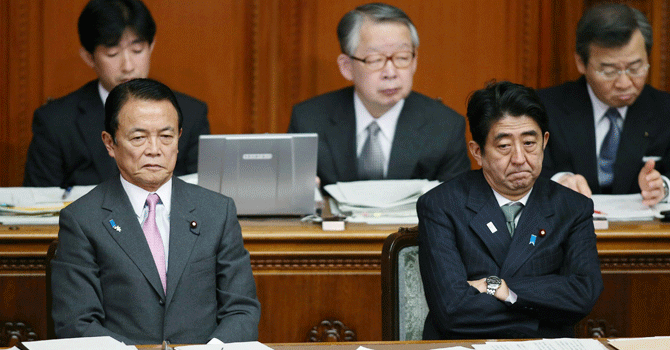
“The incident is a dangerous conduct that could have led to an unforeseeable situation. It is extremely regrettable that China carried out such a one-sided, provocative act when signs are emerging for dialogue,” Abe told parliament.
“I ask the Chinese side to return to the spirit of mutually beneficial, strategic relations and prevent the recurrence of an incident like this. I strongly ask them for restraints so that the situation will not escalate further.”
Fire control radar is used to pinpoint the location of a target for missiles or shells. Directing the radar at a target can be considered a step away from actual firing.
The radar incident, which Japan said took place in the East China Sea on Jan. 30, came days after Chinese Communist Party chief Xi Jinping told Abe's envoy that he was committed to developing bilateral ties.
“I have seen the reports but I don't understand the details of the situation,” Chinese Foreign Ministry spokeswoman Hua Chunying told reporters.
“In recent days, Japan has on many occasions deployed aircraft and ships and illegally entered Chinese waters around the DiaoyuIslands. China has made representations on many occasions and requested Japan stop its illegal activities.”
Relations between Asia's two biggest economies deteriorated sharply when the Japanese government bought the islets, called the Senkaku in Japan and the Diaoyu in China, from a private Japanese owner, in September, igniting protests across China.
The island row has in recent months escalated to the point where both sides have scrambled fighter jets while patrol ships shadow each other.