Weekly Classics: Shatranj ke Khilari
One of the masters of world cinema is undoubtedly the great Bengali film director Satyajit Ray who, along with Akira Kurasawa, put Asian film making on the map. The Japanese movie making titan put it best himself when he said, “To not have seen the films of Ray is to have lived in the world without ever having seen the moon and the sun”.
High praise indeed, especially coming from a man who was regarded by critics and audiences alike as the great Asian filmmaker. Although Kurasawa may have won more plaudits in the West, Satyajit Ray did manage to hold his own and could rightfully take his place alongside the Japanese director.
Ray was a poet and intellectual who came from a rich literary culture that left its mark in the arts. A tall man (he was 6’5 in height) with a towering presence, his eye for realism and attention to detail in period films, was uncanny and brilliant. He was inspired by French filmmaker Jean Renoir and Italian neorealist director Vittorio De Sica’s 1948 classic ‘Bicycle Thieves’. This movie encouraged Ray to make his first landmark film ‘Pathar Panchali’. It won numerous international awards and was the first film in his famous ‘Apu Trilogy’.
Although in his later years the standard of his films was not at the same level as those he had made earlier, nevertheless his reputation as a visual poet was undiminished. He understood the culture and history of the sub-continent and criticised its faults in a manner that did not denigrate it, but presented it as a unique anomaly.
One his best films in earlier years was ‘Jalsaghar’ (1958), the story of a land lord indifferent to a world changing around him, who preferred music to the responsibilities a man in his position had to perform. This was a theme that he returned to again in ‘Shatranj Ke Khilari’ (1978).

Based on a story by Munshi Premchand and set a year before the uprising of 1857, it’s a window into a bygone era that is shifting, which the protagonists of the film refuse to accept or simply wish to escape from. The Nawab of Awadh, Wajid Ali Shah (Amjad Khan) is a master of puppets who has been placed into power by British imperialists after having signed a treaty. The Nawab is a weak ruler and he knows it. Not interested in being a strong man at the helm of affairs, he prefers the arts and a leisurely hedonistic life. An unaccountable lifestyle may be appealing to many people but when one is the king of many subjects, you can’t afford it. This holds especially true when those same British imperialists wish to directly annex Awadh, after deciding that its effeminate Nawab has outlived his usefulness.

While this political change is taking place, two landlords living in Lucknow, Mirza Sajjad Ali (Sanjeev Kumar) and Mir Roshan Ali (Saeed Jaffrey) are even more oblivious to their surroundings than the Nawab. Being born in the lap of luxury has its advantages in terms of personal comfort, but it does no favours to building character amongst the feudal ruling elite. The two landlords simply live off the wealth of their ancestral lands and are obsessed with the game of chess, which turns out is not the only thing they have in common. Both are also married to women who are sexually neglected due to their husbands’ love of chess.

Mirza Sajjad Ali Shah’s wife is the feisty Khurshid (Shabana Azmi) who on one occasion does manage to lure her husband away from the chessboard and into their bed chamber, for a brief period of intimacy. Sadly for her this is short lived as he soon leaves her company and goes back to playing the game. It seems his love of chess pieces is stronger than his basic instincts.
Mir Roshan Ali on the other hand is not the sharpest tool in the shed, and his love of chess and constant absence is exploited by his wife Nafeesa (Farida Jalal). Instead of mourning the absence of the dim Mir Roshan, she uses it to indulge in a love affair with his young nephew (Farooq Shaikh). When finding his nephew hiding under his bed with the help of his wife, he foolishly believes the lie fed to him that he is hiding from recruitment orders to join up in the army for the coming showdown with the British.

Being a coward, Mir Roshan decides that he and Mirza Sajjad should hide in the country side and continue playing chess there, in case they are called up as well to serve in the army. Mirza Sajjad after being told the facts realises that his chess companion is a fool, but decides to go with him as well, because he wants to play the game as well.
Meanwhile the gutless Nawab of Awadh, after an initial burst of bravado, decides that he will allow the British to annex his territory rather than put up a fight. In one of the best scenes in the film, like a sad a pathetic figure, he sings a musical text (thumri):
“As we leave our beloved city of Lucknow, see what we have to go through,”
All the while the sun is setting on the horizon, symbolising for him that his time is up and the house of cards that he has lived in has now collapsed.
In the end, the Nawab relinquishes his crown to the British East India Company, lets them march in and take over. The two landlords Mirza Sajjad and Mir Roshan on the other hand, continue to play chess, oblivious to the fact that they and their people have been checkmated at the far more tangible game of life.
Satyajit Ray used the symbolism of chess brilliantly in this film. He used it as a metaphor for the bad judgments and unwise decisions that the losing side makes. Demonstrating the margin for mistakes, but repeat history, and the game is over. The king will be checkmated after his pawns have been disintegrated.
There has been some criticism made about this film. Some have said that the film advocates a view that the reason the British were able to colonise India was simply the fact that the people of the sub-continent put away their swords, and indulged in artistic pleasures and debauchery, instead of fighting. Others have said that Ray destroyed the patriotic essence of Munshi Premchand’s story in order to give the film a universal appeal. It’s more likely that Ray did not intend to kill the nationalist sentiment of the narrative, but preferred to criticise the inadequacy and indifference of the ruling elite. The elite were apathetic, outdated and not up to the challenge of political chess, which in turn allowed a calamity such as the colonisation to take place. In essence that is the message that Ray was trying to convey, which is faithful to Premchand’s story.
Rudyard Kipling may have said that ‘East is East and West is West, and never the twain shall meet’, but Ray begs to differ especially with the Eastern and Western actors that he uses in this film.

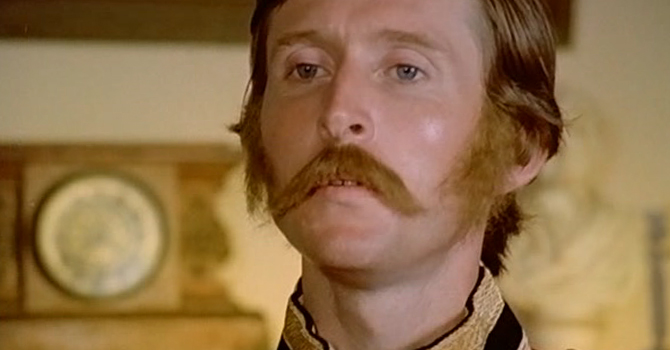
Amjad Khan, Sanjeev Kumar, Saeed Jaffrey, Victor Banerjee along with Shabana Azmi, Farida Jalal and Farooq Shaikh are all superb in this film. The lion’s share of screen time may belong to Sanjeev Kumar and Saeed Jaffrey, but the others do leave their mark in the limited period of their performances. Amjad Khan may be best remembered as Gabbar Singh from ‘Sholay’ but his role as the weak and incompetent Nawab Wajid Ali Shah, shows that he not only had range but was capable of pure genius.

Richard Attenborough, as the main Western actor, was also very good as the arrogant yet somewhat decent General Outram, who like a conquering Caesar marches into the Nawab’s lavish residence and cuts him down to size, showing in essence who was the real master in his land. Tom Alter, the Indian actor of American origin, is most intriguing in this film. In his role as Outram’s interpreter, his Urdu is more spot-on than the British accent that he tries to get his tongue around. Kudos to him as well for the fine job he does.
This was one of only two films Satyajit Ray made that was not in the Bengali language. Like most of his films, the pace of the film is slow and may not appeal to everyone, but have a look, because it’s a great piece of film making from a master film maker.
View Dawn.com’s weekly classics archive here.
Raza Ali Sayeed is a journalist at Dawn.com and can be reached at rsayeed1984@gmail.com










great write up. however i have one correction to make.!857 was called uprising by the British. For us Indian it was the First war of independence.
I watched this movie long long back, I still recall it as very good movie however after reading the analysis cum commentary in this article I want to see it again. All these nawabs were and their offshoots still are pathetic, this breed of sub continent along with their cousins, kings have brought nothing but tragic misery and destitution that we see all around us. Tragedy multiplies hundreds of times when we see that some people still find heroes among these and empathize with them.
Raza, Its one of my favourites.I appreciate your choice of this movie. I am from Awadh and the authenticity of the dialect used in this movie is flawless. Also I agree the director has shown the true picture of the puppets of those time . The protagonists (Sanjeev Kumar and Saedd Jafari) has acted remarkably well.
Every detail has been taken care of in this movie.Elites in the movie speak urdu among themselves but general public speak Awadhi and and when elite talk to ordinal public they speak in Awadhi.
It was foolishness to fight British at that time,the Nawab had his life and some of his properties saved by accepting the treaty.See what happened to people who fought against the British many people were defeated and killed in the battle field example Tippu Sultan. Contemporary and Hypothetical example would be Pakistan fighting against America a war for not agreeing to Americans using Drones inside Pakistan’s NWFP on Pak-Afgh border .
My dear friend, Tipu Sultan (my Hero) was killed, becuase of traitors in his own ranks. This is unfortunately a repeated story in our sub-continent, particularly in Pakistan. It is always a very thin line between bravery and foolishness. Fighting for your moral principles may seem foolish to many, but not doing it in right time results into slavery of the whole nation.
By the way: Pakistan is fighting against America and against Talibans. We can (and should) win these wars by using both mind and soul. I can not imagine that groups who stop the polio vacination for the childern in my country are less dangerous than Drohns!
This fim was released decades ago, why are u reviewing it now?
Many thanks for this excellent review. I wonder if there are any left in Pakistan who still grieve over their exile from Lucknow. The city is poorer for their absence. And many in India are still as easily carried away as ever by the heartfelt and exquisite elegiac melancholia of ‘Babul mora naihar chhooto hi jaye’.
Lucknow is now a different city , immigration from eastern UP has changed the language demography & culture of the city. My ancestors migrated to Lucknow from Kashmir nearly 200 years ago and I grew up in the old city (Aminabad). I can hardly relate to the city now
That generation is dying slowly!!
Good. A lessen in recent history. This film must be shown to all school kids in the Indian sub-continent.
kabhi kuch pakistani filmo kebaare mein bhi likha karo be..
Thanks much for a fine commentary on a great movie. I in particular enjoyed the chaste language spoken. I never knew who Tom Alter was but I was amazed at his Urdu ( or Hindustani as it was known then) diction.
I want to comment on one aspect that you have perhaps knowingly left out. The music! In particular, there is a song, danced by a Katthak dancer -I think choreographed by none other than Birju Maharaj. The music of the movie too is directed by Satyajit Ray. I loved the composition so much that I extracted the song as an mp3 file from a youtube video. That song is a testimonial to Ray’s genius: movie making, painting, photography, art direction, writing and finally music – both western and Eastern. I am not sure there are that many people that were as multi-faceted as him. Ah…he had a great voice too and spoke English with both a fine accent and diction….so it is a pleasure to listen to him as he speaks to Shyam Benegal, who incidentally was influenced directly by Ray.
Very well-written article. But I can’t agree that Ray’s later works were of less high standard. Some of his greatest works were towards the fag end of his life. Ghare Baire – a very complex story around freedom fighters, the landlord, the women in the household, the hypocracy around each, is worth mentioning. Also the movies Shakha Proshakha, and Agantuk are masterpieces. Ray’s children movies have stuck as epics in Bengal through decades.
One of the many beautiful works to have come out of India over the past Century. I hope we get to see more cerebral film making in the future from our Indian friends.The young crop of film makers from Pakistan need not look too far for inspiration!
Thanks to Dawn for the story on Ray. Satranj Ke Khilari is indeed a masterpiece. He had written many short stories some of which have been made into movies by him and others. Interestingly, it is believed that Steven Spielberg made the movie ‘ET’ after getting the idea from one of Ray’s stories. Ray drew the ET in his story that resembled Spielberg’s ET too. Ray made a short run (movie) of it for Columbia in Hollywood that never saw daylight. It is believed that Spielberg got hold of it. He did not confess though.
‘Shatranj ke Khilari’ ke jabab nahi! Kash, aishe picture aaj bhi buntey.
I agree Altaf.
Great movie. Very pertinent for the presnt times
The movie is a superb reflection on the incompetence of rulers in the Indian subcontinent. Today the same people are engrossed with real and dangerous chess games – persistent conflicts (religious, ethnic, and sectarian). Just like the characters Mirza Sajjad Ali and Mir Roshan Ali, they are oblivious of changes in the real world. They always commiserate that Western powers are jerking them around.
The British managed to conquer and rule the Indian subcontinent for over two hundred years due to the gross incompetence and backwardness of the Mughal rulers. People in the subcontinent must cease to explain away the domination of the British by pointing out they (British) had superior military technology – a lazy explanation. They must acknowledge that they had inferior military technology – a hard explanation. In other words, they need to update and modify not only their military technology, but also everything – that means a lot of hard work. Using bombs to destroy buildings and killing people is easier.
In the 1950s, Mao Zedong of China came up with the Great Leap Forward program with the objective of catching up with the West. Mao realized that China has fallen back and that he needed to take concrete steps to rectify the problem. The program failed, due to a highly centralized economic system (Marxism), but at least they tried. Later, with the introduction of free enterprise and open market, China succeeded beyond the wildest expectations.
Disagree… to cut the story short read “The last Mughal” by William Dalrymple and see how cunningly the British capture India.
Yes you are right, they used to pit one ruler against other!! and used mostly indian soldiers and forces to control India. They played on the regional insecurities!
Very good write up. This movie came out when I was in school in Calcutta, and I never got to see it. I certainly am going to do it now.
Nice review. Makes we want to see the film again. The clips were a nice reminder.
I liked the role of Shabana AZMI his suffering , frustrated wife.
Masterpeice indeed!
The Chess player is a movie with layers upon layer of complexity and depth. The reviewer has reduced this absolutely masterpiece to a mere recipe for cooking. The reviewer was more excited to associated Amjad Khan to Gubber Singh than to mention his eloquent soliloquy during the climax of the film. The reviewer also most abashedly ignored the satirical introduction by non other than Amitabh Bachnan himself. Amitabh’s tone and Urdu was superb. It was marvelous to hear him read and satirize the ruling elite and the danger posed by the British. Another more important scene that the reviewer most skillfully left behind was the dialogue with Munshi Ji who sums up the whole idleness and complacency that entrenched the Indian Muslims. Here, the dialogue is at its most refined and elegant when Munshi Ji defines the different sets of rules for playing Chess between the West and the East. Perhaps, it is best to cultivate your mind by watching the movie itself. Personally, The Chess Player is one the absolute great films I have ever seen which include Dark City, The Decalogue, Lawrence Of Arabia and Wild Strawberries.
And not to forget the wonderful thumri. This film is truly a gem.
Thanks dawn for the article. I am a great fan of this movie and watched it many times. What I remember the movie is for excellent Urdu dialogue between Saeed Jafri and Sanjeve Kumar, their Lucknawai urdu is a treat to the ear. If you have not seen it, try to dig it out and watch a masterpiece of Indian Cinema. Pure Delight
I have seen this movie. Really a treat to watch. No doubt Satyajit Ray was the best film maker subcontinent has ever produced and we are proud of him. What happened to Indian cinema? why such movies are no more produced?