4
4

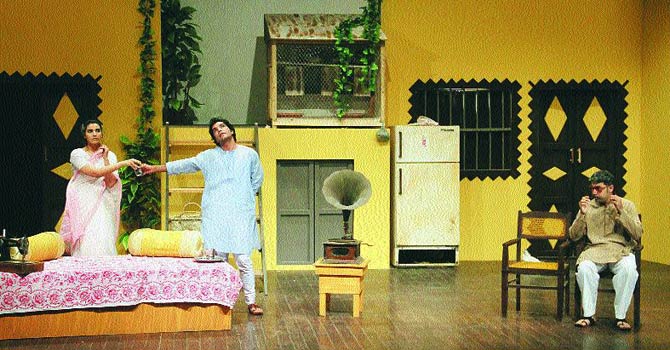
KARACHI: It is no joke recreating a classic comedy series to give it the shape of a stage play. It requires a great deal of skill, planning and most of all courage to even entertain the idea.
It would be an understatement to suggest that Aangan Terha was one of the classiest, if not the classiest, of all comedies to have been produced on Pakistani national television.
It hit the airwaves in 1983 and after three decades those who had seen it have not forgotten the stock characters, and the one-liners masterfully penned by Anwar Maqsood, which were so integral to the play. It would not be incorrect to claim that director Dawar Mahmood’s theatrical interpretation of Aangan Terha, which began in the Arts Council auditorium on Friday night, lived up to its reputation and proved just as hilarious and meaningful as its television version.
There’s much to like about the play. For starters: the music. The moment curtains are drawn we hear the same light-hearted soundtrack used in the beginning and end of the 1980s’ TV series. It immediately connects the audience to the era when life did not move at the speed of light.
The principal characters, Mehboob (Talal Jilani), Jahan Ara (Hareem Farooq), Chaudhry (Sajeeruddin) and Mehboob and Jahan Ara’s namby-pamby servant Akbar (Yasir Hussain) make their appearance and do not take long to get into their own. It’s amazing how all of them sound almost like actors Shakil, Bushra Ansari, Arshad Mahmood and Salim Nasir (original cast members) and yet maintain their distinctness. Especially Yasir Hussain as Akbar throws his typical tongue-in-cheek jibes at Jahan Ara and Chauhdry sahib using the ebb and flow of dialogue delivery quite like the late Salim Nasir (extending the vowel in the verb ‘hai’). When Chaudhry reveals that he intends to contest election against Mehboob, Akbar advises him to join a certain Karachi-based political party because ‘yeh waqt se zayada khof ka taqaza hai’ (it is more to do with fear than vagaries of time).
The bantering between Jahan Ara and Mehboob is delightful and touches on sensitive subjects (such as the couple being childless and financially challenged). When the unmarried Chaudhry and Mehboob discuss politics, at one point the former says ‘sawal hi paida nahin hota’ (no such question will arise) to which Akbar responds ‘aap donon ke ghar mein sirf sawal hi paida ho sakta hai’ (only a question can be born to both of you).
To overcome their financial woes (and to get his wages to the tune of Rs 130,000) Akbar comes up with the idea to rent out one of the rooms in the house. This makes an assortment of characters (a journalist – Bilal Yousufzai ––, an Urdu poet –– Wassam Wahid –– and a morning show host –– Sana Khan Niazi) introduced into the play.
They get so much bugged by the zaniness of the principal characters that they run away from the house before completing their tenancy period. The inclusion of the feisty morning show anchor lends an air of contemporariness to the drama. Her silly gestures point to the inanity that is these days associated with TV personalities. At one point she tries to entice Jahan Ara, Chauhdry and Mehboob to appear on her morning show on which ‘marriage’ is the theme. They will have to dance and will be paid per thumka. This prompts Akbar to count how many thumkas they’d need to accumulate an amount worth his so-far-unpaid salary.
The characters of Chaudhry’s sister Sultana (Nurjis Jafri), her second husband-to-be Colonel Barkat (Nazar Husain), Jahan Ara’s mother (Zahra Vayani) and the classical musician from Gujarat (Nazar Husain) add flavour to the scheme of things. The scene where Chaudhry hides in a takht to evade the colonel with his left arm flailing outside and Jahan Ara’s mother on top of the takht is a hilarious one and borders on decent slapstick.
Towards the climax when Jahan Ara’s mother orders Akbar to leave the house and Mehboob and Jahan Ara are unable to stop her, the mood of the play changes but only for some fleeting moments. Here Anwar Maqsood intelligently hints at how the likes of Salim Nasir and Moin Akhtar are forgotten in a society for which the phrase out-of-sight, out-of-mind holds true. In an earlier scene Akbar touchingly remarks, “Main mar gaya to mujhe koi yaad bhi nahin kare ga’ (nobody will remember me after I’m gone) subtly insinuating how the services of the great Salim Nasir have been overlooked.
Literature and politics have their fair share in the script. Chaudhry’s murdering of Ghalib’s couplets –– ‘Aik shakhs ke tasawwur se raa’naai thi/ Where is he or she’ had Akbar reply, ‘Ghalib ka masala she tha he nahin’ (Ghalib was fond of women). In terms of politics, in one sequence the morning show asks Akbar if he could translate into English ‘Kia main ja rahi hoon’. Akbar responds: ‘Are me going.’ Mehboob chimes in with the line ‘hamare mulk mein are me [army] sirf ati hai, jati nahin’ (the army never leaves the country’s political landscape).
All the actors did a superlative job and must be praised for not only acting well but also for understanding the nuances of the script. Anwar Maqsood does not have to prove anything to anyone, but it has to be said that when it comes to meaningful humour, he is second to none.
Credit must also be given to the director of Aangan Terha, Dawar Mahmood. Apart from doing justice to the writing and acting, he nicely used the lighting, the set (with a pigeon coop on the upper floor) and the music to create the ambience that suited the concept of the play.Hareem Farooq blossomed in the scene where she’s eager to give an interview to the journalist and in the process rattles off her life journey like a crazy woman. Since Yasir Hussain had a majority of the zingy Anwar Maqsood lines to say, he’s the centerpiece of the play. He had the audiences in stitches whenever he appeared on stage.