0
0

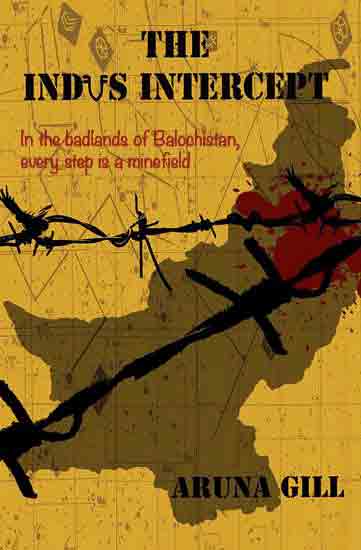
Spy fiction has always had its villains — scheming Russians, evil Nazis, shadowy conglomerates and all kinds of people gone wild. Now that the communists have been replaced with dastardly Muslims (and their nukes) as the proverbial bad guys, it is inevitable that Pakistanis have started to feature in spy novels. Of late, Pakistanis have made an appearance in Washington Post columnist David Ignatius’ novel Bloodmoney and now in The Indus Intercept.
Aruna Gill, the author of The Indus Intercept, deserves an A for effort. Gill has managed to single-handedly include in her novel every single cliché, stereotype and badly sourced news report about Balochistan that has been produced in the past decade. That is perhaps the kindest thing one can say in the author’s defence, since The Indus Intercept doesn’t have much going for it.
The novel is set in Balochistan in 2003: a province overridden by spies, overshadowed by the war in Afghanistan and under a regime that perpetrates atrocities on its people.
Over the course of The Indus Intercept, the author offers a whirlwind tour of the province, from the Brahui Mountains to the Serena Hotel in Quetta. The central character — Mir — is an imposing figure and the head of Sobani Balochistan, described as a little-known group. Fourteen pages in, we’ve already figured out one key motivator for him and an account of him closing in on one of his targets.
Sobani Balochistan’s goals are never made entirely clear: so far, we learn that the group has only been attacking the Frontier Corps and military officers, and seeks support from (here’s a nod to the conspiracy theorists) the CIA and RAW.
There’s another host of characters thrown in: a professor sympathetic to Mir’s cause, his niece, who is documenting indigenous music and folklore, her American boyfriend, two members of Sobani Balochistan, Raheem and Nusayba, and a slew of ambitious CIA and RAW operatives. The spies are all angling for promotions, fond of whiskey, and often so incompetent that even Raymond Davis seems like James Bond in comparison.
It’s a complicated mess, made worse by Gill’s tendency to provide ‘context’ akin to background information found in foreign press reportage or wire agency copy. Addresses are provided in minute detail, and there’s even a pop culture reference: “[Mir’s] own fighters preferred the pop hits of Sajjad Ali and the Sufi rock of Mekaal Hasan.”
Since the book is clearly ‘inspired’ by news events, the injustices, murders and enforced disappearances in Balochistan that could have made for poignant storytelling (as was the case in Mirza Waheed’s exceptional debut novel, The Collaborator) are missing from The Indus Intercept, save for the odd throwaway reference to the “Punjab-dominated” army or Baloch chieftains in Mir’s diatribes.
The dialogue doesn’t fare any better. CIA operatives discuss current news developments and have abstract arguments about America’s role in Afghanistan or discuss Maulana Fazlur Rehman. The author drives home points repeatedly. If we hadn’t already understood Mir’s motives, for example, he tells the professor as he leaves him that “you are very much in my prayers as I fight for our people’s freedom.”
The real — and rare — bit of storytelling is not in Mir’s character development or his group’s struggle but in the portrayal of Nusayba’s character, who Mir recruits and places in a courtesan’s house in Islamabad to elicit information from government operatives. Raheem, who struggles with his love for Nusayba and his commitment to Mir, is also well-written.
Unfortunately, mentions of this relationship are few and far in between since Gill is hard at work explaining every last political nuance.
Mir, on the other hand, is steadfast, calm and collected: even though his personal life is ripped apart he works his way through negotiations with the CIA and a quid pro quo deal with RAW, organising the group, and collecting intelligence.
The book descends into a meleé midway, with each character crisscrossing all others, plots on either side of the Line of Control and a code written in a script last used in the Indus civilisation. Throats are slit, arms are handed out, kidnappings are pulled off without a single hitch (or ransom demand) and Mir’s well-laid plans and strategies begin to blow up in his face. We are treated to plots that have little connection to the issues in Balochistan and a love angle as old as the hills — of a girl being saved by a knight (or a CIA spy, in this case) in shining armour (on a mule).
In what is supposed to be a spy novel, there is little intrigue or mystery. Gill tries too hard to tie every strand that has anything to do with Pakistan together — nuclear weapons, the Afghan Taliban, Al Qaeda and Osama bin Laden all find mentions — but these attempts fail at making the book colourful or entertaining, let alone providing a connection to the faltering plot. By the time Mir’s final outlandish and ill-executed scheme rolls around, one can’t help but wish an end to the book.
The reviewer works as a freelance journalist and reports for a number of Pakistani and foreign news organisations.
The Indus Intercept
(Novel)
By Aruna Gill
HarperCollins Publishers, India
ISBN 978-93-5029-352-2
329 pp. Rs625