0
0

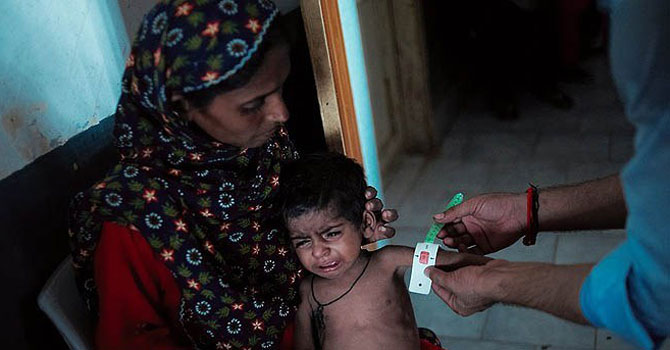
HYDERABAD: The sparse efforts made by government to contain measles outbreak reflect in the figures released by Sindh health officials regarding related deaths.
This year, till February 6 alone, there have been a total of 96 measles-related deaths across the province. This fact makes the health department’s oft-repeated claim that a crash vaccination programme had been undertaken seem doubtful.
In fact, Dawn learnt that the health department’s entire Expanded Programme on Immunisation (EPI) is still hit by several handicaps such as shortage of doctors and proper maintenance of cold chain, crucial for efficacy of vaccine and manpower.
According to statistics provided by the health department, till Feb 6 this year around 3,103 suspected measles cases were reported in Sindh with 96 deaths while 210 deaths had been confirmed last year. However, the number of deaths had been much lower in 2011, when only 28 deaths were reported from the province with 1,650 suspected cases.
According to a source in the office of director-general (DG) health services, one of the two vaccine chillers in Hyderabad division had been out of order until a few days back, in spite of the fact that the province had been badly hit by a measles outbreak since Nov 2012. He said that the chiller had been out of order for quite a long time and no one had paid heed to it until recently when it had been brought to the notice of Sindh government functionaries.
Moreover, he said, the second chiller’s thermostat also had some problem since it could not maintain the temperature required to maintain the cold chain.
“Some of the vehicles coming to the office of DG health to collect the vaccine were without air conditioning,” said the source. “So you can imagine the level of efficacy of these [stored] vaccines.”
The level of care taken in the manner of storing and transporting the measles vaccines reveals the importance health officials gave to the vaccination programme.
However, talking to Dawn recently, the project director for EPI Sindh, Mazhar Khamisani, said, “The chiller has been repaired and is functional. You can check it now. I have returned from Hyderabad today after checking it myself.”
About the second chiller, he said that the temperature being displayed on the thermostat reading had been in minus while the maintained temperature wasn’t. But, he said, it had been accordingly adjusted.
Meanwhile, a recently-released report by the current director-general of health services, Dr Ashfaq Memon, also hinted at lapses in administering the measles vaccine to children across the province. According to the report, it had been claimed that measles coverage in the year 2012 was 81 per cent, but the figure could not be depended upon because of carelessness and lack of interest in routine immunisation.
The blame game The predecessor of the current DG health services, Dr Feroz Memon, who was replaced with Sindh special secretary Dr Suresh Kumar in the backdrop of recurring epidemics, attributed the high number of deaths to a number of factors.
He counted malnourishment, poverty, community displacement because of floods, and, lack of awareness as the main factors that led to the present crisis related to the measles outbreak. “Routine vaccination is not satisfactory and needs improvement,” he admitted, while talking to Dawn.
Referring to political interference in the health department, he said, “Political postings and transfers in the health department are major stumbling blocks in service delivery. I have mentioned it quite candidly in my report submitted to the Sindh health minister.”
Meanwhile, the large number of measles-related deaths drew a lot of criticism on the role of EPI while the Sindh health department and the People’s Primary Healthcare Initiatives (PPHI) continued to pass the buck at each other for lapses in routine immunisation.
The PPHI controls around 1,100 basic health units of the Sindh health department but argues that the Memorandum of Understanding (MoU) signed with the health department and the Sindh Rural Support Organisation (SRSO) does not stipulate that the PPHI had to handle the vaccination programme as well.
Budgetary constraints It turns out that the health department has still not released the budget for EPI even though half of the current financial year has passed. Reportedly, the finance department released Rs60 million out of a total allocation of Rs96 million, the budget is yet to be disbursed among district health officers.
According to the president of the Vaccinators Welfare Association (VWA), Maula Bux Chandio, even vaccinators haven’t yet been paid their fuel allowances for immunisation drives held in the past two years. “We were paid per day but were not compensated for the fuel expenses,” he said. “Not even for year 2011.”
In his response to the complaints, Sindh EPI chief Khamisani insisted that if vaccinators had not been paid then they should have submitted a written complaint to district health authorities.
There are around 2,400 vaccinators working with the department and not paying fuel expenses has dire consequences, seen in the form of high number of deaths. Sources in the department said that since vaccinators don’t get compensated for their fuel expenses, they avoid actually visiting assigned areas for vaccination. The health department has to pay around Rs5,000 to each area in charge as transportation expense of eight vaccinators for a ten-day programme.
Management lapses Though lady health workers are also engaged with the health department, administering the measles vaccine needs expertise because unlike the oral polio vaccine it is given in the form of injections given in two doses. “Only trained vaccinators can do the job,” remarked a health official.
The chief of paediatrics and child health department at the Aga Khan University Hospital, Dr Anita Zaidi, also questioned the Sindh government’s crash vaccination programme, undertaken in the wake of continued measles-related deaths. “The high number of deaths shows that immunisation was not conducted properly in the crash programme,” she said. “Secondly, who is going to verify whether the crash programme was actually carried out? There has to be some kind of accountability.”
Sharing her own experience, Dr Zaidi said that when she had visited Sukkur division in January, she had realised that government health facilities were badly suffering from severe shortage of doctors and manpower. “You need medical officers to follow the treatment once a senior doctor examines patients,” she said. “What we felt in our visits to various areas such as Salehpat, Sukkur and Ghotki etc that there was serious shortage of doctors and also medicines.
She wondered how patients would be treated if the required protocol was not followed and medicines were not available. “If these issued had been tackled then the number of deaths wouldn’t have been so high,” she said. “There is serious lack of proper case management.”
The population worst-hit by measles outbreak was displaced in the wake of floods in 2010 and 2011, and who still have to be rehabilitated. According to health officials who visited a few districts of upper Sindh, a large number of people have returned home but many still live in makeshift camps. These are also the people among whom malnutrition is most prevalent, they added.