NEWLANDS Cricket Ground in Cape Town is the most panoramic and scenic Test venue that I have seen. The towering Table Mountain and the Devil’s Peak next to it as backdrop present a sight to behold. No other venue in the world has such a breathtaking view, not even in the West Indian islands or in Australia or New Zealand.
I have covered Tests at nearly 85 venues around the world out of nearly 110 grounds where international matches have been played. Some of them are no more in use and some are now extinct. I enjoy coming here to this city, one of the most beautiful places in the world, and to cover cricket and watch the game here is an experience in itself.
During apartheid when this country believed in segregation and racial discrimination, the races were classified as whites, blacks, Asians and Cape coloured. Since the apartheid period, spanning nearly 50 years, came to an end in 1991, things have dramatically changed in every strata of society including sports and cricket is, of course, part of it.
No non-white team was allowed to play at the Newlands where the first ever Test was played in 1889 when England beat South Africa by 202 runs. And no mixed races matches were ever heard of. After the abolition of apartheid, however, almost every Test playing country has visited here and people of all creed and cast are allowed to play at Newlands and at all the other grounds in the country.
Cricket like rugby is a popular sport in this country and their most famous son — a Cape-coloured Basil D’Oliveira — from this town was the man responsible for changing the history of the game in this part of the world.
His inclusion in the England team to tour South Africa for the 1969 tour was rebuffed by the then Prime Minister of the country, John Vorster, who refused to host England to play Tests here because of a non-white man in England team which resulted in the founder member of the ICC South Africa being thrown out of Test cricket.
They were brought back into the international arena only after Nelson Mandela was released from 27 years of imprisonment at the Robben Island in the sea, not far from this ground, and apartheid was abolished in 1991.
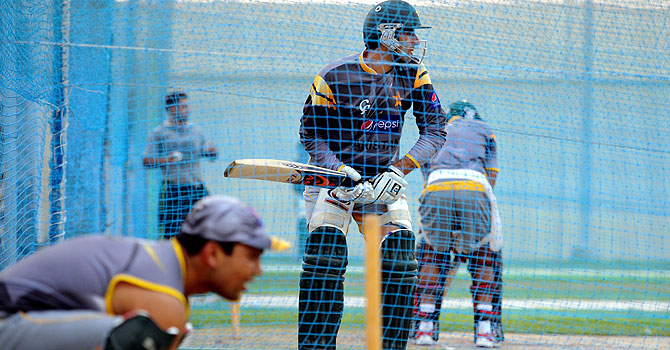
Now a word about the current series. Pakistan play their second Test of the three-match series here from Thursday to redeem their lost pride, having lost the first Test at the Wanderers Stadium in Johannesburg by 211 runs. Losing another would mean losing the series and Graeme Smith’s men seem determined to win the series here before it is over.
They have shown in the first Test that the frail and unpredictable Pakistan batting can be tested against pace and put to smithereens once again as in the first innings of the first Test when they were shot out for 49 — their lowest in Tests.
Since 1993 and returning from isolation, South Africa have won 17 of their 25 Tests here, drawing five and losing three and all of them to the Australians in 1994, 2002 and in 2006 respectively. Only last month New Zealand suffered a heavy defeat here inside three days when Vernon Philander, the local man, picked up five wickets for seven runs against them.
Smith is determined to carry on with the same success as he achieved in recent times and specially after he led his team for the hundredth time in the previous Test. I do not feel he will have a changed side despite Newlands recent reputation of favouring the spinners.
Pakistan, however, were faced with a grim situation here with their talented pacer Junaid Khan becoming doubtful due to a thigh strain on the eve of the Test. Junaid has bowled with a lot of fire and success in recent Tests and ODIs for Pakistan and if he misses out, it will be a body blow for the tourists.
If he gets ruled out, Pakistan team management is likely to consider off-spinner Abdul Rahman or medium pacer Tanvir Ahmed in Junaid’s place because both are experienced players and have done reasonably well in side games here.
Nasir Jamshed and Sarfraz Ahmed seem to have recovered fully and will most definitely be part of the playing XI. The only other change that I see is that of in-form pacer Mohammad Irfan in place of Rahat Ali who failed to impress at Johannesburg.
Irfan, with his tally of seven wickets in the side match against the Emerging Cape Cobras, has shown that in short bursts he could be handful if conditions and luck favour him.
Misbah-ul-Haq, the Pakistan captain, said of Irfan: “He is ready and he did well in the tour game. I feel he is now getting there.” Obviously it’s a hint that Irfan will be getting his first Test cap today.
Misbah also said that his boys have the ability to fight back. He may be right, only if his batsmen show some more determination and skill to stick around, as he and Asad Shafiq displayed in the second innings of the first Test.