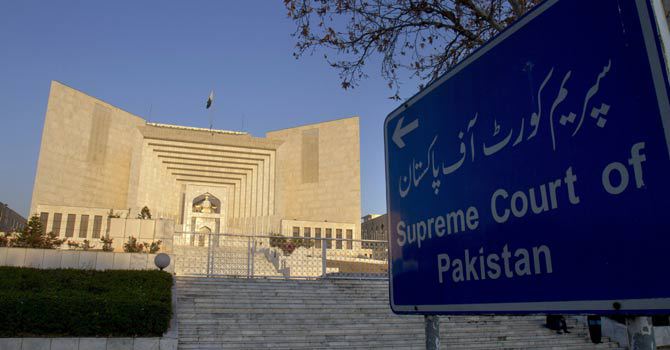
ISLAMABAD: The Supreme Court Wednesday, by halting any further action regarding the Sindh Local Government Act (SLGA), stated that no provincial department would be transferred to the local government till further orders.
A three-judge bench headed by Chief Justice Iftikhar Muhammad Chaudhry and comprising Justice Arif Hussain Khilji and Justice Sheikh Azmat Saeed heard the petition challenging the controversial SLGA, 2012.
The petition, filed by Barrister Zamir Hussain Ghumro of the Sindh Bachayo Committee, seeks the court to declare the law as illegal, unconstitutional and unlawful.
The petitioner apprised the apex court that, “no rural areas are going to emerge in Metropolitan,” adding that the statement by the Advocate General Sindh was also backing his stance.
Later, the court deferred the case till March 7 in view of the absence of the original bench.
The petition
The petition says that dozens of sections of the law, Schedule 1 and its parts from A to W are wholly or partly in clear conflict with Articles 2, 5, 9, 25, 97, 129, 130, 137, 142 and 175 of the Constitution. Pointing out that these and other constitutional provisions could not be severed, the petitioner has prayed to the court to either declare the whole law ultra vires of the Constitution or alternatively declare these sections as illegal and void.
The court has also been requested to declare that towns could not be created outside the boundaries of revenue divisions, no new police districts could be created on the basis of towns in metropolitan corporations and provincial subjects and executive authority of other departments under schedule 1 could not be transferred to the department of local government or any local body.
Barrister Ghumro has also prayed to the court to stop the Sindh government from transferring provincial government departments in schedule 1 of the Act including their assets and resources to metropolitan corporations, district councils, taluka and town municipal administrations and union councils until the final adjudication of the petition.
The court has also been asked to restrain the Sindh government from allowing the local government bodies or metropolitan corporations from creating community police, watch and ward police or any other militia, office or department under section 14 of the impugned act.