0
0
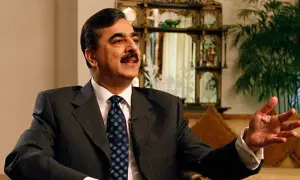
ISLAMABAD, Feb 20: Interior Minister Rehman Malik told his critics on Wednesday that the real target of their ire at terrorists’ attacks should be chief ministers because law and order was the responsibility of provincial governments after the 18th Amendment.
Winding up a debate in the Senate on an adjournment motion on the Feb 16 bomb blast in Quetta, the minister disclosed that he had sent a “security alert” to the Balochistan authorities on Jan 27 about the possibility of a massive terrorist attack on the Hazara community.
“Instead of criticising me, summon all the four chief ministers and ask them what’s going on,” Mr Malik said in reply to the criticism by senators. “How can you say that the federal government has failed?” he asked.
As a federal minister, he said, his job was restricted to “intelligence sharing” and the rest was the responsibility of provincial governments. “Even today in the morning, I sent an alert to the Sindh government that Karachi will witness mass killing,” he told the house.
“I simply ask them (provinces) to enhance security. And if they do not do it, what can I do?” he remarked, adding that he would continue to fulfil his responsibility of providing information to the provinces.
He told the house that the explosive material used by terrorists in the Quetta blast had been transported from Lahore and a number of arrests had already been made.
He claimed that four people involved in the attack had been killed and seven others were arrested during a raid at a house.
The minister told the house that Karachi police had recently arrested 30 members of the banned Lashkar-i-Jhangvi whose head office, according to him, was situated in Lahore. He alleged that there had been a nexus between Al Qaeda, Lashkar-i-Jhangvi and Balochistan Liberation Army (BLA) in the province.
The minister said that the Taliban were not behind every terrorist incident in the country, claiming that Lashkar-i-Jhangvi was responsible for 80 per cent of terror attacks. He also named Sipah-i-Sahaba and Jaish-i-Mohammad as the organisations involved in terrorism.
Mr Malik said he had provided a list of 3,117 members of proscribed organisations to the provinces for action.
He praised the Punjab government for taking effective measures to prevent acts of terrorism on the basis of information he had provided.
“The Punjab (government) handles information in a better way since they have resources. Do I not provide information to the Sindh government? Do I not give information to the Balochistan government?” he said rhetorically.
Mr Malik tried to dispel a perception that the Quetta blast was a result of “intelligence failure”. He said he was ready to give an in camera briefing to a joint sitting of parliament, suggesting that all provincial chief ministers should be asked to attend it.
The PPP’s Raza Rabbani said that foreign powers who were unhappy over Pakistan’s decision to hand over Gwadar port to China and signing of a gas pipeline agreement with Iran were creating unrest in Balochistan.
Kalsoom Parveen of the Balochistan National Party warned that the country could face a “civil war” if steps were not taken to stop spread of sectarianism.
Mohammad Khan Sheerani of the JUI-F asked the government to stop receiving the Coalition Support Fund and aid through the Kerry-Lugar bill. JUI-F members staged a token walkout over poor handling of the terrorism issue by the government.