8
8

Zahrah Nasir recalls the times she spent with the Afghan Mujahideen during the 1980s
Turning the clock back 30 years to the time spent with the Mujahideen in the mountains and valleys of Afghanistan is a simple matter because, in many respects, those days — days of war, death and womanhood — live on in my mind and always will. I still hear the rhythm of voices in Pashtu and Dari, the echoing ring of horses’ hooves as we traversed seemingly impossible mountain tracks in the dark of night, smell the heady fragrance of the wild sage through which we rode in narrow valleys and canyons and, whenever and wherever I hear the ominous chop-chop-chop of helicopter rotor blades I am ‘there’ — the sharp taste of fear filling my mouth.
People, especially the younger generation, find it difficult to believe that a lone woman travelled with the Mujahideen as I did — and as a few other women did too later on during the war against the then Soviet Union — and they look at me wide-eyed in disbelief when I assure them, in all honesty, that I was, irrespective of the situation, always treated with the utmost honour and taken special care of simply because I am a woman.
It was, admittedly, acutely embarrassing to have to ask when I needed the loo, which when once I was struck with dysentery was often, but I soon realised this was for my own safety and privacy too. Someone, usually one of the bodyguards I had been assigned, would scout out a ‘suitable place’, checking for signs of the ‘enemy’ and for mines before indicating that it was safe for me to ‘go’ and stand guard, fully armed, to forestall any interruptions until I was through but, after a couple of days, embarrassment was replaced with acceptance as, let’s face it, the call of nature must be answered!
It was the same with sleeping arrangements when travelling as, again for safety, I slept sandwiched in between the men: Maybe there would be a dozen on either side of me, plus, more at head and feet. But, once we made it to the base camp — this was the home valley of the rugged assortment of men with whom I went to war — then I was assigned a charpoy on a little rooftop of its own, men sleeping on adjacent rooftops all around with, as always, guns at the ready for if and when the enemy appeared on land or by air.
Whilst it is so very easy for me to ‘magic’ myself back with the Mujahideen, my ‘Brothers in arms’ some of whom remain close friends, it is much harder for me to relate to the person, the young woman I was before that, my first-ever journey into Afghanistan, a country which is now, more than ever, my second home.
I had arrived, exhausted and completely out of my depth, in Peshawar where, as a newly hatched war correspondent, I was to make contact with the Mujahideen and talk them into taking me with them to war and this is exactly what I did. But what no one knew, and I wasn’t about to tell them, was that this was my first time outside of Europe and my first time in a war zone.
Outwardly I appeared, I think, reasonably confident; inwardly I was a totally demoralised divorcee who, a mere month prior to this, was the editor of a local newspaper who tended goats, cows, sheep and chickens on a tiny farm in the Highlands of Scotland when not in the office.
That life, the ‘Scottish incarnation’ is completely alien: as if it ‘happened’ to someone else — a non-person — certainly a ‘non-woman’.
The woman I am now was ‘birthed’ in a mountain valley full of Mujahideen in war-torn Afghanistan where, for the first time ever, I was accepted, completely, for exactly who and what I am and awarded a measure of respect I had never before known existed.
Many people, including those who should know better, now condemn the Mujahideen as illiterate, blood-thirsty bandits, confusing them with the 1,050 and more bands of renegades creating sheer hell in Afghanistan right now. But the Mujahideen of the 1980s were a very different breed of men — they were, at least those I travelled with and others I had reason to interact with, gentlemen.
Names and faces, some of their owners long since killed in the fighting, swim through my memory: There was soft-voiced, very tall, Qadir, an agricultural graduate from Kabul University with his dreams of modernising farming throughout the country; hawk-nosed, grey-eyed, ‘Engineer Namak’, a geologist with a Doctorate from Germany; Karimullah, an Olympic wrestler who had represented Afghanistan in the Moscow Olympic Games; Commander Anwar with a degree in literature who, rather than leading men in guerrilla warfare, had hoped to enter government service, probably in the diplomatic field, with teaching to fall back on; and then men like Commander Gul Ruz, an uneducated farmer who was determined to fight for his land, his traditional way of life and, above all, for freedom. These were true patriots. Real ‘Freedom Fighters’ who, despite, or perhaps because of, the situation, went out of their way to ensure my comfort and safety as best they could under the circumstances.
There were, in the valley used as a base by the group I travelled with, approximately 1,500 men, many of whom had not seen a woman, until I rode in, for a very long time indeed. They belonged to, by the way and for the record, Jamiat-i-Islami operating under the umbrella of Professor Burhanuddin Rabbani who later headed up the Afghan High Peace Council and who was assassinated by the Taliban on September 19, 2011, in his Kabul home.
Obviously, this should go without saying, anything could have happened but what did happen was that these fiercely proud fighters rallied round me like the brothers they came to be. One or another of them heated up an oil can full of water on a cooking fire each evening approaching sunset, then carried it to a ‘private’ room in the remains of a bombed out house and stood guard outside while I washed.
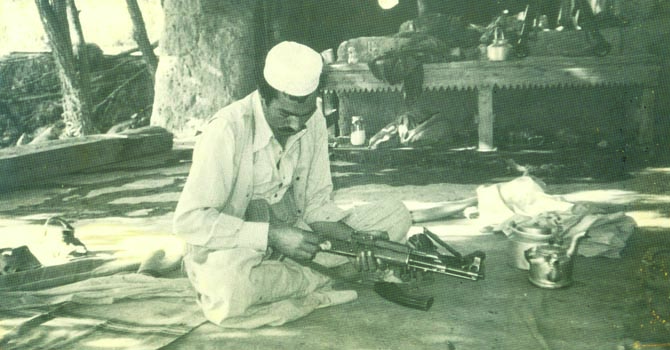
I hadn’t asked for this — it was given as were things like handfuls of hard sweets, for energy when travelling, extra lumps of potato on my plate when food was very short as was mostly the case, a place in the shade, a battered car seat to sit on with a purple velvet cushion thrown in for good measure and, to balance the books, a turn on an anti-aircraft gun and my own Kalashnikov with training on how to use and maintain it!
A spreading mulberry tree shaded the courtyard of the main camp where we sat in the evening. This tree — ‘The Gun Tree’ I called it — was used to hang weapons on, to keep them out of the dust, when not in use and my ‘place’ was sitting leaning against its reassuring trunk, scarred and bleeding as it was from shrapnel wounds.
Just last year I returned to the base camp, with some of my surviving ‘brothers’ who honour me with the same, perhaps even more, respect now than they did when we first met. I also returned to ‘my’ tree. Somehow I knew it would still be there but what I hadn’t expected was to see it decked out with makeshift children’s swings — a beautiful sight to see and a sight which promptly transformed ‘The Gun Tree’ into ‘The Peace Tree’ — it stands as a symbol of hope and, strangely enough, equality.