2
2
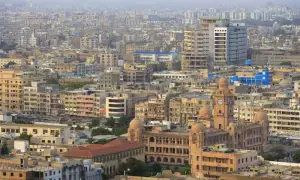
IN his excellent keynote address at the fourth Karachi Literature Festival, Urdu fiction writer Intizar Husain, one of the 10 finalists for the Man Booker International Prize for 2013, eloquently reflected on a dilemma.
Should we be celebrating literature in the catastrophic times we live in when people are being killed by the hundreds?
Intizar Sahib said he first delved into the wealth of Urdu and Persian poetry but could not find an answer to his question. To his credit, the speaker turned to prose and the legendary One Thousand and One Nights provided him an insight into how literature could be turned to one’s advantage in adverse circumstances. Didn’t Scheherzade buy her reprieve from execution by her storytelling gift? “Literature can change human nature,” Intizar Sahib concluded in support of the literature festival.
Not surprisingly violence was the theme of the discourse in several discussions. However, none could have missed the irony when soon after the second day’s session on Mohammed Hanif’s The Baloch Who Is Not Missing and Others Who Are, a 46-page booklet published by the HRCP, came the blast in Quetta that killed over 100 Hazara Shias. Intriguingly the suicide bomber who penetrated the ring of security thrown around the Balochistan capital by the security forces met no resistance at the numerous checkposts he crossed to reach his target.
The Lashkar-i-Jhangvi claimed responsibility for the blast. Hanif’s publication captures in powerful narrative the pain and sorrow of the families affected by the ‘dirty war’ in Balochistan. The attack on the Hazaras adds a new heart-wrenching dimension to the sad story of forced disappearances. Another book is now needed to capture the tragedy of the Hazaras.
How much violence can Pakistanis accept without losing their equanimity? And where does this instinct to destroy and kill come from? I found the answer in the call I received from Shehzad Roy, pop singer and heartthrob of the youth. He wanted me to watch his show on TV on education titled Chal Parhaa.
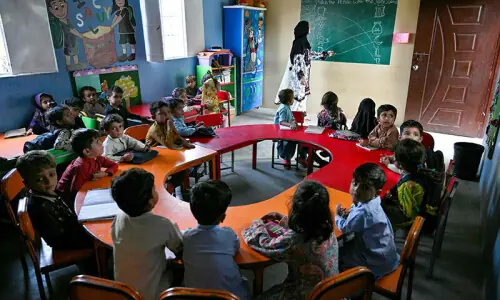
The theme of that episode was violence in schools. It portrayed the widespread prevalence of corporal punishment in our schools. This is one of the “un-talked” about issues known to all but only reported when a child dies. What was more shocking was that even today there are parents and teachers who actually believe in the age-old dictum “spare the rod and spoil the child”.
Now it was plain where some of the violence in our society was coming from. A child growing up in a home prone to domestic violence and going to school to experience more brutality would hardly be expected to be peace-loving. In his programme Shehzad was pleading for a law banning corporal punishment.
To check what the law said I looked up the Right of Children to Free and Compulsory Education Act recently adopted by the Sindh Assembly. To my relief this piece of legislation states in Article 13 (iii): “No child shall be subjected to corporal punishment or mental harassment”. The law adopted by the National Assembly for the Islamabad Capital Territory also has a similar provision though neither has any provision for the manner in which any contravention of the law will be addressed.
The simple solution would be to enact a strong child protection law under the UN Convention on the Rights of the Child to which Pakistan is a signatory and make its observance mandatory in the RTE (right to education) legislation. What is disturbing is that the connection between corporal punishment in schools and violence in society is not widely understood. The rod continues to be regarded as a basic tool of good upbringing.
Coming back to the sectarian killings in our society, one can well ask why should a man’s mindset be so violent and perverse that he has zero tolerance for plurality and is willing to destroy himself along with the “other”?
The bomber who drove his explosives-laden tanker into a busy marketplace would have certainly been indoctrinated and had his psyche irretrievably damaged by psychological and physical abuse. Our system which encourages the brutalisation of children makes suicide bombers readily available for recruitment in the deadly militant organisations for their unholy wars.
The Quetta bombing was not an individual act carried out in isolation. The bomber was acting on behalf of his handler — in this case the Lashkar-i-Jhangvi. Can the attacks on Shias in Pakistan be traced to the proxy war that many believe Saudi Arabia is fighting to decimate those whose loyalties are suspect, namely, the Shias who share the same sect as the Iranians — Saudi Arabia’s nemesis in the Gulf.
Until now the fault lines in Pakistan ran deep — politics, economics, language, ethnicity, education, etc are dividing society. Religious and sectarian beliefs did not split society initially. One cannot say that now. First the Ahmadis were marginalised. The Shias, who are integrated closely in the political, economic and social mainstream, are now under attack. Can Pakistan survive once that happens?