17
17

If you happen to be in Lahore these days, you will empathise with my lost sense of direction. Almost all the important roads are dug up to clear the way for the Turkish bus transport system; your knowledge of the narrow Lahori side streets is a life saver these days. The Chief Minister of Punjab is emulating the brother Islamic country's urban transport model and is betting on it to win him another tenure. 'Cheating' among the post-colonial wannabe nation-states is quite common.
Marcos in Philippines, Pinochet in Chile and Ziaul Haq in Pakistan did not impose their undemocratic and brutal rules in the same era by coincidence. You also cannot leave it to the theory of chance that Aquino was assassinated by Marcos, Allende killed during Pinochet's take over and Bhutto hanged by Zia; and that then people in the Philippines first elected Aquino's wife and then his son (the current president), Allende's daughter is a serving senator and well, the Bhutto 'dynasty' you know all about. So global powers, local elites and the people across the globe have been behaving in somewhat similar ways or have they been copying each other?
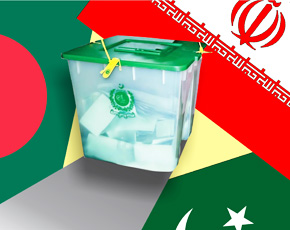
For some in Pakistan, there is an urgent need to copy what they term 'the Bangladesh model'. It implies a long caretaker government underwritten by pious judges and run by delivering economists while the generals smile overhead in their well-starched spotless uniforms. But haven't we been served with this biryani before? What is different in the recipe this time around?
In nascent democracies, holding elections in a manner that is acceptable to all and then managing peaceful transition from one elected government to another is a major challenge. Bangladesh too, had trouble with transitions. It first hit a road block in 1990 when President General (R) Ershad was forced to quit. Someone considered a non-partisan had to fill the vacuum till the elections and everyone agreed to make the chief justice the head of the interim setup, the transition was managed successfully. But since it was a temporary arrangement with no constitutional standing, the transition again became an issue when the elections were due in 1996. Following a crisis spanning months, an amendment to the Constitution was made to provide for a senior judge-led caretaker government. It worked in next elections held in 2001 too, but itself became a problem by the next elections scheduled for January 2007.
There was no agreement on the appointment of any justice as the caretaker prime minister. All the possible candidate judges now had become or were propagated as partisan by opposing parties. Many believe that the army maneuvered and exacerbated the crisis to make way for and justify its latter interventions. To break the deadlock, the President appointed himself as the caretaker prime minister, but he too was elected president by one of the two major parties and thus, was not considered above par. Days later he had to relinquish the caretaker post resulting in the further deepening of the constitutional crisis.
Then finally, the Army flew in a Chief Advisor – Fakharuddin Ahmed, an 'IMF-educated' economist set to overhaul Bangladesh's sputtering economics and feuding polity. The not-so-thinly-veiled rule of the military got the tenure of his dummy Chief Advisor extended beyond its constitutional term and mandate. It promised elections only after fixing the corrupt politicians. They toyed with ideas like the minus-two formula (the two main parties without their known heads), exiling leaders to Saudi Arabia, 'NABing' politicians etc, but accomplished nothing. The long caretaker finally had to cut short its tenure and ambitions. The two main parties came back again, headed by the same old 'corrupt' leaders, and the general elections in December 2008 brought Awami League to power.
The country will go to polls again in early 2014. The incumbent government has undone the constitutional amendment that provided for the setting up of an interim caretaker government as many parties had started seeing it as a constitutional window available to the military to misuse.
So in Pakistan, we are talking, thanks to free-media, about a Bangladesh model that the Bangladeshi establishment had found useless and its political parties declared it dangerous and discarded it. But it was a mere talk till it qualified to the status of a conspiracy when Qadri marched on to Islamabad. Many saw that talk walking and shuddered at a creeping coup. The hype has subsided but oblique references to an extra-constitutional intervention persists. If Qadri's demands and the agreement with the government are an indication of the direction of such an intervention, it does not lead you to Bangladesh. It in fact guides you to Iran. So take a u-turn.
Hello Iran! Iran has a quasi democratic system. It regularly holds elections to the office of president, parliament and local governments. But it has a Supreme Leader and a Guardian Council too. What do the two do?
Ruhallah Khomeini, the father of the Iranian revolution of 1979 was the first Supreme Leader. Another senior clergyman, Ali Khamenie was elected as the president for the first two terms (1981 to 1989) under the new Islamic Constitution. Khamenie was elevated to the position of Supreme Leader after the death of Khomeini in 1989. He still occupies that office which means that Ali Khamenie is at the highest echelon of power in Iran since the last 34 years. He has all the powers that the Shah of Iran used to enjoy, in fact more, as the Supreme Leader claims to have a divine sanction too. The cleric king is the envy of ulema across the Muslim world, sectarian differences aside.
The Supreme Leader makes all the important appointments – the army chief, the chief justice, the heads of radio and television and is authorised to declare war or peace. He also appoints six ulema to the 12-member Guardian Council. The other six, who have to be lawyers, are nominated by the chief justice and vetted by the parliament.
The Guardian Council is thus a forum of appointed (not elected by the people) clergymen and jurists. The Council defines the boundary within which democracy is allowed to exist in Iran. No act of parliament can become a law without their approval; they are vested with the authority to interpret the Constitution and then they 'supervise' all elections, which means that they scrutinise all the candidates before allowing voters to choose one from them. The powerful clerics and jurists of Iran decide who is pious enough to contest an election. They use their powers frequently and blatantly and in most elections the majority of the candidates are screened out and the voters are asked to choose either this conservative or that conservative.
Iran's Islamic Constitution came into effect in December 1979, that was the time when Jamaat-i-Islami's legal draftsmen in Pakistan had occupied the room next to President General Zia's office at GHQ for Islamising our Constitution. The rulers in both the countries shared a passion for limiting people's choices in the name of Islam and for pre-selecting candidates on moral and religious grounds. Iran institutionalised a full system to that end while Pakistan made additions to Article 62 and 63 of the Constitution that set the same standards but did not put a practical system in place. Our poor country has to do a lot of catching up, if it is not too late already. So, is it the Bangladesh model or the Iran model that some fear might surface in Pakistan?

The views expressed by this blogger and in the following reader comments do not necessarily reflect the views and policies of the Dawn Media Group.