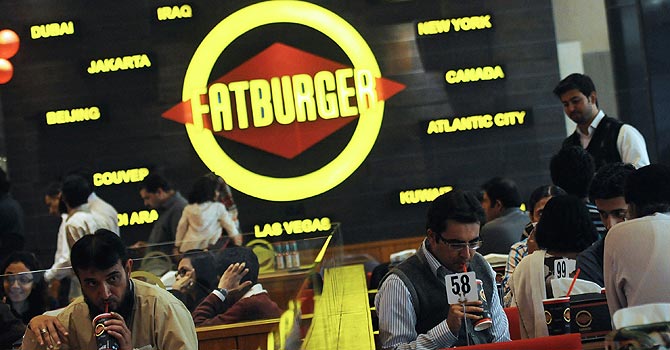
KARACHI: American fast-food and Western fashion outlets are taking Pakistan's growing middle class by storm, defying stereotypes about a conservative Muslim country plagued by violence.
The rupee may have nose-dived, a third of the population may live in poverty and sectarian violence may be at a record high, but remarkably, consumer spending is up among a resilient elite fond of imported luxuries.
In a smart corner of Karachi, a new mall offers wealthy clientele the chance to lunch on an American burger, buy French cosmetics, shop for cocktail dresses, sip an afternoon cappuccino or wolf down a cinnamon roll.
Female sales assistants dressed in jeans and T-shirts buck the idea that “service industry” jobs are unsuitable for women, even if many of them commute into work heavily veiled to avoid being harassed or insulted.
“It is time when Pakistanis are getting branded. It is a new phenomenon,” says Samiullah Mohabbat, the chief executive who brought American franchise Fatburger from Beverly Hills to Karachi, a city troubled by shootings and kidnappings.
“The world has just started coming to Pakistan and this trend will grow.”
While the economy has stagnated in the last five years, a business and foreign investment boom after the 9/11 attacks widened employment opportunities. Television was liberalised in 1999 and public sector salaries were increased.
As a result, the middle class has grown over the last decade. Karachi, the country's financial hub, Lahore and the capital Islamabad have all seen a surge in Western-style coffee shops, fast-food franchises and new malls.
Karachi's Dolmen Mall is the newest and flashiest.
There is Spanish fashion favourite Mango, US beauty and home firm Crabtree and Evelyn and British high street staples Mothercare and Debenhams.
But when it comes to food, Mohabbat says “American is best”. Regardless of the political tensions in Islamabad's relations with Washington, many wealthy Pakistanis are attracted to American films, clothes, music and of course food.
Mohabbat has invested $7 million in opening Pakistan's first Fatburger restaurant last month on the second floor of Dolmen Mall, with plans for another in Karachi, two in Lahore and a fifth in Islamabad.
Far from seeing the country's troubles as a bar to business, Mohabbat says a $5.50 burger is the perfect antidote.
“Food is the only entertainment in Pakistan,” he said. “People are certainly frightened because of the law and order situation, so they don't go anywhere except food outlets.”
At lunch time, his 130-seat restaurant is buzzing. In Beverly Hills, there may be nothing exciting about going out for a burger, but in Karachi the novelty and the relative expense make it a sought-after privilege.
The walls are plastered with large notebook papers scribbled with the experiences of the clients. “Yummilicious,” screeches out one.
There is a scrum at the counters as customers wait their turn. A dozen workers cut and cook imported American beef, slathering it with spices and vegetables, shoving it in a bun and handing it to the waiters.
“It's certainly quite expensive for the average Pakistani, but I prefer it because I can afford it,” says businessman Masroor Afzal, 44, who works round the corner and says he frequently pops over.
“The beauty of Karachi is that it has everything for everyone. There are many people who can't afford to eat or shop here, but they have other bazaars.”
Analysts say there is enormous potential in Pakistan as a market for global consumer goods, despite the structural problems in the economy.
According to the finance ministry, 104 million people are aged 15 to 59 and by 2030, 30 percent of the population will be younger than 30.
Khurram Schehzad, head of research at investment firm Arif Habib Securities in Karachi, says consumer spending has grown 26 percent in Pakistan since 2010, compared to seven percent for Asia as a whole.
Business mogul Abid Umer says there is “tremendous potential” for retail.
His Al-Karam Group brought its first foreign franchises – Babyshop from Bahrain and Splash from the United Arab Emirates – to Pakistan in 2005. Today his portfolio has extended to Mango.
“Pakistan is full of aspirational customers,” said Umer.
“Sure, Pakistan has its share of issues but in most cases, day to day life is not affected, plus the tremendous customer response and low cost of operations makes it worthwhile.”
On Saturday, a woman and a security guard were shot and wounded when men opened fire in the Dolmen Mall car park, police said.
The motive for the attack was not immediately clear. Witnesses said the woman was accompanied by her daughter and maid. The attackers escaped.
Helen Lacey, Debenhams' senior PR manager, told AFP the company had carried out extensive market research and had "no current security concerns".
"International brands in Pakistan in general are performing strongly. This is a large and growing market and there is a clear appetite for British brands here and growth potential with a rapidly growing middle class," she said.
But Mohabbat admits it can be difficult persuading foreigners to invest in a country plagued by terrorism, political and sectarian murders and a grave energy crisis. Most Western governments advise against travel to Pakistan.
"The most challenging thing for us is to convince people about Pakistan. We put our case and show them the true picture, which does not show Pakistan as a totally dangerous country," said Mohabbat.