0
0

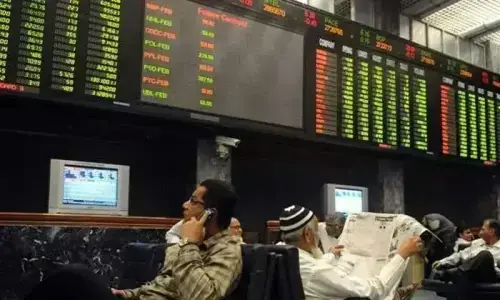
KARACHI, March 9: The Engro Corporation stock, apart from Attock Refinery, remained in the limelight at the Karachi Stock market for most of past week.
For at least the last two sessions (Thursday and Friday), the stock closed at its ‘upper circuit’ with maximum gain of five per cent in price allowed during a trading day.
Engro settled on Friday at Rs127.98, outperforming the market by 4.4pc over the week.
Having risen from Rs92, punters would have trembled in their shoes to speculate in the Engro stock over the price of Rs110.
Yet there were buyers at the end of second session on Friday.
The optimism was based on the belief that the Economic Coordination Committee (ECC) of the Cabinet, which sat down to a meeting on Friday, an hour before the close of market, would approve allocation of gas to Engro’s Enven plant at concessionary rates. It was supposed to be huge cut, from $5/mmbtu to just 80 cents/mmbtu.
Many market participants suspect that the incessant rise in Engro’s stock price was on the premise that some people were in the knowledge that the ECC would honour the government’s commitment of concessionary price for Engro’s Enven.
Tabled before the ECC were also proposals for consideration of increasing the deemed duty to 9pc from 7.5pc on HSD for refineries and to raise import tariff on PTA from 3pc to 4pc both of which led the stock prices of Attock Refinery and LoTPTA to outperform the market by 14.2pc and 4.9pc the previous week.
The ECC meeting, chaired by the Federal Minister for Finance, Saleem H. Mandviwalla, came out with something of an ambiguous decision on Friday relating to Engro.
It read: “On a summary moved by the ministry of industries, the ECC also approved Engro’s existing Mari Gas allocation for reallocation to SNGPL for onward supply to Engro’s new energy efficient plant on a dedicated basis which would be supplied under existing SNGPL contract with all terms and conditions staying unchanged.”
Yet many analysts thought that the concessionary rate was granted to Engro.
Insider trading is hard to detect and more difficult to prove. Yet several big market participants suggest that some members of the ECC and brokers were collaborating in the purchase of Engro stock; an important member in the government was said to have acquired big quantity at Rs92 in mid-October last year, for he was in the full knowledge of what was likely to come to pass.
But the argument is not on trading, but knowledge. The theory of “efficient market hypothesis” requires that flow of material information should be at the same time for all. The ’material disclosure’ clauses of the KSE also require companies to disseminate price-sensitive information within the shortest time. Many people wonder if important corporate matters which have the potential of impacting share prices and are to be discussed and decided in the ECC meeting should be released through the stock exchange.
It would be futile to expect government to take upon itself such responsibility and so the ECC agenda was unlikely be made public through the exchange.
Should the particular companies about which important decisions are to be taken at the ECC meeting, then be required to disclose such information through notices at the stock exchange?
Without such notices, does trading in huge lots in such stocks constitute ‘insider trading’ or ‘front running’ on the basis of Regulators rules regarding ‘material information’ and what constitutes ‘insider trading’. To be fair, many sponsors of companies rightly argue that it would confound their confusion on what was or wasn’t ‘material information’ and the hassle they already have to go through to comply with smallest details of the ‘code of corporate governance’. Beside, they say, the ECC could defer its meeting or decision on any matter for weeks, which would make it impossible for companies to make fresh announcements on the same issues all the time.
The companies, they say, could be bound to make announcements once decisions have been taken. Yet, for the Regulators, there is food for thought. Company sponsors and brokers who have access to members on the ECC could, on behalf of the members as well as themselves engage in ‘front running’ and line their pockets, at the cost of other ordinary investors.
But as the proof of the pudding is in the eating, in order to ascertain if such ‘front running’ does take place on prior knowledge of the outcome of items on ECC agenda relating to corporates, the Regulators could begin by investigation in the recent phenomenal price rise in stocks of Engro and Attock Refinery.