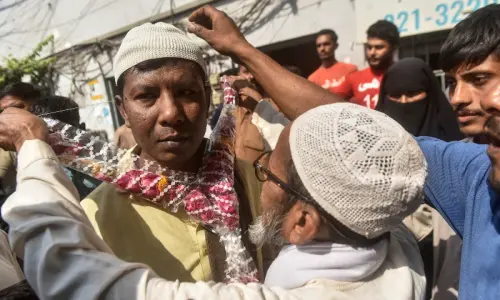
KARACHI: Before joining the race for parliament, candidates for the May 11 elections may have to prove their ‘adequate knowledge’ of Islamic teachings and the Quran and may be requested to recite a ‘Sura’ or particular Quranic verses and answer questions about the number of ‘rakats’ in any of the five daily prayers.
But according to some political parties, this is an “astounding addition” to the process of scrutiny. However, the Election Commission of Pakistan (ECP) has described it as being in conformity with ‘constitutional’ requirements.
What a senior ECP official termed a process of “ruthless” scrutiny began on Monday with a number of candidates appearing before returning officers had to answer different questions, including those about religious injunctions.
One such case was recorded by TV channels when Owais Muzaffar Tappi, PPP candidate for a Sindh Assembly seat and President Asif Ali Zardari’s close aide, was asked about the number of Namaz one is required to offer in a day. He took a couple of seconds to tell the number of ‘rakats’ in Fajr prayers.
In Hyderabad region, nomination papers of a Muttahida Qaumi Movement candidate were rejected during scrutiny. The party says if lack of knowledge about Islamic teaching was declared as the reason behind the rejection, it would challenge the process of scrutiny.
“Papers of one of our candidates from Matiari were rejected by the returning officer,” said Advocate Aslam Pervez of the MQM’s legal aid committee. “The reason is not yet mentioned but the candidate was asked several questions about Islamic teachings and if it would be the cause of the rejection we would definitely file an appeal.”
He said returning officers had no authority to ask such questions, adding that a person’s faith could not be gauged through questions relating more to his memory than his knowledge about Islam and its teachings.
But a senior ECP official justified the questions and said that under article 62 (e) of the constitution candidates were required to have adequate knowledge of Islamic teachings.
“There is no harm in asking such questions if the returning officers want to satisfy themselves about an important element of the qualification clauses”, he said.
The article 62 of the constitution explains the criterion of “qualifications for member of Majlis-i-Shoora (parliament)” and its clause (e) reads: “He has adequate knowledge of Islamic teachings and practices obligatory duties prescribed by Islam as well as abstains from major sins.”But political parties deem it “inappropriate” to judge any candidate’s knowledge about Islamic teachings through a set of questions. They argue that memorising answers of certain questions could not determine anyone’s faith.
“Nomination papers of our party candidates have not been rejected because of that particular reason but I still believe that testing a candidate’s faith in Islam through his memory is not appropriate,” said the Awami National Party’s provincial general secretary Bashir Jan. “One can’t reject any honest and upright candidate just because he has not learnt any Quranic verse by heart.”
Rashid Rabbani of the PPP agreed with Mr Jan and said:
“I don’t think it’s justified to weigh one person’s knowledge of Islamic teachings through these questions.”