0
0
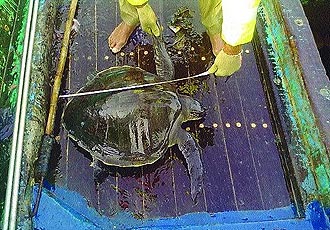
KARACHI: Olive ridley sea turtles, considered to have become extinct in the country, have been spotted in large numbers in the offshore waters during a survey currently being conducted for monitoring tuna, a saltwater finfish, in the sea.
“The specific turtle species (Lepidochelys olivacea) hadn’t been reported in Pakistan for 13 years. About 113 turtle nests of the same species were spotted in 1987 and then a few were recorded in the late 90s. Both events were recorded along the Hawkesbay beach,” said Mohammad Moazzam Khan working as a technical adviser on marine resources with World Wide Fund for Nature.
The discovery had come during tuna’s monitoring that would continue till next year, Mr Khan said.
“We found that every launch coming with tonnes of tuna after a month’s trip also got at least 10 turtles. Most of them were olive ridley turtles while there were a few green turtles, the other turtle species reported from Pakistan,” he said, adding that olive ridley seemed to have disappeared from our coast but green turtles still nested along the Karachi coast.
The recent discovery, however, he said, had given the hope that there could be some unexplored sites along the coast where these turtles were still nesting. “Or it could be that olive ridley turtles only travel to our off-shore waters for feeding. Natural reasons could be at play, preventing them from nesting here,” he explained.
According to Mr Khan, gillnets generally used to catch tuna were a major threat not only to marine turtles but also to a number of other important species such as whales, sharks and dolphins and the solution was to use the longline fishing technique.
“It’s an effective method to minimise bycatch as it uses a long line with baited hooks attached at intervals to target specific fish species. Besides, fishermen could be trained in handling and releasing turtles incidentally caught in the net as the species is alive in most cases when the net is heaved back,” he said.
The WWF conducting the survey, he said, was also training fishermen in this regard and turtles were released after their details were recorded.
“Earlier, they used to throw them off. But now they are trained how to handle them properly and release them back without harm. The organisation also plans to carry out satellite monitoring of turtles in the next fishing season,” he said.
Regarding the turtle habitat, he said that olive ridley was the most common turtle species in the world found in warm and tropical waters, primarily in Pacific and Indian Oceans. Its population was estimated to be 8.5 million in the world in a 2006 survey, whereas the single most important breeding area of olive ridley turtles in the Indian Ocean along the Bay of Bengal is Orissa where its population was once recorded to be 200,000.
“It’s omnivorous but its preferred food is jellyfish,” he said.