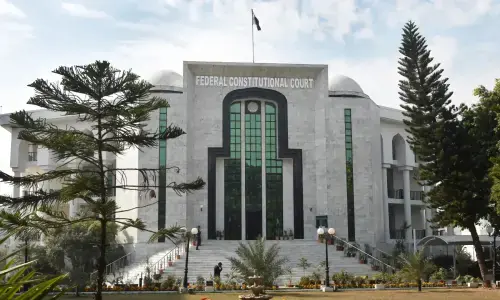
IT was a moment foretold many times over but nevertheless came as a surprise. On Thursday morning, former military dictator General Pervez Musharraf headed to the Islamabad High Court for his bail application in the judges’ detention case. Perhaps he expected a positive response — a day earlier he had been given bail in the Benazir Bhutto murder case. But he was in for a disappointment: the IHC rejected his application and ordered that Musharraf be arrested but the former chief of army staff’s security personnel whisked him out of the court premises and rushed him to his farmhouse.
It is hard to believe that he had not foreseen this. The lukewarm reception he received on his return; the rejection of his nomination papers from one constituency after another; the disdain with which the media and civil society reacted to his return even as political parties maintained a silence — indeed, it had been evident that “everyone ended up finding his place in the world, everyone except him”. If nothing else, as a man who had been part of the political system for so long, Musharraf should have realised that no guarantees — from any quarter — could have ensured how he was treated upon return. He could simply have recalled the fate of his ‘deal’ with Benazir to understand this. But now that he has miscalculated once more, Musharraf — who has time and again said that he would abide by the law — needs to toe the legal line. He should hand himself over and court arrest; anything short of that will reflect badly on him. Indeed, the jokes that were circulating about the commando who ran away on Thursday should be enough to convince him that the honourable course lies in surrendering before the law rather than defying it.
At the same time, it is necessary to caution the judiciary. With the history of the courts’ clash with the dictator still fresh in our memory, the former should be careful as the cases against the latter are heard. Not for a moment should anyone be able to accuse the courts of pursuing vengeance rather than justice. The general has already been judged by history. Had he been allowed to contest the elections and been delivered a sound defeat, there would have been little that the law could have added to this. Indeed, the people’s verdict would have sealed his fate far more effectively than any legal order that still runs the risk of making a martyr out of him.