



 0
0

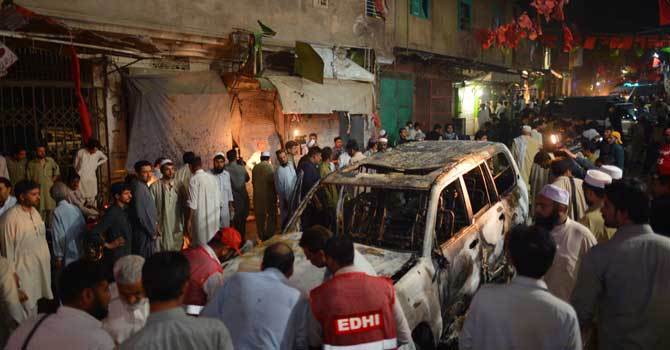
PESHAWAR: Despite being under attack from the belligerent Tehrik-i-Taliban Pakistan, Awami National Party has no option but to take active part in the May 11 elections to avoid getting sidelined, experts believe.
Political and security analysts, in their separate background interviews with Dawn, observed that continuity in Taliban’s current onslaught against ANP could translate into a ‘make or break’ point for the Pakhtun nationalist force.
When asked about what possible options were available to ANP under the given situation, these experts shared a common thought that ANP had no option but to contest elections no matter the Taliban persisted with attacks streak.
“There does not appear to be any hope for ANP,” said Khalid Aziz, former chief secretary, Khyber Pakhtunkhwa.
The initiative, he added, did not rest with ANP as attackers had already ‘issued a charge sheet’ against it, leaving it with no option but to go to election amidst existing imbalance.
Like him, Dr Ijaz Khan Khattak, a senior professor at the international relations department of the University of Peshawar, also believed that ANP could not afford to stay from the political process despite insecurity.
He said the party would have to find innovative ways to conduct its electioneering.
“They (ANP leaders) can’t sit at home, needing to remain in touch with their voters in spite of the threat,” said Mr Khattak.
The failure to provide security cover to ANP candidates, he added, reflected negative on the state as well.
However, former home and tribal affairs department secretary Brig (r) Mehmud Shah thinks the official security cover, even if extended to ANP leaders, would be inadequate.
He said ANP could not be extended the kind of security cover its leaders were used to get during their five year stint in power.
“Even if each of them (leaders) is provided a separate police mobile squad, it would prove insufficient,” said Shah, referring to the six policemen, who lost life in the April 16 suicide bomb attack on senior ANP leader Haji Ghulam Ahmad Bilour’s electoral event.
He said ANP would need to change its electioneering tactics to counter threat.
On his part, Senator Haji Adeel, a senior ANP leader from Peshawar, believed ANP did not need to hold public meetings or conduct door-to-door contact campaigns.
“Those who are sympathetic to us would come and vote for us, no matter we campaign or not,” said Haji Adeel.
He said the party leaders had a significant presence on the television news channels as a result it was possible to spread the party message.
“It is not only about saving us” said the ANP leader, “the party workers have to be protected as well.”
Qazi Ayyazuddin, a candidate of Jamiat Ulema-i-Islam-Fazl for the provincial assembly constituency PK-94, also echoed what Senator Adeel said.
“They are a political party and have no choice than opting for elections,” said Mr Ayyaz, adding that “they need to avoid exposing their supporters to unnecessary danger.”
He also said the party was being provided adequate coverage by popular national television channels.
“As they claim that ANP has served well the masses during its five year term in the government, it should not need to hold public meetings,” said the JUI-F candidate.
The current situation, he added, could also fetch sympathy vote for ANP as the electronic media coverage of the attacks had been creating public appeal for it.
Dr Ijaz Khattak and Khalid Aziz did not agree with the notion of ANP riding to success by dint of likely sympathy vote.
“That mindset exists in urban areas only while ANP’s strength rests mostly in the rural areas of the province,” said former chief secretary Aziz.
Dr Khattak expressed identical views, observing electronic media was ANP’s best bet under the given circumstances to protect its leaders against rising attacks by militants.
“The problem has become so big that it cannot be fixed in the remaining three weeks in the run up to the elections day, therefore, ANP should fully concentrate on taking part in the polls,” said Mr Aziz.
The government, he added, could not conduct a military operation in the remaining three weeks prior to the elections day.
“This leaves them (ANP) with only one viable option, i.e. to contest,” said the former chief secretary.
An effective operation against militants, said Shah, should have been conducted in Khyber Agency and other restive tribal territories at least six months back.
“It would have, at least, shaken up the militants, disturbing them to lose ground they are well entrenched into,” said Shah.
He, however, said any such operation against militants was not likely in the foreseeable futures.
“The federal government lacks the initiative and the military leadership is looking towards the post-2014 withdrawal of US troops from Afghanistan,” said Mr Shah.



























