0
0

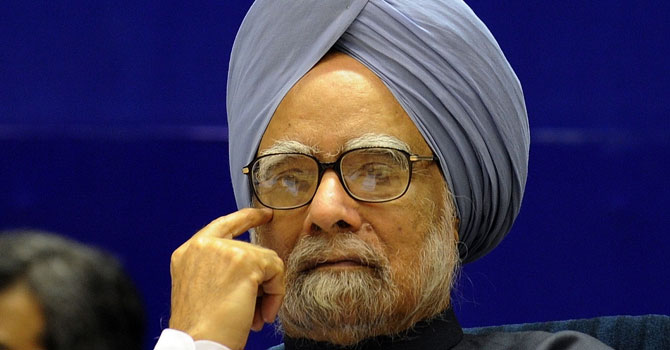
NEW DELHI: India’s prime minister said Saturday a dispute over an alleged incursion by Chinese troops deep inside Indian-claimed territory can be settled peacefully and warned against exacerbating tensions.
The reported Chinese infiltration across the disputed Himalayan border has strained ties between the nuclear-armed neighbours whose relations have long been chequered by mutual suspicion – a legacy of a 1962 border war.
“We do believe it is possible to resolve this problem. Talks are going on,” Prime Minister Manmohan Singh said in his first comments on the incident in the Ladakh region normally controlled by India.
“It is a localised problem,” he told reporters in New Delhi.
Indian analysts say a Chinese intrusion could be a response to New Delhi’s drive to step up road-building near their de facto border to ferry Indian troops and counter China’s build-up of military infrastructure.
Singh’s statement came a day after Indian Defence Secretary Shashi Kant Sharma told parliamentarians Chinese soldiers had pitched their tents nearly 20 kilometres (12 miles) inside Indian-claimed territory.
The premier’s comments echoed other Indian ministers who have insisted the alleged incursion in the unpopulated desert area can be settled through diplomatic channels.
Beijing has made similar statements, with the Chinese government saying Friday both countries had the “capacity and wisdom” to defuse the row through “friendly consultation”.
India has called on Beijing to withdraw its solders but China’s foreign ministry earlier in the week denied Chinese troops had “crossed the lines”.
Singh warned against stoking tensions between the Asian giants whose bilateral trade soared by a third to nearly $76 billion last year.
“We do not want to accentuate the situation,” Singh said, adding New Delhi has “a plan”, without elaborating.
Indian foreign minister Salman Khurshid announced earlier in the week he will head for China on May 8, saying both countries had a mutual interest in not allowing the dispute to “destroy” long-term progress in ties.
An Indian foreign ministry official has said new Chinese Premier Li Keqiang will travel to New Delhi late next month.
Lower-level talks between military officials have so far failed to break the impasse over the camp that New Delhi says Chinese troops set up on April 15.
The informal border separating China and India is known as the Line of Actual Control (LAC). While it has never been formally demarcated, the countries have signed two accords to maintain peace in frontier areas.
Small incursions of a few kilometres across the contested boundary are common but it is rare for either country to set up camps in disputed territory.
Sujit Datta, a Sino-Indian specialist at New Delhi’s JamiaMilliaIslamiaUniversity, said the extent of the Chinese advance indicated a “planned operation” and reflected China’s new assertiveness.
“Nineteen kilometers is a serious matter,” Datta told AFP. “The Indian diplomats will have to do their job and talk tough to keep the Chinese at bay.”
India’s infrastructure buildup is “in response to the systematic Chinese building of roads and other facilities on the Chinese side”, he added.
“The Chinese don’t want India to equalise its infrastructure capacity -- they want to be in a position of strength along the border.”
India increasingly sees Beijing as a longer-term threat to its security than Pakistan. Last November, India was angered by a new map in Chinese passports showing disputed territories as its own.
India’s conciliatory approach has drawn fire from the opposition with Jaswant Singh, a former defence minister under the previous Bharatiya Janata Party government, calling New Delhi’s response “inadequate”.
The row with India comes as China’s ties with its East Asian neighbours, especially Japan, have frayed over territorial disputes in the East and South China seas.