



 0
0

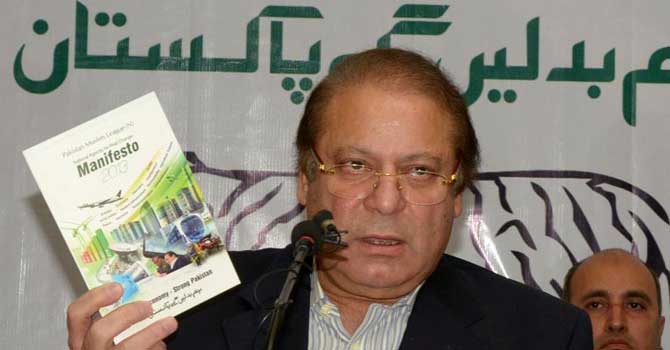
KARACHI: Ever since major political parties launched their manifestos they are coming under scrutiny by various research organisations.
In this connection a seminar was organised by the Pakistan Institute of International Affairs on Thursday in which different political parties’ position on foreign policy was discussed.
Addressing a large audience comprising international relations students and experts, foreign policy scholar Nausheen Wasi gave the first presentation at the seminar.
She mainly touched on the intricacies of foreign policy under a coalition government.
“Foreign policy making is a complex affair, especially when there is a coalition government. Coalition partners are not averse to manoeuvrings in foreign policy matters hence policy matters become a restricted affair.”
She said that there was hardly any difference in foreign policy objectives stated in the manifestos of the Pakistan Peoples Party, the Pakistan Muslim League-Nawaz and the Pakistan Tehreek-i-Insaf.
To the relief of the guests Ms Wasi spoke briefly but one wished that she had expanded more on the subject.
The next speaker, former ambassador of Pakistan Mansur Alam, initially gave a useful backgrounder on Pakistan’s foreign policy objectives.
According to him, the nascent country was right in aligning itself with the United States since it was a new superpower and Pakistan needed financial assistance which the US was willing to provide.
He then came to the topic of the seminar and said that even though “the PTI states that it wants an independent foreign policy, who doesn’t want it?”
Another flaw pointed out by the former ambassador in the PTI manifesto was that, “the manifesto says it will not buckle under political and economic blackmail,” except that Mr Alam asked, “how will you deal with the external debt of $60 billion apart from a huge internal debt?”
Mr Alam seemed to have examined the PTI manifesto a great deal more than of other parties since he barely talked about the foreign policy objectives of other parties.
The final presenter at the seminar was another former ambassador, Shahid Amin, whose presentation was by far the most engaging as it was obvious that he had done his homework on the topic.
According to him, all major political parties in their manifestos have resorted to clichés such as “friendship with neighbours”, ‘cooperation’ and “a balanced relationship with the US” without discussing the real nitty-gritty of such vague ideas.
He said that in the case of relations with India “all political parties have tagged it with Kashmir, which is then further tagged with the UN resolutions on the matter.”
However, Mr Amin pointed out that to do so was unrealistic since India did not accept those resolutions.
Another contradiction highlighted by Mr Amin was that even though political parties publicly displayed anti-US sentiment, there was no such factor in their manifestos.
In addition, he noted that although the political parties had raised much hue and cry over the issue of drone attacks, in the case of the MQM manifesto there was nothing on drones in it, the PPP stated that it was against drone attacks and wanted a balanced partnership with the US with further strengthening of their relationship with the superpower and the PML-N did not use the word ‘drone’ in its manifesto and stated that it was against unilateral strikes.
He said that none of the parties were cognizant of the fact that Pakistan at this at this juncture was isolated due to its internal troubles and its inadequacy in dealing with them.
One could not help but concur with Mr Amin when he finally said: “Political parties have not given foreign policy a high priority which is a cause of concern.”



























