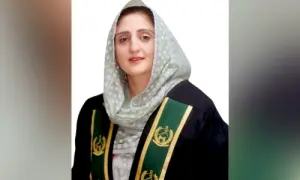
For Dr Ruquiya Saeed Hashmi, Pakistan Muslim League-Quaid candidate from NA-259 in Quetta, using decoy vehicles and changing her chador several times is a survival tactic. As a Hazara Shia, particularly one with a public profile in a city where members of her community are being relentlessly targeted by sectarian militants, not taking these precautions while venturing out of her gated community would be sheer recklessness. “I’m on their hit list,” she says. “Meanwhile my husband, being Punjabi, is the target of Baloch separatists.”
Dr Hashmi has seen death up close and personal. In August 2009, her brother-in-law, a cardiologist, was shot dead on his way to his clinic in Quetta. In the two bombings that targeted the city’s Hazara community this year and killed about 200 people, she lost 10 members of her extended family.
These days, Quetta is even more on edge than usual. At her house in the heavily secured Hazara-majority area of Gulistan Town, Dr Hashmi is meeting a group of about 40 members of the Hindu community. Suddenly, news breaks of a bomb explosion on Jan Mohammed Road, close to where the community lives and they rush home to check on their families. This is the seventh blast in the city since April 23.
Regardless of the danger she faces from multiple quarters, sitting out the elections was never an option. She can safely campaign only in the Hazara-majority areas of her constituency. Here too, she holds small corner meetings and keeps the proceedings fairly brief. Trust is an unaffordable luxury, and all her campaign staff and security detail belong to the Shia community. However, she says firmly that she doesn’t only represent the Hazaras, which form about 20 per cent of her constituency, but also other communities among whom she has lived her life in Quetta. “This city once used to be called ‘little Paris’,” she says wistfully.
“I want to make it peaceful again, the way it used to be 15 years ago when I could drive alone here everywhere. I want to take Quetta’s voice all the way to Islamabad.”
Dr Hashmi participated with gusto in student politics during her years at the Dow Medical College and then married into a Punjabi political family settled in Quetta. “My father-in-law, Saeed Iqbal Shah Hashmi, was a Muslim Leaguer and a friend of the Quaid’s. In 1946, when Mohtarma Fatima Jinnah and the Quaid’s daughter Dina visited Quetta they stayed with my in-laws.” Her husband Saeed Ahmed Hashmi, a PML-Q provincial assembly candidate in the coming polls, is also an established politician. He has returned to the provincial assembly four times on the party’s ticket.
There are more than 20 candidates vying for NA-259, but Dr Hashmi is confident that if the Hazara community votes for her in large numbers (and this is a community with a high voter turnout), she will pip the others to the post.
A trailblazer in many ways, Dr Hashmi is the first Hazara female doctor, and the first to serve in uniform as army captain in the medical corps, where she worked for eight years. She was also the first woman MPA from her community (she was elected on reserved seats in 2002 and 2008) and the first to be appointed minister. In the coming elections, she’s the only woman candidate contesting from a general seat in Balochistan. But try to pigeonhole her as a woman politician, and you’ll be likely greeted with a withering look. “At the age of 60 years, there’s no difficulty for me to go and talk to the men [like male politicians]. We’re equal.”
Dr Hashmi has had a ringside view of the powers-that-be that have long manipulated politics in Pakistan. “The PML-Q was created in our house by the military, in a meeting that was chaired by my husband,” she says. “At that time, the agencies were running everything, especially in Balochistan.”
Before the 2008 elections, she recalls that sitting MPAs were individually summoned by intelligence personnel and asked how they were going to conduct their campaigns, and what they were going to say.
As Dr Hashmi works the campaign trail, dashing from corner meetings to door-to-door meetings with voters, her daughter Salma, one of her four children, is her constant companion. “She organises the youth and women’s groups, while I talk to the rest,” she says.
Every Friday, she visits the Hazara graveyard where the walkways are lined with portraits of those who have fallen victim to sectarian violence. Droves of women mill around, placing flowers on the graves and reciting prayers for their loved ones. “Coming here gives me strength,” she says. “I emerge with a renewed resolve to do something for the people.”