0
0

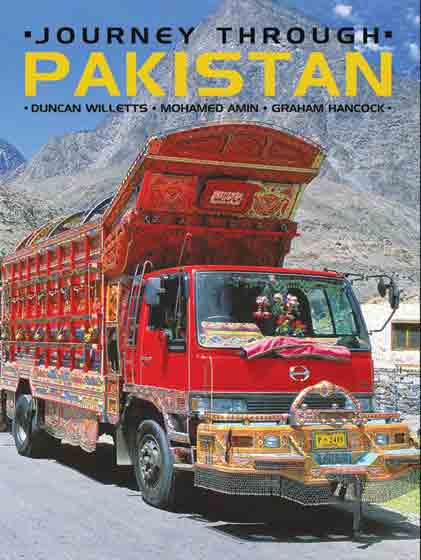
Journey through Pakistan is written as an actual road trip from Khyber through Punjab to Karachi and then Quetta, making various stops along the way to indulge passionately in trivial details and descriptions of peoples and cultures, their traditions of hospitality and the mundanities of their everyday life. Along the journey, the text frequently takes on a romanticised tone, falling into fantastical descriptions of places and people. It is at such pauses that the authors create a trancelike setting where the reader is free to navigate and create his own alternate reading of the places.
The book begins with a brief historical outline of the lands in and around Pakistan, and how invasions and migrations have marked their history and geography. It gives an overview of the events that have contributed to how the land and its people came to be, from the cultured settlements of the Indus Valley to Buddhist enlightenment in Taxila and around; the invasions of Alexander, the Huns, the Persians, the Ghaznavids and the Mughals, followed by the British, and finally the charismatic souls who went on to become the founders of the modern state. The book lists all these details in an attempt to explain the convergence of diverse peoples and the resultant cultural exchange, and to account for semantic similarities and differences and other aspects of human culture that have always transcended political boundaries. Within the well-established realities of ethnic and linguistic divides, the book details accounts of life in frontier towns, shedding light on some very obscure settlements and customs. The influence of a rapidly globalising world on ancient, introverted societies and their transition, especially those of the younger members of the communities, and its effects on the vernacular lifestyle is also touched upon lightly. Thankfully, rather than a detailed analysis on paradigm shifts, the authors, Duncan Willetts, Mohamed Amin, Graham Hancock and Asif Noorani, illustrate the transformation via anecdotes and individual events, which makes for a more intimate reading.
Sometimes, the reader is taken off track and shown glimpses of community life as rapid flashbacks before the journey is resumed again, leaving the reader in a haze of incomplete memories and unrequited expectations — aspects that are so characteristic of a fleeting road trip.
Northwards into Gilgit, the book takes us to the mystical world of the Kalash and their rituals, and we see polo matches being played between various Balti tribes. Inscribed on the gates of the central polo ground in Gilgit is the proud proclamation: “Let other people play at other things; the king of games is still the game of kings.”
We exit Khyber Pakhtunkhwa via the Karakorum Highway and enter Rawalpindi, where one is never more than a few hours away from a trip to any of the Galiyat and Kashmir. Down the motorway to Jhelum and the Rohtas Fort, and then to Lahore, the melting pot of cultures ancient and modern — upscale shopping districts rub shoulders with old street bazaars and the lingering air in the Mughal monuments attracts as many tourists as do the tantalising spices of its modern food streets. Out of Lahore and onwards, by fields and plantations and rural hovels down Punjab, occasionally stopping at roadside tea shacks and diners, where truckers flaunt their multicolored beauties as they sit back for an invigorating round of tea before resuming their strenuous journey. Sometimes, we make an impulsive detour and follow a secluded path that leads to a remote village where we are met with pleasant curiosity, “and, of course, because the afternoon is hot, you must have tea.” Then to the land of the saints, Multan:
“With four things rare Multan abounds,
Dust, beggars, heat and burial grounds.”
Further down the highway that traces the meandering Indus River we see smaller rural settlements, with crumbling brick walls, worn walkways and twisting streets: “Here tall houses of great antiquity throng together, their steep roofs and trellised wooden balconies almost touching above the narrow cobblestone lanes … behind you, in the early evening, fluorescent lights glow and car engines throw up their familiar din; ahead of you is another world where the 21st century does not intrude …. broad courtyards that you stumble across, where ragged children play by firelight among slumbering buffalos.” As evening draws in, silhouettes of boats and fishermen navigating the Indus appear against the fiery sky. One can create whole stories out of the brief, teasing, almost provocative fragments of rural imagery the authors throw their way.
Onwards to Hyderabad, Thatta, and then Karachi: an evening at the Clifton beach brings the day to a mesmerising end, where the tourist either spends the blue hour gazing longingly at the receding ocean waves or rushes off towards the frenzied atmosphere of the nearby amusement park, no longer present, where insanity and short-lived merrymaking helps him momentarily forget the fatigue of travel.
We then depart for Balochistan, stopping at Lasbela and Kalat, then Quetta, and from there travel to Ziarat: serene lakes, terraced valleys, aromatic forests and vertical cliffs that afford stunning panoramic views of acres of untouched terrain. Finally, we make our way to the Chaman border and visit the treacherous KojakPass, where our journey comes to an end.
What I found impressive was the ease with which the authors slide smoothly from a bird’s eye view down to the street level, examine the intricacies of communal life and bazaars for a while, and then gently swoop up again to resume the journey, the sights and sounds resonating in the reader’s mind. Catchy couplets and quatrains are sprinkled selectively onto the text and provide for delightful indulgence, transforming the reading experience from merely informative to richly imaginative. Of special note are various verses by Kipling who provides unique observations on life on the frontier — hospitality, aggression, fraternity and the trivial moments of mirth that punctuate an otherwise formal and structured societal order. It is such poetic retreats that help bind the text together as a captivating account. Was it not for these brief, sporadic sketches on life, the book would have been just another travelogue centered around superficial descriptions of cultural routines, traditional cuisine and a tourist-specific itinerary. These detailed indulgences, however, tone the book down to a human scale, drawing the reader into the random happenings. At one instance the authors paint an almost magical picture of a camel caravan trudging along a mountain road guided by scrawny human figures, the dust clouds creating a surreal silhouette that signals its arrival in advance.
The book has a small turn-off: it was quite impossible to overlook the numerous small errors in the text, given that the book is a revised edition. Nevertheless, Journey through Pakistan is a rich and enthralling experience.
Journey through Pakistan
(Travelogue)
By Duncan Willetts, Mohamed Amin, Graham Hancock and Asif Noorani
Liberty Books, Karachi
ISBN 978-1-904722-58-8
245pp.