0
0

The PML-N’s convincing electoral mandate has revived business confidence — a good sign for revival of the economy. Representatives of trade and industry seem confident that the party would deliver on its pro-business agenda.
With polls completed, the Karachi Stock Exchange index has hit an all time-high and Standard and Poor’s says the election results have ‘set the stage for longer-term stability of ‘B’ sovereign credit rating on Pakistan.
And now what definitely appears to be a stable constitutional democracy offers the country immense opportunities for progress and prosperity. However, the question arises how much of the robust business confidence will translate into real much-needed investment , production, exports and employment given the multiple crises facing the economy particularly the critical energy shortage that fuels economic growth. The energy problem has no easy, immediate solution.
With Mr Ishaq Dar as finance minister, the PML-N will face its first litmus test when he presents the budget for the next fiscal year. At this point of time, he may not have a clear road map but he would have underlying concepts and principles enunciated in the party’s electoral manifesto to guide him. It is therefore necessary to see how much of the party’s election pledges are grounded on reality. In these hard times, his most challenging job would be to a develop programmes, policies, strategy and action plan implicit in the manifesto.
The party manifesto raises hope of the business community by recognising economic revival as the ‘key challenge’ Business prospers in high economic growth. The manifesto states that economic revival holds the key for achieving other vital economic and social targets listed in its manifesto. Contrary to monetarist approach, the party asserts that “cutting development spending is in fact crippling the economy in the long-term. It is not the sustainable way to reduce deficit financing.”
For more than three decades, in the aftermath of Ango-Saxon Model, many developed and developing countries have abandoned the then governing concept of maximisation of production and, reverted to mercantilism, resulting in elusive pursuit of what has been described as ‘sustainable development’.
If the development spending is huge, prudent and the money well spent, it will generate a lot of business for the private sector. To stimulate investment, the PML-N is also committed to make interest rates ‘conducive for borrowings’ while “the upfront cost of investment in prioritised sectors will be reduced.”
The manifesto forcefully points out that “at present profitability is affected by huge cost of borrowings combined with expensive energy. This inevitably leads to a declining savings rate (mere 10.8 per cent), stifled growth, a crumbling manufacturing sector, rising unemployment and poverty.”
Here, apart from energy crisis, Mr Ishaq Dar will also have to look into a much deeper problem as to why so much excess money in the market is not finding productive investment. Why are businesses collecting cash and not converting money into productive capital? There is also a problem of dispersal of capital through outsourcing and corporate subsidiaries. Why do people prefer private limited companies to listing on the stock exchanges? He will have to find answers to these problems to reverse the trend of deindustrialisation.
No doubt, the party has committed to create a ‘vibrant financial sector ‘supported by reforms in the capital market which, it maintains, will result in ‘substantial new investment in the corporate sector’. It has to be spelt out how without reversing the enormous government borrowings, the banks would be encouraged to lend to the private sector.
Here the IMF may be required to provide the ‘breathing space’ under the extended facility. The party manifesto will have to be compromised to evolve a programme that is agreed with the IMF. The nature of the compromise will depend on how skillfully the new finance minister negotiates with the Fund. After all, industrial capitalism needs sovereign space to grow faster.
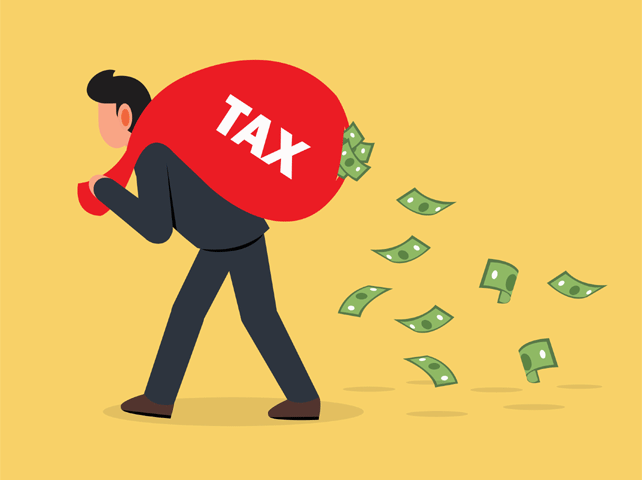
Nawaz Sharif’s pro-business approach is also reflected in the proposed taxation policies. The party manifesto declares that there will be no increase in tax rates for businesses. Tax rates will be decreased to ‘reduce inflation’. Apparently this will encourage consumer buying and markets for domestic goods and services. There would be some element of protectionism to manage trade deficit. Regulatory duties will be imposed on non-essential items. Tariffs will be raised to eliminate anti-tax bias.
The tax-GDP-ratio is proposed to be increased from nine per cent to 15 per cent in 2016. Given the poor tax culture, the government would face an enormous challenge to raise tax revenue, particularly because of the perception that taxpayers’ money is squandered away by the state. One area that needs to be focused is tax on farm incomes in Punjab. It is question of vigorous implementation rather than framing a new policy. PML-N government in Punjab can set an example for other provinces to follow. However its record of allowing the tax on farm incomes to dwindle during its last tenure does not offer hope for the future.
Despite the sharp rise in support prices for wheat and sugar, the incomes of big farmers virtually remain exempt. If the PML-N promises to ‘turn farming into a viable economic activity’ by improving terms of trade in agriculture, taxable incomes should not escape the tax net. The manifesto rightly points out that agricultural growth rate has been slow due to ‘adverse terms of trade’. The focus will be on small farmers described as ‘the backbone of the economy’. Agricultural credit will be substantially raised.
For the past few decades, there has been so much rhetoric about ‘inclusive economic growth’ which is included in PML-N agenda, promising socio-economic development, generation of opportunities and jobs based on equity, fairness and justice, on the foundation of democratic principles and above all, rule of law. And it aims to spearhead a moderate and modern welfare state with Islamic values.
PML-N is not alone in promising a welfare state in a situation persisting for the past few decades where government is cash-strapped and social spending is much below the required level to make economic development socially sustainable. The governments of the most developed and sophisticate market economies of Europe and the US are shedding social spending after the financial crisis and Great Recession in the developed world. The old welfare model is no longer financially or even socially valid.
The core issue is how to put all the nation’s able-bodied people to work, earn their living and fend for themselves while the flexible labour policies pursued by corporate bodies and other business no longer offer life-time careers. It would involve building a new great society.
The changes that PML-N has promised will be within the framework of status quo. Perhaps for the common citizen, it will be more of the same, till such time, an active citizenry has an effective voice in the corridors of power in a developing inclusive democracy.