3
3

ISLAMABAD: Pakistan Prime Minister-elect Nawaz Sharif will oversee the sensitive foreign and defence portfolios as he seeks to forge a working partnership with the all-powerful military in the early days of his tenure, sources close to him said on Tuesday.
Sharif, ousted in a bloodless military coup in 1999, has decided not to appoint defence and foreign ministers in the cabinet he is putting together.
He led his party, the Pakistan Muslim League-Nawaz (PML-N), back to power in May 11 elections.
Instead, he will select a retired civil servant as an adviser on foreign affairs – Tariq Fatemi, a former ambassador to the United States and the European Union, the sources said.
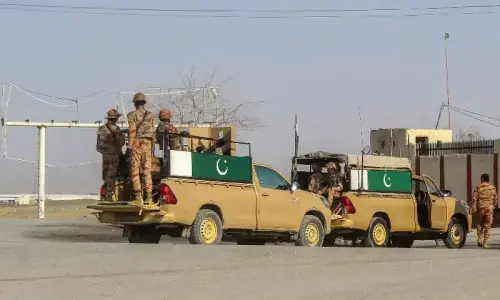
The army has ruled Pakistan for more than half its history since partition with India in 1947 and critics say generals have jealously guarded the right to dictate foreign policy.
The move to defer appointing a foreign minister suggests that Sharif wants to get to grips with the government’s relationship with the army.
“The incoming government and the army need to be on the same page on key foreign policy issues, not least Pakistan’s relations with Afghanistan, India and the United States,” a PML-N insider told Reuters, requesting anonymity as he was not authorised to speak to the media about the issue.
The United States wants ally Pakistan to help rein in the Afghan Taliban before most Nato combat troops pull out of Afghanistan in 2014.
Pakistan’s arch rival, India, with which Pakistan has fought three wars since 1947, is constantly a perceived threat.
Pakistan is beset by high unemployment, a failing economy, widespread poverty, a Taliban insurgency and sectarian violence.
The United States is troubled by elements in the country supporting Islamic militants fighting US troops in neighbouring Afghanistan.
“Supporting Western-backed attempts to engage with Taliban leaders in Afghanistan; what to do about India – until the government’s policy contours are crystal clear, the prime minister is not willing to take any risks,” the insider said.
Sharif was a protégé of military dictator General Zia ul-Haq in the 1980s. But he was overthrown by General Pervez Musharraf because he refused to allow an airliner carrying the army chief to land in Pakistan.
In the last days of his election campaign, Sharif spoke openly against what he called a “flawed” US war on terror, raising questions about which direction he would try to push the trajectory of bilateral relations.
Pakistan backed the Taliban’s rise to power in Afghanistan in the mid-1990s and is seen as a crucial gatekeeper in attempts by the US and Afghan governments to reach out to insurgent leaders who fled to Pakistan after the group’s 2001 ousting.
“Handling the US, Afghanistan and India after foreign troops withdraw from Afghanistan will be a very tough job,” another PML-N source said.
“Right now, Sharif has decided he’s the best man to do this delicate dance. He won’t take the chance of someone else making a mess in the early days of his government.”