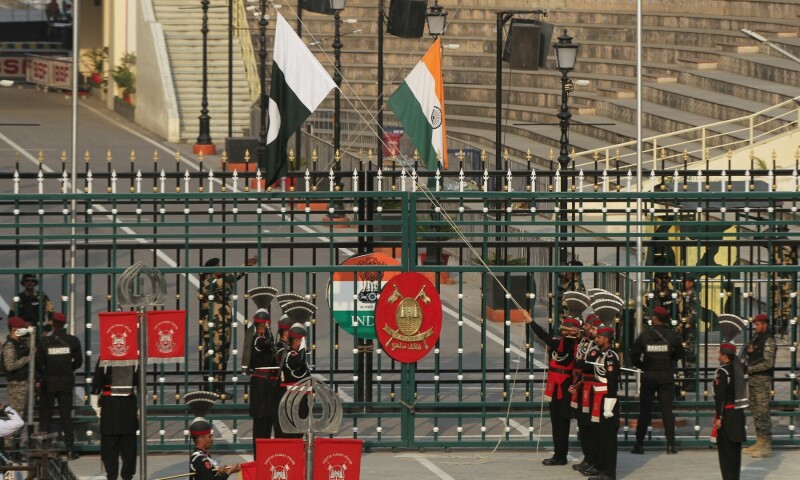
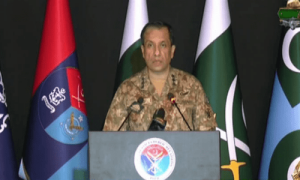
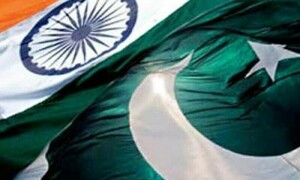
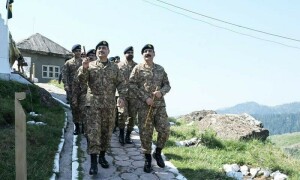
India launched a series of strikes under ‘Operation Sindoor’ soon after the Pahalgam tragedy in the early hours of May 7 across Pakistan; ISPR said 24 impacts were reported in six localities; 40 Pakistani civilians slain, 121 injured; 13 soldiers martyred, 78 wounded
Pakistan’s military responded swiftly, downing 5 Indian jets, and destroying Indian brigade headquarters, checkposts along Line of Control
India launched air-to-ground missiles on three airbases on early May 10; Pakistan launched ‘Operation Bunyan-um-Marsoos’ in retaliation; ceasefire came into effect following US mediation at 4:30pm the same day
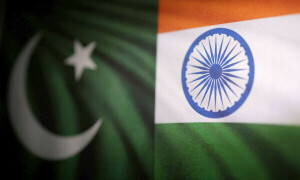
Pakistan expressed on Sunday “utmost satisfaction” over a supplemental award by the Permanent Court of Arbitration (PCA) that it said affirmed Islamabad’s position of the Indus Waters Treaty placing “substantive limits on India’s water-control capability” on Indus River system’s western rivers.
The decision pertained to maximum pondage — a technical term for the maximum volume of water that could be stored in a reservoir — in Indus Waters Treaty proceedings arising from design disputes concerning the Ratle Hydroelectric Plant and the Kishenganga Hydroelectric Project in occupied Kashmir, a statement issued by the Pakistan government said.
According to the statement, the supplemental award was issued on May 15. However, the decision has not been publicly shared by the PCA as yet.
Pakistan had first instituted arbitral proceedings against India regarding the Indus Waters Treaty (IWT) in 2016. And while India continues to boycott the proceedings, the court shares its procedural updates and decisions with both Indian and Pakistani Indus water commissioners ex-officio.
The IWT, brokered by the World Bank in 1960, allocates the three western rivers — Indus, Jhelum and Chenab — largely to Pakistan, and the three eastern rivers — Ravi, Beas and Sutlej — to India.
In April 2025, India announced a unilateral suspension of its obligations under the IWT following an attack on tourists in occupied Kashmir’s Pahalgam that killed 26 — an incident New Delhi blamed on Islamabad without evidence.
In June 2015, the PCA, which provides a framework for international disputes, issued a supplemental award of competence, stating that India cannot unilaterally hold the treaty in abeyance.
According to the government of Pakistan’s statement, the latest supplemental award by the PCA affirmed Islamabad’s “central position that the treaty places substantive limits on India’s water-control capability on the western rivers”.
“These limits are not formalities. They apply at the planning and design stage and cannot be satisfied merely by a later assurance of operational restraint.
“Pondage for a run-of-river Plant must be justified by real project needs, actual expected operation, site hydrology, hydraulic conditions, power-system requirements, and the information and explanation required under the treaty,” the statement said.
It added that building on the PCA’s Award on Issues of General Interpretation of the IWT on August 8, 2025, the supplemental award gave practical effect to the standard that installed capacity and anticipated load must be realistic, well-founded and defensible.
“Installed capacity must correspond to actual expected operation, hydrologic and hydraulic data, and treaty requirements. Anticipated load must correspond to actual expected operation and to the projected needs of the power system the plant is intended to serve,” it said.
This, the statement said, addressed a core IWT concern that “India cannot justify increased pondage through imagined capacity, artificial load curves, unrealistic peaking assumptions, or bare assertions of compliance with paragraph 15 release limits”.
“Paragraph 15 remains an operational constraint, but it is not a substitute for an evidence-based justification of the water-control capacity sought. Any different operating pattern must be supported by specific information and underlying data produced by India,” it said.
Paragraph 15 of the treaty elaborates on “interference with the waters” under the pact.
The statement said the award also strengthened Pakistan’s review rights.
“India must provide Pakistan with sufficient information and explanation to assess treaty compliance. If India fails to do so, it fails to carry its burden of establishing that the proposed maximum pondage satisfies Paragraph 8(c) of Annexure D,” it stated.
The said provision elaborates on the design of any new run-of-river plant, stating that the “maximum pondage in the operating pool shall not exceed twice the pondage required for firm power”.
According to the Pakistan government’s statement, the PCA also confirmed that “any applicable minimum-flow obligation must be taken into account in calculating pondage required for firm power where such obligation exists and is not otherwise satisfied. Paragraph 15 release requirements do not automatically satisfy such an obligation”.
It said Pakistan “also notes the Court’s earlier holding that the awards of a court of arbitration are final and binding on the parties and have otherwise controlling legal effect for subsequent treaty bodies on relevant questions of treaty interpretation”.
“Pakistan will place these interpretations before the neutral expert process, consistent with treaty procedures and applicable confidentiality arrangements,” it added.
The statement further said that Pakistan remained committed to the Indus Waters Treaty, its dispute-resolution procedures, and the peaceful settlement of water-related differences.
“Pakistan will continue to protect its rights under the IWT and will pursue every lawful and diplomatic means to ensure that hydroelectric projects on the western rivers are designed and operated strictly within treaty limits.
“The award is a strategic consolidation of Pakistan’s treaty position: maximum pondage must be realistic, evidence-based, hydrologically grounded, power-system justified, treaty-compliant, and incapable of inflation through artificial assumptions,” the statement read.
India rejects decision
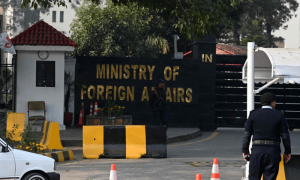
Earlier, the Indian foreign ministry issued a statement rejecting the PCA’s decision.
“The illegally constituted so-called Court of Arbitration (CoA) has, on May 15, 2026, issued what it termed an award concerning maximum pondage supplemental to the award on issues of general interpretation of the Indus Waters Treaty.
“India categorically rejects the present so-called award, just as it has firmly rejected all prior pronouncements of the illegally constituted CoA,” the statement said.
It said India “never recognised the establishment of this so-called CoA. Any proceeding, award, or decision issued by it is null and void”.
The statement added that India’s decision to hold the Indus Waters Treaty in abeyance remained in force.
Law Minister Azam Nazeer Tarar says the armed forces have once again “demonstrated unwavering resolve, unparalleled professionalism and steadfast dedication in the successful execution of Operation Bunyan-um-Marsoos.
The minister, during a session of the Senate today, says that the operation was carried out with exceptional restraint and maturity, reflecting the conduct of a responsible nuclear state.
Chief of the Naval Staff, Admiral Naveed Ashraf, has visited the Combined Military Hospital (CMH) Rawalpindi to inquire about the well-being of soldiers and civilians injured during Operation Bunyan-um-Marsoos.
Chief of the Naval Staff Admiral Naveed Ashraf visits Combined Military Hospital (CMH) Rawalpindi and pays tribute to injured troops of Operation Bunyanum Marsoos. — Pakistan Navy
In a press release by Directorate General Public Relations (Pakistan Navy), he says that the Naval Chief personally interacted with each injured individual and paid tribute to their unwavering bravery, indomitable spirit, and steadfast commitment to duty.
“While speaking with the injured, Admiral Naveed Ashraf emphasised the unified resolve of the nation and the armed forces, affirming that any future misadventure by the adversary will be met with the same determination and vigour.”
Chief of the Naval Staff Admiral Naveed Ashraf visits Combined Military Hospital (CMH) Rawalpindi and pays tribute to injured troops of Operation Bunyanum Marsoos. — Pakistan Navy
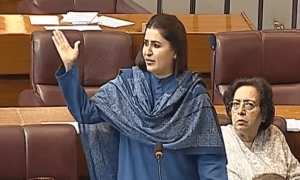
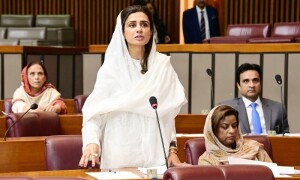
PPP Senator Sherry Rehman has congratulated the military and political leadership for emerging victorious against India, saying a new redline of ‘strategic conventional deterrence’ was established during the conflict.
Speaking during a Senate session, the PPP leader says the nation was united and manned on different fronts during the Indian aggression.
“India had launched a narrative war, a huge information war like no one has seen in modern combat time,” she says. “This war was thrust on us, Pakistan is a rational country and emerged as a mature, responsible nuclear state.”
She says India pointed fingers at Pakistan accusing it of being a terrorist state without any evidence after the Pahalgam attack. “They attacked us without warning, without provocation in the dead of night. Within one hour, PAF made history in a compressed battlefield unlike ever seen in modern warfare,” she adds.
“Our air force excelled in a narrow envelope and made combat history. India doesn’t know what just happened. They are still gathering their intelligence and reconnaissance.”
She says the Chinese have emerged as strategic victors as it was their aircraft untested in the traditional battlefield and their missiles.
“We have a new redline of strategic conventional deterrence established. Pakistan has achieved dominance in the tactical field with India’s far more expensive forces.”
The senator goes on to say that during this war, new redlines were crossed by them without provocation. “This hot war was the first which escalated so quickly since Kargil”.
She says the US had to interfere and India couldn’t hide the fact that it asked for a ceasefire. She said Information warfare was part of the instrument, while India weaponised water for the first time.
Rehman adds that Indian Prime Minister Narendra Modi is still calling it a strategic pause. “We are not Palestine. We will hit right back with lethality and maturity.”
United States President Donald Trump has said that hostilities between Pakistan and India were settled, after he urged the two countries to focus on trade instead of war, Reuters reports.
He told US troops at a base in Qatar during a Gulf tour that Pakistan and India were happy with that.
The nuclear-armed neighbours halted their worst fighting in nearly three decades after agreeing to a ceasefire on Saturday, following diplomacy and pressure from the US.
The Sindh government has announced a compensation package worth Rs10 million for all martyrs of Operation Bayan-um-Marsoos, and Rs1m for all injured during the Indian aggression.
Speaking at an event to celebrate the ‘Day of Thanksgiving’ by the PPP, Sindh Chief Minister Murad Ali Shah hailed the valiant efforts of the armed forces and said, “The army, navy and air force have proven they are ready for Pakistan’s defence.”
He announced that seven people, including a civilian, were martyred in Sindh.
“Six soldiers of the Pakistan Air Force (PAF) — Squadron Leader Usman Yusuf, chief technician Aurangzeb, senior technician Najeeb, technician Farooq, senior technician Mubashir, and senior technician Muhammad Ayaz.
“The first civilian martyr of Indian aggression in Sindh was Mukhtiar Leghari from Ghotki, he said, adding that Leghari’s father was also injured in Ghotki.
“[His father’s] medical treatment will be borne by the government and a nearby medical facility will renamed after his martyred son,” he said.
CM Sindh added that five soldiers were injured at the Bholari airbase, nine at PAF base Shahbaz in Jacobabad, and a police constable was injured during the drone strike in Sharafi Goth Malir, Karachi.
Pakistan strongly condemns the remarks of the Indian Defence Minister on its nuclear arsenal, made today in Indian Occupied Jammu and Kashmir.
In a statement, Foreign Office spokesperson Shafqat Ali Khan says, “These irresponsible remarks reveal his profound insecurity and frustration regarding Pakistan’s effective defence and deterrence against Indian aggression through conventional means. Pakistan’s conventional capabilities are adequate to deter India, without the self-imposed ‘nuclear blackmail’ that New Delhi suffers.”
“The comments of India’s Defence Minister also show his sheer ignorance of the mandate and responsibilities of a specialised agency of the United Nations like the IAEA (International Atomic Energy Agency)”, the FO spokesperson comments.
Furthermore, the spokesperson raised questions on India’s involvement in “repeated theft” and “illicit trafficking incidents” involving nuclear and radioactive material in India. He thinks the IAEA and the international community should be worried about that instead.
“Just last year, five individuals with a radioactive device reportedly stolen from the Bhabha Atomic Research Centre (BARC) were found in Dehradun, India.
Later, a gang of individuals was found with illegal possession of a highly radioactive and toxic substance, Californium, worth $100 million. Three incidents of theft of Californium were also reported in 2021.“
He questions the measures taken by New Delhi “for the safety and security of nuclear and other radioactive material.”
“These incidents also suggest the existence of a black market for sensitive, dual-use materials inside India.”
In his statement, he states that “Pakistan urges a thorough investigation of these incidents” and “calls upon India to ensure the safety and security of its nuclear facilities and arsenal.”
Earlier today, Indian Defence Minister Rajnath Singh has said, “Pakistan’s nuclear arsenal should be under the surveillance of the UN’s nuclear watchdog.”
He questioned if “nuclear weapons safe in the hands of a rogue and irresponsible nation” and stated that “Pakistan’s atomic weapons should be brought under the surveillance of the IAEA.”
Senior journalist Hamid Mir has pointed out that while his X account has been banned for users in India, some people there were still reading his posts “by using a VPN”.
“We were using the same VPN in Pakistan when X was banned here before the war,” he said, referring to the over a year-long ban on X in Pakistan.
“At least Indians learned a good thing from Pakistanis. VPN Zindabad,” Mir quipped.
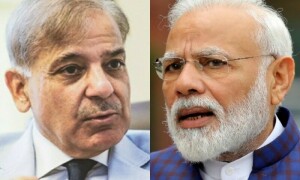
PM Shehbaz has conveyed his concerns on the Indian government’s “provocative statements” to Azerbaijan President Ilham Aliyev during their phone call.
The premier “expressed his concern over the recent provocative statements by the Indian leadership, and affirmed that in [the] face of any future aggression, Pakistan would resolutely defend its sovereignty and territorial integrity”, a PMO statement read.
The prime minister emphasised that Pakistan had agreed to the ceasefire understanding with India in the interest of regional peace, and remained committed to upholding it“.
He stressed that the Jammu and Kashmir dispute was the root cause of instability in South Asia, which should be resolved in accordance with the UN Security Council’s resolutions.
PM Shehbaz also conveyed his “profound thanks to President Aliyev for his country’s steadfast and principled support to the Kashmir cause”.
PM Shehbaz Sharif has thanked Azerbaijan President Ilham Aliyev for his country’s “steadfast support” during the recent military strife between Pakistan and India.
During a telephone conversation with Aliyev this afternoon, the premier conveyed his profound gratitude for “resolutely standing with Pakistan during the recent crisis in South Asia”, the PM Office said in a statement.
He termed President Aliyev’s steadfast support “yet another demonstration of his great love and affection for the people of Pakistan”.
On his part, Aliyev “warmly congratulated PM Shehbaz upon Pakistan’s remarkable success”, the PMO said. The president welcomed the Pak-India ceasefire understanding, while appreciating Pakistan’s efforts for peace.
He reaffirmed that Azerbaijan was committed to the strengthening of its brotherly ties with Pakistan across all spheres. PM Shehbaz also thanked the brotherly people of Azerbaijan for their overwhelming expression of solidarity with Pakistan.
Shuli Ren, a Bloomberg Opinion columnist covering Asian markets and a former investment banker, has said that China’s defence industry for “getting a DeepSeek moment”.
DeepSeek is Chinese startup that triggered a $1 trillion-plus sell-off in global equities markets earlier this year with a cut-price AI reasoning model.
“Investors are reassessing Beijing’s military capacity and potential to rise as an arms exporter,” Ren noted.
“In investing, narratives can matter a lot more than earnings or cash flow analysis,” she said, highlighting Pakistan’s recent use of Chinese J-10C planes to shoot down five Indian jets.
“India’s government has not confirmed or denied Islamabad’s claim and evidence remains inconclusive,” Ren added.
Special Assistant to Prime Minister Rana Sanaullah has lauded the armed forces, saying the nation believed in Pakistan’s ability to defend itself against Indian aggression.
While speaking to Geo news, he said, “the whole nation had the faith that Pakistan always had the capability to defend itself, no matter how powerful India gets.”
“If the situation demands it, we will be prepared to defend ourselves,” he added.
The adviser to KP chief minister on information, Barrister Mohammad Ali Saif, has alleged that India used a “fabricated incident as a pretext for aggression against Pakistan”.
The act not only constituted a grave violation of international law but also posed a serious threat to regional peace and stability, he said, according to a statement.
Saif asserted that Indian Prime Minister Narendra Modi’s narrative to brand Pakistan as an irresponsible state was debunked by India’s own reckless actions.
In contrast, Pakistan, as a responsible nuclear state, exercised utmost restraint and demonstrated a mature and constructive role before the international community, he said.
Punjab CM Maryam Nawaz has termed the recent military escalation between India and Pakistan a “battle of emotions”.
“This wasn’t a battle of borders, but of ideologies and of emotions, in which Pakistan has defeated everyone,” she said, addressing an event in Lahore.
She paid tribute to the armed forces and the personnel.
“The world has been forced to say that Pakistan is rising as a powerful and strong country,” Maryam asserted.
The Postgraduate Medical Institute (PGMI) organised a solidarity walk in support of the armed forces and to pay tribute to the martyrs.
Principal Prof Al-Fareed Zafar, MS Dr. Faryad Hussain and other staff members joined the walk. The participants carried placards and chanted slogans in support of defence institutions.
Prof Zafar said Pakistan’s armed forces have once again proven that wars are won not merely through numerical strength but by unwavering faith, exceptional courage and professional excellence.
China has declared giving Chinese names to places in Zangnan — or the disputed Himalayan state of Arunachal Pradesh — as its sovereign decision, state-run Radio Pakistanreports.
A statement issued by the Chinese Ministry of Foreign Affairs states that Zangnan is a part of China in terms of history, geography and administration.
The ministry asserted that naming those locations with Chinese names was an “internal matter”.
India considers Zangnan to be part of its territory under the name Arunachal Pradesh, whereas China regards it as part of southern Tibet.
The recent military engagement saw India deploy its French and US weapons against Pakistan’s new range of sophisticated Chinese arms, notes France24.
The takeaways of the May 7-10 military engagement for Yun Sun, director of the China Programme at the Washington DC-based Stimson Centre, are two-fold.
“The first one is that the Indian weapons system is not as effective as a lot of people thought they would be,” she noted. “The second takeaway is that the Indian strategic intent could be more ambitious than a lot of people had expected.”
While cautioning that it’s still too early to “jump to conclusions”, Carlotta Rinaudo, a China expert at the International Team for the Study of Security Verona, notes that perception was key in initial assessments.
“We always had the impression that Chinese weapons were the same as Chinese goods in a way. We assumed that Chinese weapons are inferior. This is not the case anymore,” Rinaudo told France24.
The Senate has offered fateha for the martyrs of the armed and innocent Pakistani civilians, who laid down their lives in the recent Indian aggression, state-run Radio Pakistanreports.
Maulana Attaur Rehman led the fateha, while Senate Deputy Chairman Syedaal Khan Nasar presided over the session.
The House is set to meet again at 3:30pm today.
Senate Deputy Chairman Syedaal Khan Nasar chairs a session of the Upper House on May 13, 2025. — Radio Pakistan
Indians are cancelling holidays in popular resorts in Turkiye and Azerbaijan after the two countries supported Pakistan during the recent conflict, two booking firms say.
Turkiye and Azerbaijan, popular budget holiday destinations for Indians, issued statements backing Islamabad after India’s air strikes last week.
“Bookings for Azerbaijan and Turkiye decreasing by 60 per cent (over the last week) while cancellations have surged by 250pc during the same period,” a spokesperson for MakeMyTrip said.
EaseMyTrip Chief Executive Officer Rikant Pittie said the platform had seen a 22pc rise in cancellations for Turkiye and 30pc for Azerbaijan “due to recent geopolitical tensions”. Travellers had switched to Georgia, Serbia, Greece, Thailand and Vietnam, he added.
Another ticketing platform, ixigo, earlier said in a post on X that it would be suspending flight and hotel bookings for Turkiye, Azerbaijan and China.
EaseMyTrip’s founder and chairman, Nishant Pitti, said in a post on X that 287,000 Indians visited Turkiye last year and 243,000 visited Azerbaijan. “When these nations openly support Pakistan, should we fuel their tourism and their economies?” Pitti said.
National Assembly Speaker Sardar Ayaz Sadiq has visited hospitals in Rawalpindi to inquire about the health of soldiers and civilians injured during the recent escalations between Pakistan and India.
During his visit, Sadiq praised the bravery and unwavering resolve of the armed forces in defending Pakistan’s territorial integrity and thwarting the enemy’s nefarious designs. He honoured the sacrifices made by the nation’s defenders and innocent civilians in the face of aggression.
“The entire nation stands united behind our brave armed forces and resilient civilians in this challenging time,” he stated.
The NA speaker also commended the medical staff at CMH Rawalpindi for their dedication and efforts in providing exemplary care to the wounded.